
Now Reading: ‘Shots on goal and win the game’: NASA’s effort to accelerate lunar landings
-
01
‘Shots on goal and win the game’: NASA’s effort to accelerate lunar landings

‘Shots on goal and win the game’: NASA’s effort to accelerate lunar landings

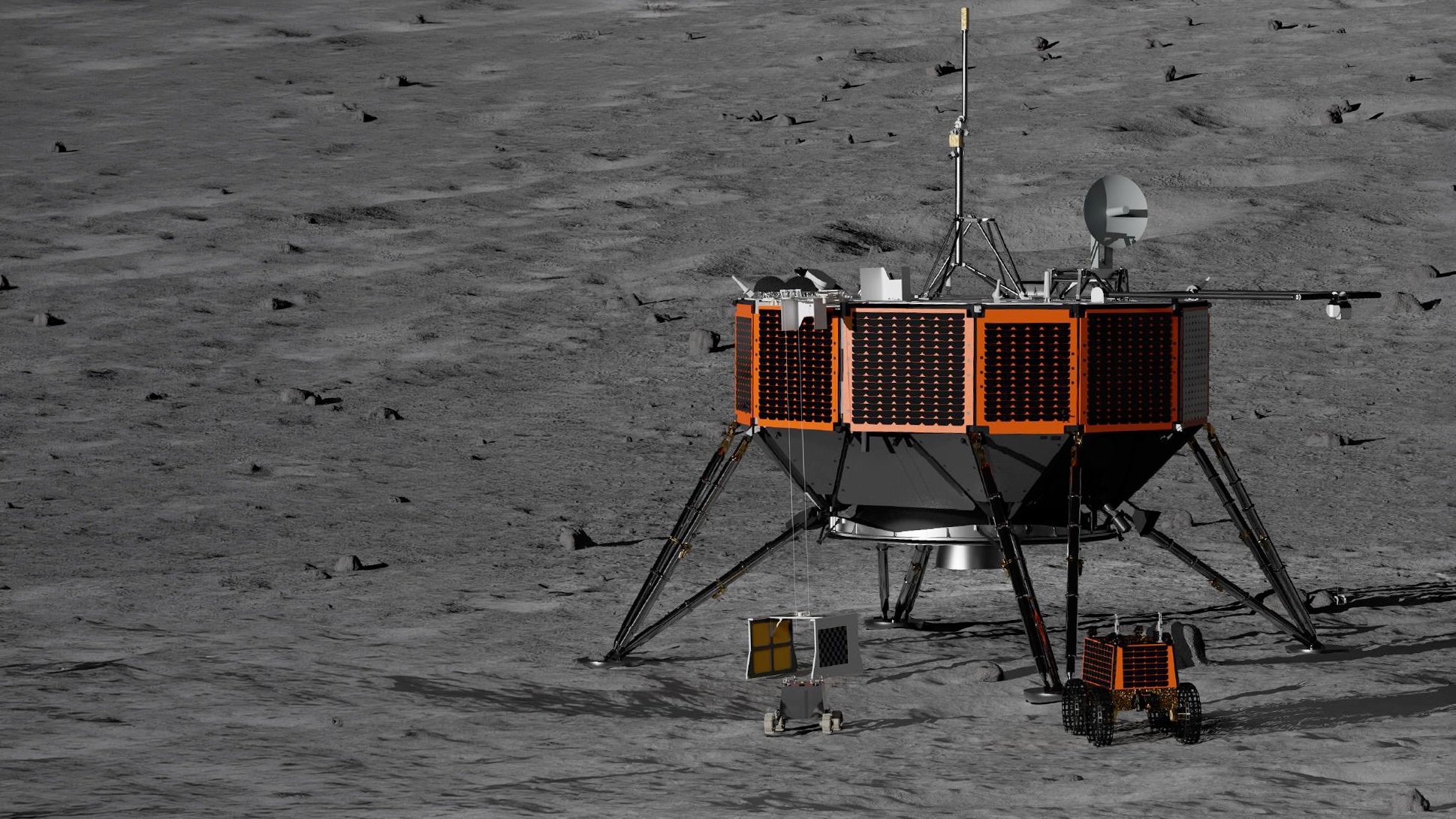

WASHINGTON — While NASA outlined plans to increase the cadence of robotic lunar lander missions at a recent event, the agency has said little about how companies will speed up work on landers that will take astronauts to the lunar surface.
At NASA’s “Ignition” event March 24, the agency discussed its new effort to develop a lunar base, a process whose first two phases will span seven years and cost $20 billion.
A major part of that plan is dramatically increasing the rate of robotic lunar lander missions, something agency officials had been hinting about for weeks leading up to the event, with a goal of monthly lunar landing missions. NASA-backed companies performed two landings in 2025, with up to four projected for 2026.
“Phase 1, which starts today, is all about getting to the moon reliably,” Carlos Garcia-Galan, program executive for Moon Base at NASA, said in a presentation at the event. “Learning how to get there in high cadence, deploying assets in different areas of the moon where we think we may want to build this moon base.”
That phase, which runs from 2026 through 2028, will include 21 landings placing 4,000 kilograms of payload on the surface. Garcia-Galan said in the presentation NASA was planning on only two landers in 2026, but increasing rapidly to nine in 2027 and 10 in 2028.
He said those lander plans will depend “on what we get from solicitations we have on the books today” and thus should be considered approximations.
Phase 2, which runs from 2029 through 2032, calls for 24 landings providing 60,000 kilograms of payload. That would include larger robotic landers through the Commercial Lunar Payload Services (CLPS) program capable of delivering up to 5,000 kilograms each.
“The numbers look smaller, but all of these systems are heavier,” he said, with an average of six landings a year during Phase 2. “This is the type of cadence we think we’re going to need to develop this moon base in the timeframes that we want.”
Phase 3, starting in 2033, would include CLPS landers capable of delivering up to eight metric tons each to the lunar surface, supporting regular logistics missions to the lunar surface and the return of cargo from the moon. That phase involves 28 landings over four years.
“The CLPS program is one of the tools that we’re going to leverage pretty heavily,” he said. However, he said the program would evolve from its origins for low-cost, risk-tolerant landers.
“We want to increase mission reliability, and that starts now,” he said. Updates to the program will allow CLPS providers to access NASA expertise for lander development.
NASA also issued March 24 a draft request for proposals for CLPS 2.0, the next phase of the CLPS program. It would support more capable landers, such as those capable of surviving the lunar night, returning samples from the moon and using radioisotope power sources.
In an interview during the event, Garcia-Galan said that increasing the cadence of robotic lander missions was an immediate priority. “It is the one area that I want to focus on first, because it’s not in our experience base to achieve that cadence,” he said.
Doing so, he said, will help find “chokepoints” in the lander ecosystem, such as manufacturing, test facilities or technologies. “Identifying that and addressing it is the number one priority here.”
He also emphasized an increased focus on reliability, with NASA offering more support to CLPS providers. “We know how to land things on a different planet,” he said. “We’re going to identify those subject matter experts. We’re going to identify the key things that we can offer.”
That is a shift from the original CLPS model, a “shots on goal” philosophy where the agency expected some missions to fail.
“It’s an evolution,” he said. “It’s shots on goal and win the game.”
CLPS award
NASA used the Ignition event to announce the latest CLPS award. The agency said it selected Intuitive Machines for a mission to the lunar south polar region in 2030 valued at $180.4 million.
The lander will carry seven NASA-sponsored payloads, including some instruments that have flown on previous landers. Also on the lander will be two small rovers, one built by Honeybee Robotics and the other “Roo-ver” from the Australian Space Agency.
The mission, designated IM-5 by Intuitive Machines, features a different lander design than its first four missions, which use a lander design called Nova-C. The IM-5 mission will use Nova-D, a lander capable of carrying larger payloads.
“We believe our space infrastructure provides the scalability and flexibility needed to support an increased cadence of new Artemis missions and advance national objectives,” Steve Altemus, chief executive of Intuitive Machines, said in a statement.
HLS update
Notably absent from the event was any major news about the Human Landing System (HLS) program. NASA officials have talked about accelerating the development of the landers Blue Origin and SpaceX are developing under HLS to support human lunar landings as soon as 2028, as well as a test of the landers in Earth orbit with the Orion spacecraft on Artemis 3 in 2027.
However, neither the agency nor the companies have disclosed details of “acceleration plans” the companies have developed to speed up landers. NASA provided few updates on those efforts during the event.
“The intent with this change, and working with both providers, is to fly with whichever provider is ready first,” Lori Glaze, NASA’s acting associate administrator for exploration systems development, said in the presentation.
She said both companies are working on “simplifying” their lander architectures to speed up their development, while retaining the requirement of a successful uncrewed landing before attempting a crewed landing.
“SpaceX has been considering alternatives of their current HLS Starship design while implementing a more streamlined approach,” she said. “The Blue Origin approach implements existing capabilities that they have today as a steppingstone toward their eventual full-capacity architecture.”
She didn’t go into details about those concepts but said that both companies have requested using alternatives to the near-rectilinear halo orbit NASA had planned to use for the Gateway. Doing so, she said, would reduce the performance requirements on the lander while increasing mission planning flexibility.
Other changes, Glaze said, involve changes to surface requirements to make them “simple and sustainable” while allowing them to be expanded in the future. “The simplification of the requirements allows us to focus on achieving the near-term goals while also preserving the long-term goals through evolution of the lander capabilities.”
She didn’t state in the presentation when NASA will disclose more details on the companies’ HLS acceleration approaches. “They’ve both come up with some pretty good, credible suggestions for how we can accelerate,” she said in an interview after the presentation.
NASA is studying how those alternative approaches, including use of different orbits, will work with Orion. “It’s critically important that we understand how the systems are going to interact together, the interfaces they’re proposing, some differences in the mission operations,” she said.
“We’ve been working it for a little while, but we still have a little bit more to go to get that complete,” she said.
Once that’s done, NASA will be ready to discuss how it wants to proceed. “We’ll be able to say, here’s how we want to work with each provider, what we’d like them to really push forward on their development,” she said. “That will also then feed backward to what we want to test during Artemis 3.”










Related Posts
Stay Informed With the Latest & Most Important News
Previous Post
Next Post

Advertisement
-
 01Two Black Holes Observed Circling Each Other for the First Time
 -
 02From Polymerization-Enabled Folding and Assembly to Chemical Evolution: Key Processes for Emergence of Functional Polymers in the Origin of Life
 -
 03Astronomy 101: From the Sun and Moon to Wormholes and Warp Drive, Key Theories, Discoveries, and Facts about the Universe (The Adams 101 Series)
 -
 04True Anomaly hires former York Space executive as chief operating officer
 -
 05Φsat-2 begins science phase for AI Earth images
 -
 06Hurricane forecasters are losing 3 key satellites ahead of peak storm season − a meteorologist explains why it matters
 -
 07Binary star systems are complex astronomical objects − a new AI approach could pin down their properties quickly