
Now Reading: Live coverage: SpaceX to launch 119 payloads on smallsat rideshare mission from California
-
01
Live coverage: SpaceX to launch 119 payloads on smallsat rideshare mission from California

Live coverage: SpaceX to launch 119 payloads on smallsat rideshare mission from California

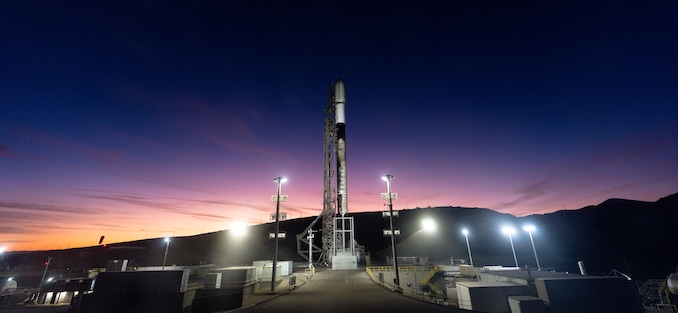
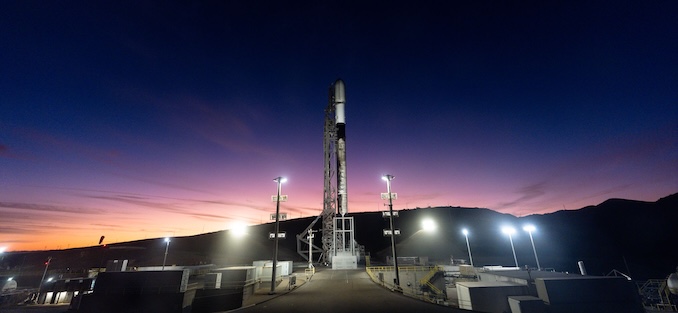
SpaceX is gearing up to launch its third largest smallsat rideshare mission on Monday morning.
The Transporter-16 mission will fly 119 payloads to a Sun-synchronous, low Earth orbit on a Falcon 9 rocket launching from Vandenberg Space Force Base.
Liftoff from Space Launch Complex 4 East is scheduled for 4:02 a.m. PDT (7:02 a.m. EDT / 1102 UTC).
Spaceflight Now will have live coverage beginning about 30 minutes prior to liftoff.
The Falcon 9 first stage booster supporting this mission has the tail number B1093. This will be its 12th flight including a pair of missions for the Space Development Agency and nine batches of Starlink satellites.
A little more than 8.5 minutes after liftoff, B1093 will target a landing on the drone ship, ‘Of Course I Still Love You,’ positioned in the Pacific Ocean. If successful, this will be the 187th landing on this vessel and the 592nd booster landing for the company to date.
What’s onboard?
Like all of SpaceX’s rideshare missions, this flight supports dozens of customers, from companies to sovereign governments to academia.
Two companies who managed manifesting the majority of the payloads are Exolaunch (57 payloads) and Seops Space (19 payloads).
“Exolaunch is enabling launch access for more than 25 commercial, institutional, and government customers from the United States, the United Kingdom, Bulgaria, France, Finland, Greece, Italy, Spain, South Korea, Taiwan, Turkey, and more on this mission,” Exolaunch said in a statement in February.
The payloads overseen by Seops Space are a combination of 14 CubeSats and five PocketQubes. The latter of which are from a company called Alba Orbital and are Earth observation satellites.
“The Seops Transporter-16 manifest represents a truly global cross-section of the small satellite community, with payloads originating from 13 countries, including Canada, France, Malaysia, Nepal, Norway, Romania, Scotland, Spain, Switzerland, Taiwan, the United Kingdom, the United States, and Vietnam,” Seops said in a statement.
Other notable payloads include Varda Space’s sixth reentry satellite bus, designed for on-orbit manufacturing, and the so-called ‘cake topper,’ the Gravitas satellite from K2 Space.
The Gravitas satellite has a wingspan of 40 meters with its solar panels unfurled and weighs about two metric tons. It’s designed to produce 20 kW of electricity.
At K2 Space, we’re Building Bigger to deploy the largest satellites ever on orbit.
Matt Cooper, our Principal Mission Assurance Engineer, describes what it’s taken to get Gravitas on orbit. As our first free-flying satellite, it meant working through every step end-to-end, from… pic.twitter.com/pEJ1tOkdfj
— K2 Space Corporation (@K2SpaceCo) March 23, 2026










Related Posts

Stay Informed With the Latest & Most Important News
Previous Post
Next Post
Previous Post

Next Post



Advertisement
-
 01Two Black Holes Observed Circling Each Other for the First Time
 -
 02From Polymerization-Enabled Folding and Assembly to Chemical Evolution: Key Processes for Emergence of Functional Polymers in the Origin of Life
 -
 03Astronomy 101: From the Sun and Moon to Wormholes and Warp Drive, Key Theories, Discoveries, and Facts about the Universe (The Adams 101 Series)
 -
 04True Anomaly hires former York Space executive as chief operating officer
 -
 05Φsat-2 begins science phase for AI Earth images
 -
 06Hurricane forecasters are losing 3 key satellites ahead of peak storm season − a meteorologist explains why it matters
 -
 07Binary star systems are complex astronomical objects − a new AI approach could pin down their properties quickly