
Now Reading: With Voyager’s help, Icarus Robotics to test free-flyer on ISS
-
01
With Voyager’s help, Icarus Robotics to test free-flyer on ISS


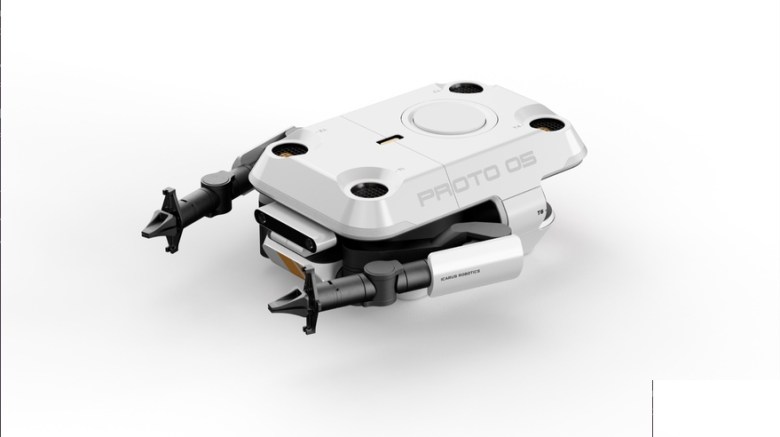
SAN FRANCISCO – Voyager Technologies announced plans March 30 to help Icarus Robotics test a free-flying platform, called Joyride, on the International Space Station.
Under the agreement, Voyager will handle payload integration, safety certification, coordination of a 2027 launch, on-orbit operations planning and execution for Joyride-1, a technology demonstration.
Icarus Robotics was founded in Brooklyn, New York, in 2024 to develop dexterous mobile robots to handle routine, time-consuming and hazardous tasks in orbit. The Joyride-1 mission will “validate that our robot can safely maneuver and perform tasks on orbit alongside crew, not just in simulation or for short periods on a parabolic flight,” Ethan Barajas, Icarus Robotics co-founder and CEO, told SpaceNews by email. “At the highest level, we are validating that our platform can carry out what we have designed it to do for our stakeholders: perform manipulation tasks on interfaces and test articles, execute cargo logistics operations, and demonstrate safe free-flight navigation.”
It’s equally important for Joyride-1 to go through the NASA/Center for the Advancement of Science in Space safety and flight certification process “for an autonomous free-flyer inside a crewed station” because it “establishes the operational precedent for this category of robot,” Barajas said. “That flight heritage and certification pathway is what makes us a credible operational platform for the future of on-orbit labor.”
Mission Management
Voyager has managed more than 1,400 missions for government and commercial customers conducting microgravity research and technology validation.
“Whether an established company or a new innovative startup, this is exactly what our mission management as a service is built for – helping companies move from ideas to proven flight heritage,” Matt Magaña, Voyager Space, Defense & National Security, president, said in a statement. “Icarus Robotics represents the next generation of space builders and provide the turnkey solution for those seeking reliable, flight-proven access to space.”

Barajas founded Icarus with Jamie Palmer. The business was inspired in part by Barajas’ participation in a NASA workforce development program: High Schools United with NASA to Create Hardware (HUNCH).
“Voyager handed me my first real look at spaceflight through HUNCH,” Barajas said in a statement. Through Joyride-1, Icarus plans “to return the favor and deliver a robotic platform to help make the ISS and future commercial stations like Starlab smarter.”










Related Posts
Stay Informed With the Latest & Most Important News
Previous Post
Next Post
Previous Post
Next Post
Advertisement
-
 01Two Black Holes Observed Circling Each Other for the First Time
 -
 02From Polymerization-Enabled Folding and Assembly to Chemical Evolution: Key Processes for Emergence of Functional Polymers in the Origin of Life
 -
 03Astronomy 101: From the Sun and Moon to Wormholes and Warp Drive, Key Theories, Discoveries, and Facts about the Universe (The Adams 101 Series)
 -
 04True Anomaly hires former York Space executive as chief operating officer
 -
 05Φsat-2 begins science phase for AI Earth images
 -
 06Hurricane forecasters are losing 3 key satellites ahead of peak storm season − a meteorologist explains why it matters
 -
 07Binary star systems are complex astronomical objects − a new AI approach could pin down their properties quickly