
Now Reading: ESA launches first Celeste satellites to test complementary LEO navigation layer
-
01
ESA launches first Celeste satellites to test complementary LEO navigation layer

ESA launches first Celeste satellites to test complementary LEO navigation layer



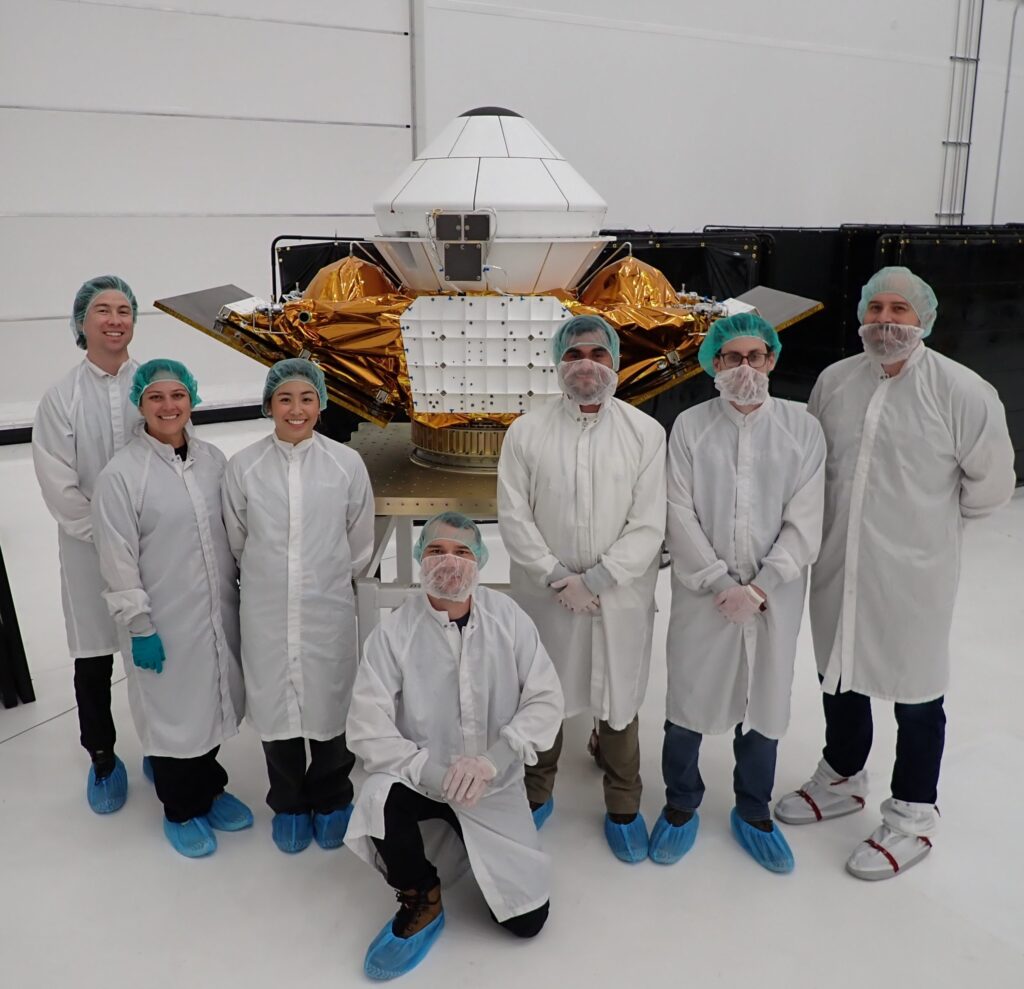
MILAN — The European Space Agency has launched the first two satellites of the Celeste in-orbit demonstration mission from New Zealand aboard a Rocket Lab Electron launcher on March 28.
The two satellites were launched at 10:14 CET and separated from the launcher about an hour later into a quasi-polar low Earth orbit at 510 kilometers. Acquisition of signal has been confirmed for both spacecraft.
Roberto Prieto-Cerderia, Celeste program manager at ESA, explained the choice of Rocket Lab over a European launcher during a pre-launch briefing. “We had an obligation to use the frequencies by May 2026. In Europe, the main possibility was Vega-C, which was fully booked at the time, so we had to find alternative solutions.”
Designed as an in-orbit demonstration (IOD) mission to assess the benefits of a complementary low Earth orbit (LEO) layer for Galileo, the final goal of Celeste is to pave the way for a fully operational PNT constellation in LEO from 2030 onward.
The current IOD phase is planned to include 11 satellites in orbit and one on the ground as a spare, for a total of 12 satellites to be launched between now and the end of 2027.
The two satellites launched Saturday, named IOD-1 and IOD-2, will validate core technologies and new signals and will bring into use the required L- and S-band frequencies for the mission’s operational phase.
“But this is not an end in itself,” Prieto said. “Ultimately, what we want to enable is an operational layer complementing Galileo and EGNOS as part of EU navigation capabilities. We are already working with the Commission to define and consolidate what this layer will be.”
The constellation is being developed through two parallel contracts led by GMV Spain with OHB Germany as a core partner, and by Thales Alenia Space France as prime contractor with Thales Alenia Space Italy responsible for the space segment. The two consortia involve more than 50 entities.
The next set of nine satellites is planned to be launched by the end of 2027 and will be injected into a quasi-polar orbit at 560 kilometers. They will be more sophisticated, larger and equipped with more advanced payloads and an extended number of frequencies, explained Miguel Romay, navigation systems general manager at GMV, during the pre-launch briefing.
“Over the last decades, Europe has built the most advanced PNT infrastructures in the world,” Romay added. “But navigation systems cannot remain static. They must continuously evolve technically, operationally, and architecturally. Celeste embodies that dynamic dimension of the European navigation ecosystem.”
Celeste received a boost at the latest Ministerial Council in Bremen, to move the program from the IOD phase to the in-orbit preparation phase, which ESA expects to begin deployment from 2028 onward.










Related Posts


Stay Informed With the Latest & Most Important News
Previous Post
Next Post






Advertisement
-
 01Two Black Holes Observed Circling Each Other for the First Time
 -
 02From Polymerization-Enabled Folding and Assembly to Chemical Evolution: Key Processes for Emergence of Functional Polymers in the Origin of Life
 -
 03Astronomy 101: From the Sun and Moon to Wormholes and Warp Drive, Key Theories, Discoveries, and Facts about the Universe (The Adams 101 Series)
 -
 04True Anomaly hires former York Space executive as chief operating officer
 -
 05Φsat-2 begins science phase for AI Earth images
 -
 06Hurricane forecasters are losing 3 key satellites ahead of peak storm season − a meteorologist explains why it matters
 -
 07Binary star systems are complex astronomical objects − a new AI approach could pin down their properties quickly