
Now Reading: Powerful X-class solar flare triggers radio blackout ahead of Artemis 2 launch (video)
-
01
Powerful X-class solar flare triggers radio blackout ahead of Artemis 2 launch (video)

Powerful X-class solar flare triggers radio blackout ahead of Artemis 2 launch (video)

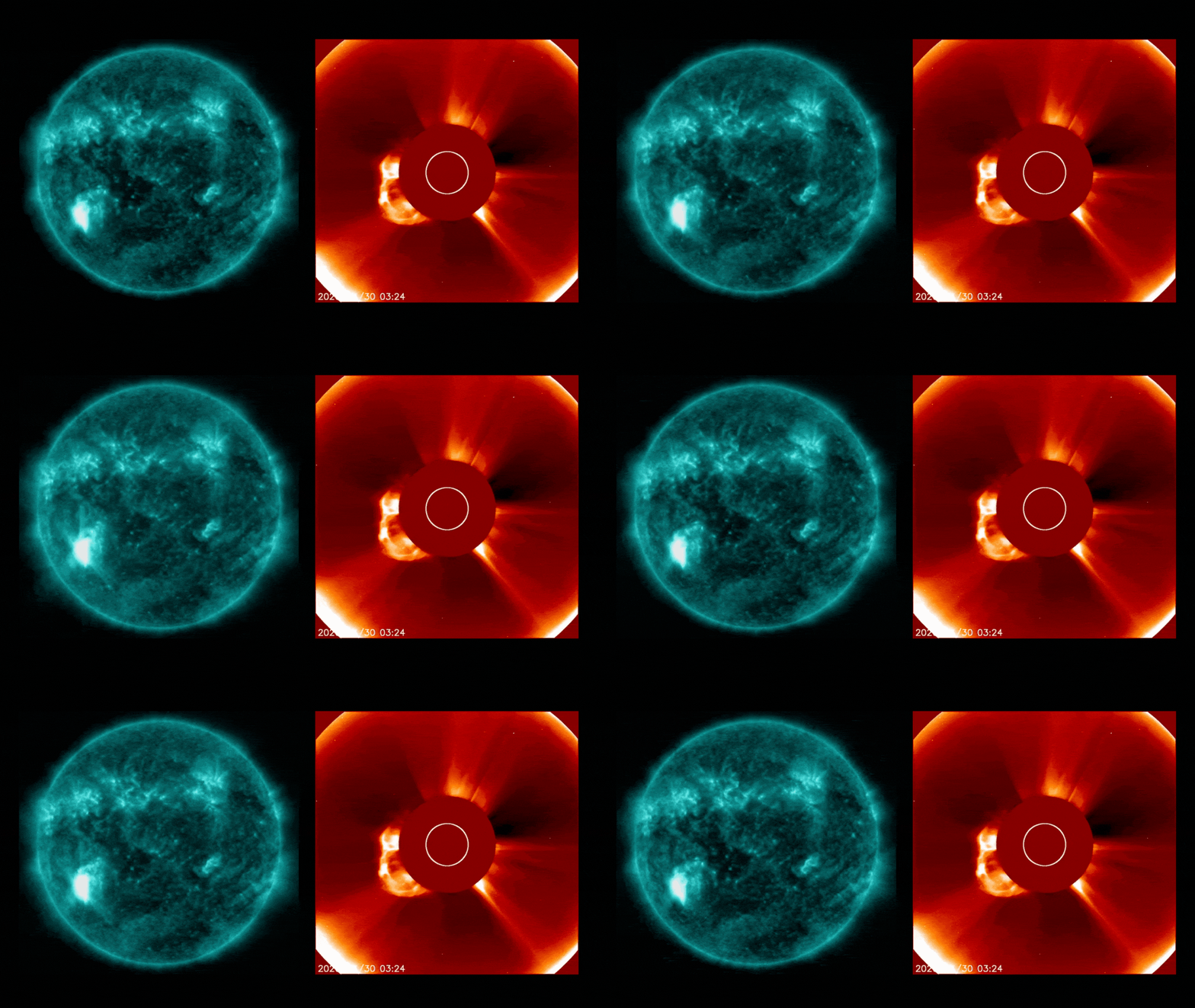
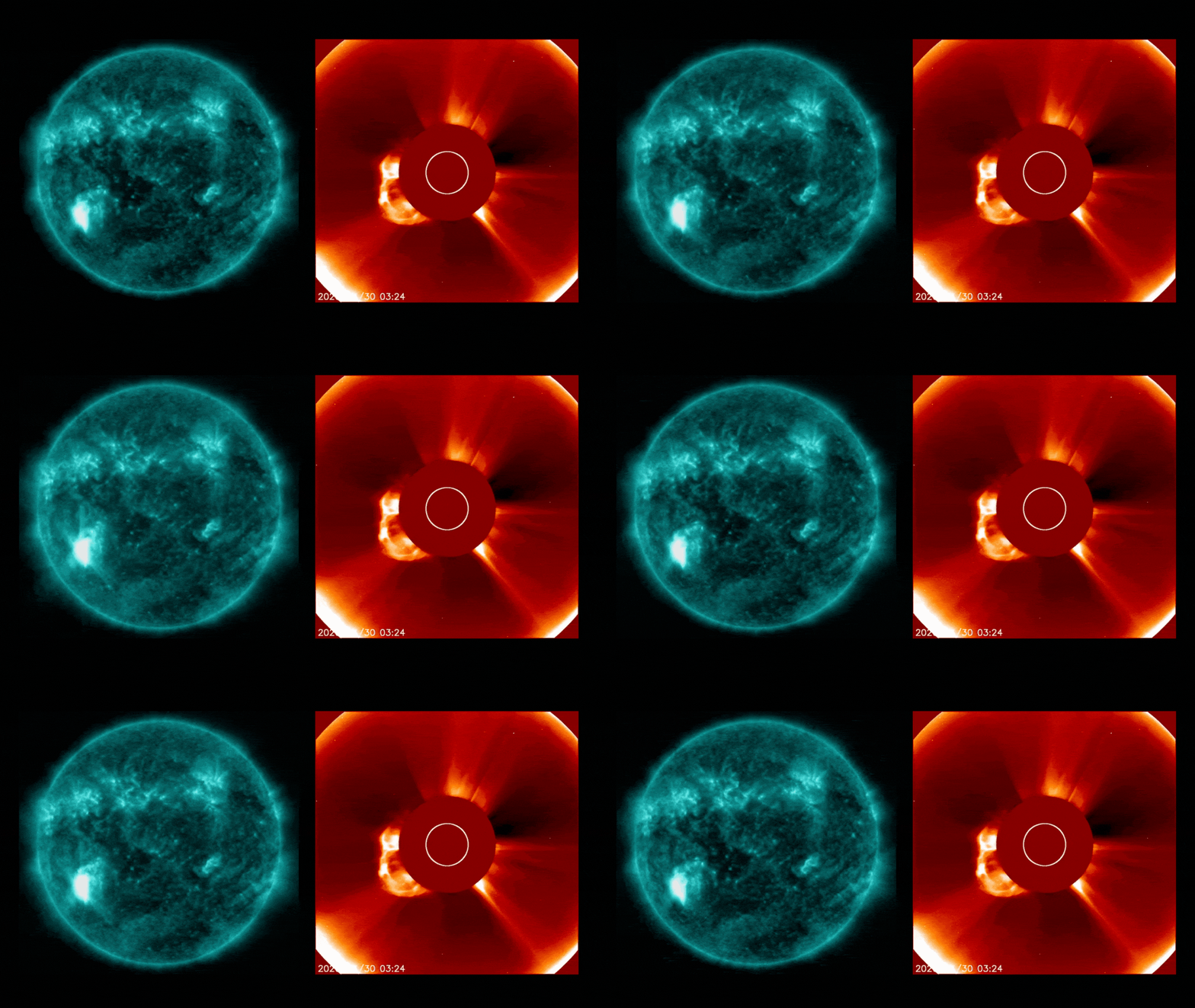
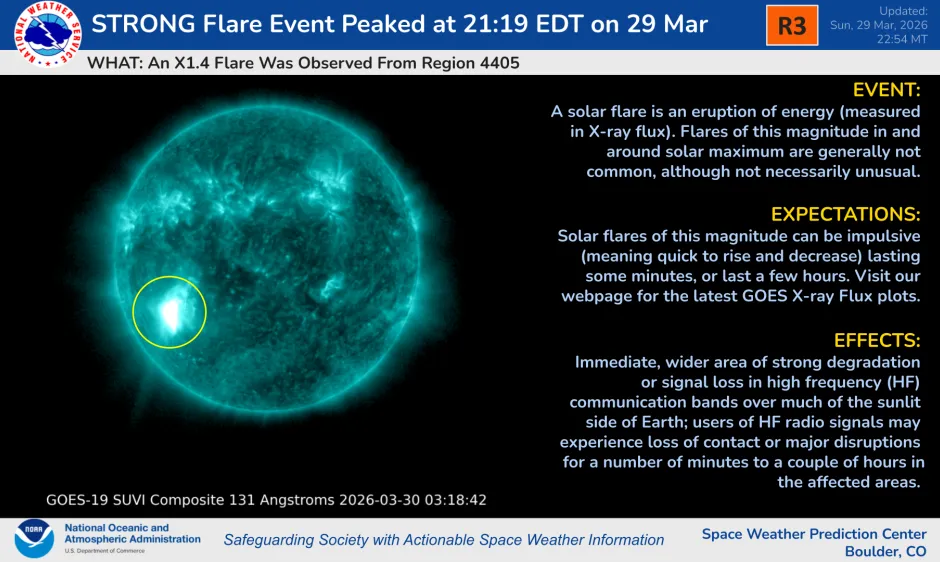
The sun unleashed a powerful X1.4 solar flare in the early hours today (March 30), triggering radio blackouts on Earth and raising potential concerns for NASA’s Artemis 2 mission preparations.
The eruption came from active region 4405, a magnetically complex sunspot group now rotating further into Earth’s view — meaning any continued activity could have more direct impacts on Earth and Artemis 2 preparations in the coming days. The flare also launched a coronal mass ejection (CME) with a possible Earth-directed component.
Article continues below
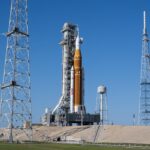
NASA is preparing to launch Artemis 2, its first astronaut mission to the moon since 1972, with liftoff set for no earlier than April 1, at 6:24 p.m. EDT (2224 GMT). The mission will send four astronauts on a 10-day journey around the moon, but heightened solar activity could complicate preparations if conditions intensify.
Read more: Could bad space weather endanger the Artemis 2 moon astronauts?
“NASA is paying attention regarding the upcoming Artemis 2 launch,” solar physicist Tamitha Skov told Space.com in a reply to a comment on X. “We need to pay attention to radio bursts now. Those can really impact HF/VHF as well as satellite radio communications during critical launch operations and early orbit maneuvers!” Skov continued.
You can keep up to date with the latest Artemis 2 news with our Artemis 2 live blog.
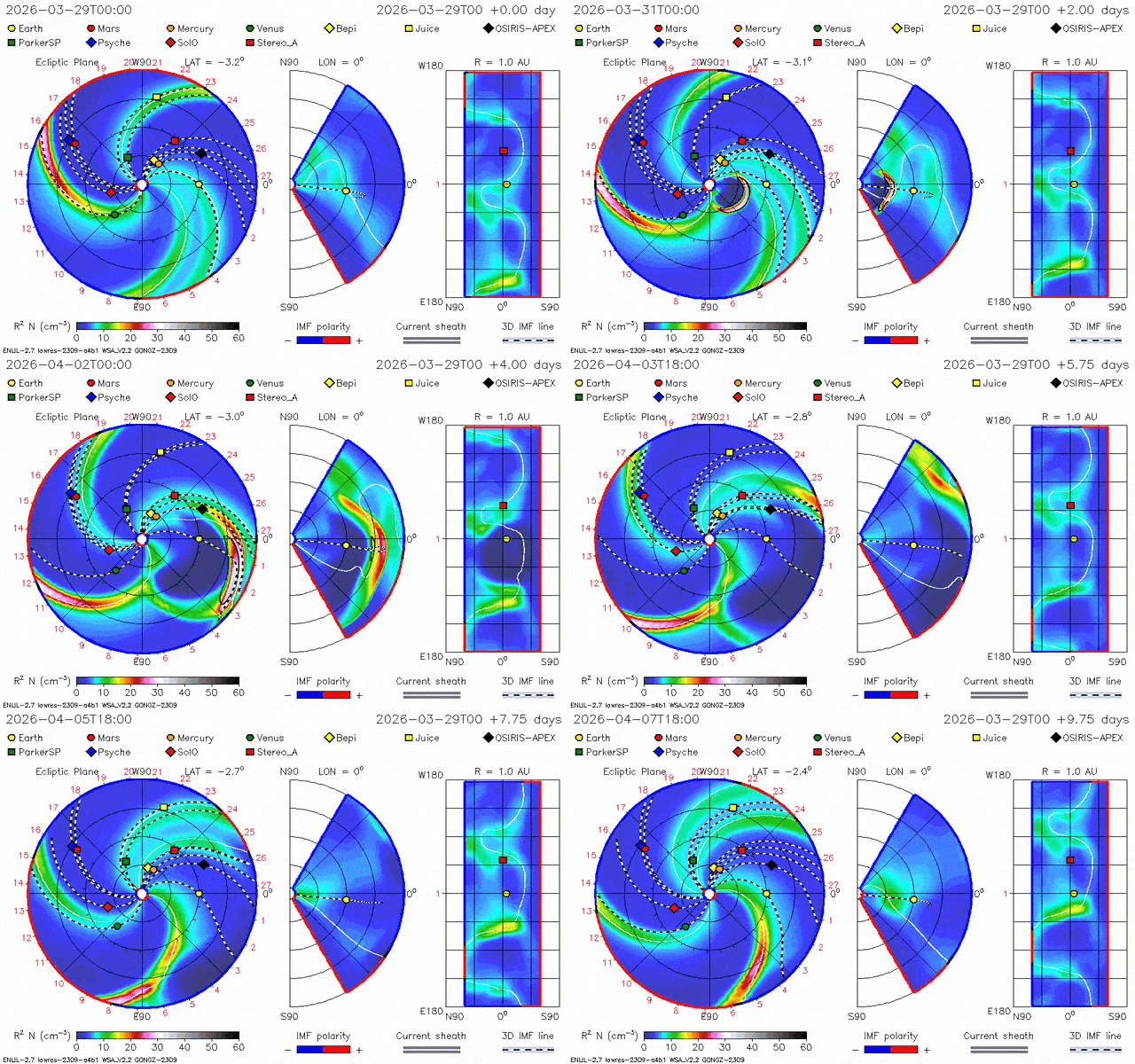
NASA officials aren’t the only ones paying close attention to the sun’s outbursts this week. Aurora chasers will also be getting excited about the prospect of a possible glancing blow from the speedy CME released during the eruption. NOAA’s Space Weather Prediction Center has issued a moderate (G2) geomagnetic storm watch for March 31, with minor (G1) storm conditions possible on March 30 and April 1.
If the CME delivers a glancing blow to Earth, it could trigger geomagnetic storm conditions and lead to auroras visible at lower latitudes than usual. If conditions align, auroras could be visible as far south as New York, Wisconsin and Washington state under G2 conditions, according to NOAA.










Related Posts


Stay Informed With the Latest & Most Important News
Previous Post
Next Post
Advertisement
-
 01Two Black Holes Observed Circling Each Other for the First Time
 -
 02From Polymerization-Enabled Folding and Assembly to Chemical Evolution: Key Processes for Emergence of Functional Polymers in the Origin of Life
 -
 03Astronomy 101: From the Sun and Moon to Wormholes and Warp Drive, Key Theories, Discoveries, and Facts about the Universe (The Adams 101 Series)
 -
 04True Anomaly hires former York Space executive as chief operating officer
 -
 05Φsat-2 begins science phase for AI Earth images
 -
 06Hurricane forecasters are losing 3 key satellites ahead of peak storm season − a meteorologist explains why it matters
 -
 07Binary star systems are complex astronomical objects − a new AI approach could pin down their properties quickly