
Now Reading: ‘Forbidden Planet’ at 70: Why the original sci-fi blockbuster is still out of this world
-
01
‘Forbidden Planet’ at 70: Why the original sci-fi blockbuster is still out of this world

‘Forbidden Planet’ at 70: Why the original sci-fi blockbuster is still out of this world

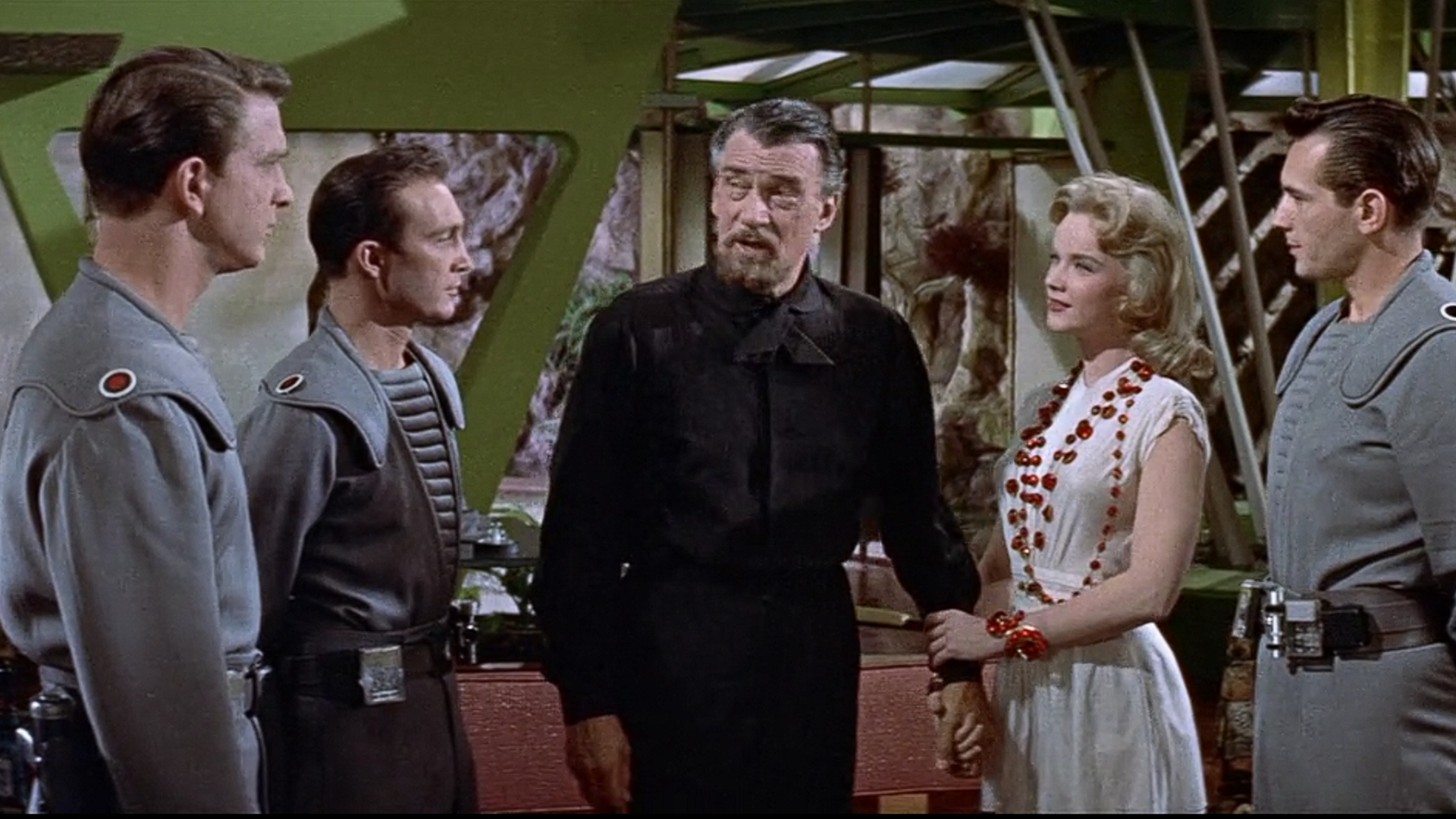
When Leslie Nielsen passed away in 2010, most of the obituaries led with his later career as a comic actor, when his masterful deadpan turned him into the unlikely star of “Airplane!” and the “Naked Gun” trilogy. But in a previous life, the Canadian was more renowned for playing it straight, that familiar baritone more likely to be utilized in serious roles than the pursuit of laughs.
Seventy years ago this month, he sought out strange new worlds as a proto-Captain Kirk in sci-fi classic “Forbidden Planet”. But while laughs are in short supply on the alien world of Altair IV, the influential 1956 blockbuster surely ranks among the finest movies in Nielsen’s filmography — and don’t call it Shirley.
Not that Nielsen — or any of “Forbidden Planet”‘s human cast, for that matter — could claim to be the real star of this game-changing sci-fi classic. With its green-skied alien vistas, futuristic spacecraft, advanced extra-terrestrial civilisations, and mechanical co-star, the film laid the groundwork for “Star Wars“, “Star Trek” and pretty much every other screen space opera that’s followed.
Article continues below

It was certainly light-years away from the other science fiction releases of the era. In the ’50s, the genre tended to be associated with monster movies (giant insects were everywhere), Cold War paranoia, and often hybrids of the two, such as “The Thing from Another World” (1951).
Hollywood’s other undisputed sci-fi classic of the decade, “The Day the Earth Stood Still” (also 1951), was a talky, political affair whose giant robot automaton and flying saucer were rather more grounded. (It was also, unlike “Forbidden Planet”, shot in black-and-white.) Meanwhile, most American audiences would have been blissfully unaware that “Godzilla” (1954) had been busy leaving his trademark trail of destruction across Japan.
“Forbidden Planet”, on the other hand, saw MGM throwing piles of cash at a big-budget studio picture set in outer space. In this vision of the future, the people of Earth (but, let’s be honest, mostly American men) have been successfully exploring, conquering, and colonizing deep space since faster-than-light hyperdrives were developed in the early 23rd century.
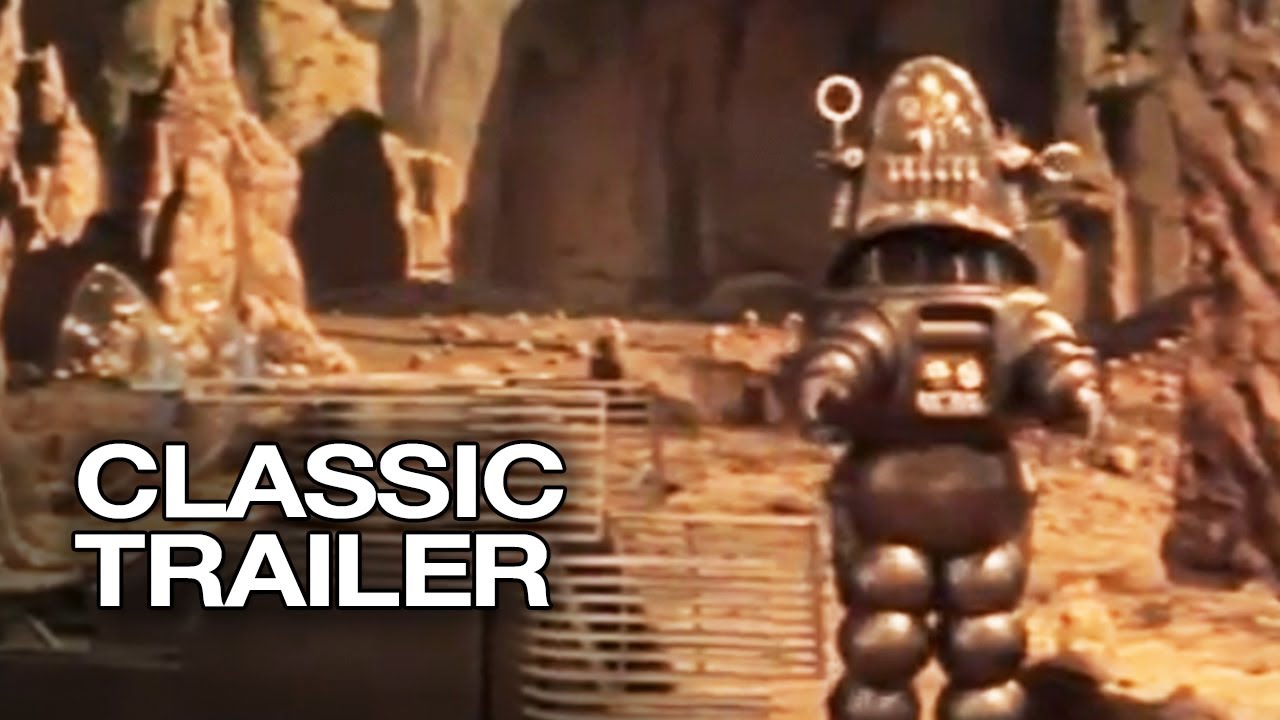
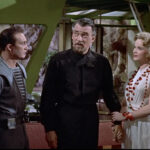
Now, some indeterminate time later, the functionally titled United Planets Cruiser C-57D (under the command of Nielsen’s by-the-book Commander John J Adams) is on a mission to find out what happened to the crew of the Bellerophon (a much more romantic name for a spaceship) two decades earlier. But when Dr Edward Morbius (Walter Pidgeon), scientist and lone survivor of the expedition, warns them it’s not safe to land, it’s clear that strange things are afoot on Altair IV…
On one level, you can view “Forbidden Planet” as “The Tempest” in space, a clever modernization of the original Shakespeare that blazed a trail for later riffs on the Bard, such as “West Side Story” and “Ten Things I Hate About You”. Admittedly, in space no one can hear you speaking iambic pentameter, but a cursory glance at your CliffsNotes should be all you need to tell you that Morbius is analogous to magician Prospero, his daughter Altaira (Anne Francis) is Miranda, and Adams is, more-or-less, the shipwrecked Ferdinand. But the movie’s radical makeovers of the ethereal Ariel and monstrous Caliban offer rather more justification for the movie’s status as a bona fide sci-fi classic.
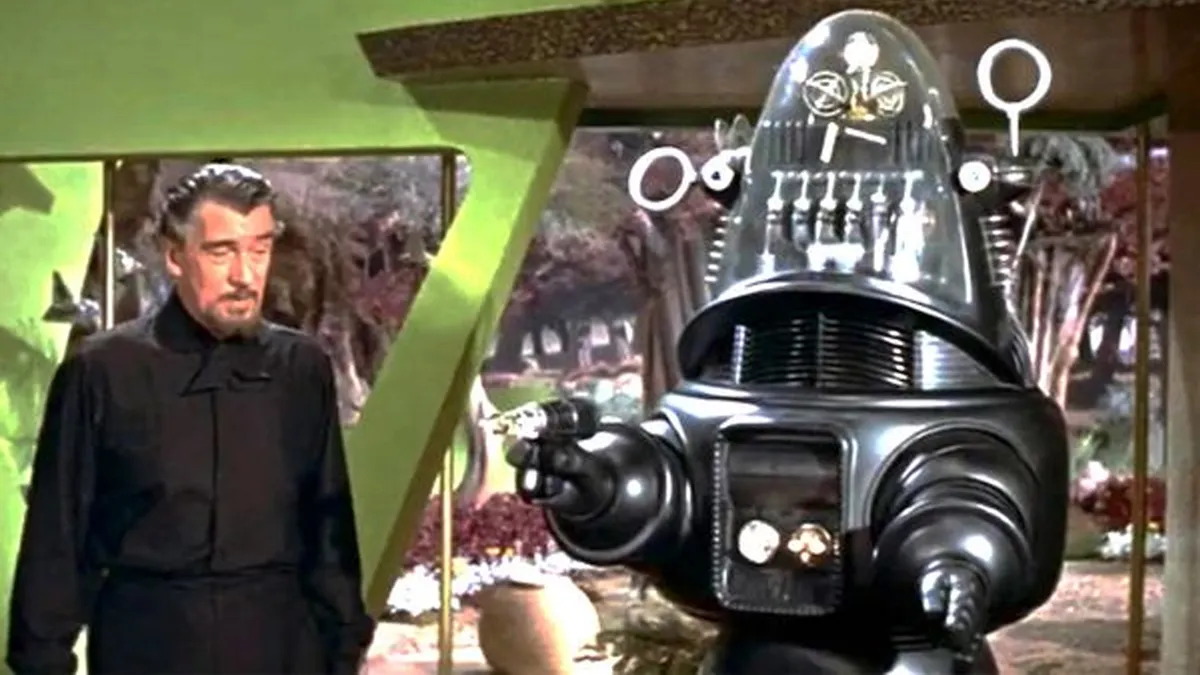
Ariel is reinvented as Robby the Robot, the droid that paved the way for everything from “Lost in Space”‘s Robot (like Robby, designed by Robert Kinoshita) to R2-D2. Far from the almost demonic presence seen carrying a scantily clad woman on the iconic “Forbidden Planet” poster — few theatrical promos have ever been quite so misleading — he’s actually a force for good constructed by Morbius.

Robby rigorously adheres to Isaac Asimov’s laws of robotics, protecting human life at all costs, while also having a useful sideline replicating clothing, whisky, and pretty much anything else you can imagine. But unlike his sleeker, more humanoid forerunners, “Metropolis”‘s Maria (1927) and “The Day the Earth Stood Still”‘s Gort, his design is defiantly functional — you can literally see what’s going on under the hood, an intriguing mass of electrical components, whirring gyroscopes, and flashing lights.
Robby would go on to become the movie’s breakout star, earning headline billing in otherwise unrelated kids’ movie “The Invisible Boy” the following year, before going on to cameo everywhere from “Wonder Woman” and “Mork and Mindy” to “Gremlins”.
The movie’s answer to Caliban, meanwhile, was even more revolutionary. In the story, the “id monster” turns out to be Morbius’s darkest thoughts given physical form, a product of the powerful technology left behind by an ancient, now-extinct alien race — a premise worthy of “Star Trek” before “Star Trek” had even been invented. But the ingenuity that brought the creature to the screen would have impressed even those long-departed Krell.
Most of the time, the creature is invisible, only given away by roars or its footprints in the soil of this extra-terrestrial world.
But the C-57D’s forcefields and laser blasts reveal something more, a glowing outline of terror that looks unlike any alien creation before or since. It was designed by Disney veteran Joshua Meador (most famous for his work on “Fantasia”), whose pencil drawings were photographed before being flipped into negatives to create the monster’s chilling, transparent form. It — and the movie’s other pioneering effects — would inspire a generation of VFX pioneers. Indeed, the first iteration of Industrial Light & Magic would have probably looked very different had the likes of John Dykstra and Dennis Muren not been entranced by events on Altair IV.
But so much of “Forbidden Planet” is ahead of its time. When the film was released, Sputnik was still a year away, space travel still very much in the realms of fantasy — the opening narration gives the late 21st century as the date of the first successful moon landing. Even so, the film’s planetary vistas and space travel tech wouldn’t feel out of place in space operas that followed decades later. Adams even mentions “reversing polarity”, a phrase that’s now among the most overused in sci-fi.

And then there’s the soundtrack, a fusion of score and audio effects so groundbreaking that Hollywood had to invent a new term to describe it. In this pre-synthesizer age, Bebe and Louis Barron utilized a mind-blowing selection of electronic gizmos to create a unique collage of otherworldly noise.
The movie credits their contributions as “Electronic Tonalities”, though the fact that they used no musicians or recognizable instruments created friction with the musicians’ union. They were subsequently declared ineligible for that year’s Best Original Score Oscar — remarkable considering this was, by several hundred light-years, the most original score out there.
That said, it’s important to note that not everything in “Forbidden Planet” stands up to modern scrutiny. The C-57D crew is all-male, and Adams’ attitude to his love interest, Altaira, is positively prehistoric.

Their awkward romance has the uncomfortable air of an older, more sophisticated man taking advantage of a naïve young woman, while his complaints about the effect her presence (and short dresses) have on his sexually frustrated shipmates is definitely the product of another time. The scene of Altaira “skinny dipping” while Francis is clearly wearing a flesh-colored bodysuit to protect her modesty is bizarre — her innocent “What’s a bathing suit?” remark makes little sense when she’s clearly fully clothed.
But seeing as many 20th-century classics — from “Some Like it Hot” to “Back to the Future” — have moments that, quite rightly, wouldn’t make it past a script editor today, it seems churlish to dismiss “Forbidden Planet” for carrying 1950s sensibilities into the distant future. This was a film that truly opened a gateway to the final frontier — and almost every space opera since has been riding its warp trails.
“Forbidden Planet” is available to rent and buy via Amazon and Apple in the US and UK. You can also pick up the Blu-ray from Amazon.










Related Posts
Stay Informed With the Latest & Most Important News
Previous Post
Next Post

Advertisement
-
 01Two Black Holes Observed Circling Each Other for the First Time
 -
 02From Polymerization-Enabled Folding and Assembly to Chemical Evolution: Key Processes for Emergence of Functional Polymers in the Origin of Life
 -
 03Astronomy 101: From the Sun and Moon to Wormholes and Warp Drive, Key Theories, Discoveries, and Facts about the Universe (The Adams 101 Series)
 -
 04True Anomaly hires former York Space executive as chief operating officer
 -
 05Φsat-2 begins science phase for AI Earth images
 -
 06Hurricane forecasters are losing 3 key satellites ahead of peak storm season − a meteorologist explains why it matters
 -
 07Binary star systems are complex astronomical objects − a new AI approach could pin down their properties quickly