
Now Reading: Starlink satellite breaks up, scatters debris
-
01
Starlink satellite breaks up, scatters debris


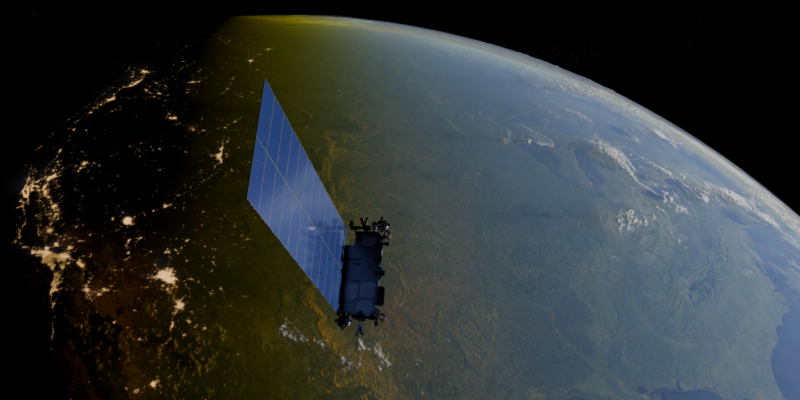

Starlink satellite unexpectedly breaks up, scattering debris
A Starlink satellite unexpectedly broke up on March 29, 2026, while in orbit about 350 miles (560 km) above Earth. The satellite – numbered 34343 – had been in orbit for less than a year. It launched from Vandenberg Space Force Base in California on May 27, 2025. SpaceX said it is investigating the cause of the rapid unscheduled disassembly (RUD). It also claimed:
Latest analysis shows the event poses no new risk to the space station, its crew, or to the upcoming launch of NASA’s Artemis II mission.
Though not everyone is confident in this assessment.
Some debris from the Starlink breakup should fall back to Earth over the next few weeks. That’s according to LeoLabs, a company that uses global radar to track satellites and space debris in low-Earth orbit. Large, remaining pieces would not return for a few years, yet.
LeoLabs said the cause of the explosion was likely internal to the satellite and not a collision. If so, this raises many questions about the likelihood of this event recurring in any of the more than 10,000 Starlink satellites currently orbiting Earth. LeoLabs’ radar detected what it called:
… tens of objects in the vicinity of the satellite after the event.
And, in fact, LeoLabs compared the Sunday event to one that occurred back on December 17, 2025. On that date, Starlink satellite 35956 also experienced a RUD.
Unexpected debris in low-Earth orbit could collide with other satellites, setting of a chain reaction known as the Kessler syndrome.
LeoLabs detected a fragment creation event involving SpaceX Starlink 34343 on 29 March 2026.
Learn more. ?? pic.twitter.com/54FoV3s953
— LeoLabs (@LeoLabs_Space) March 30, 2026
On Sunday, March 29, Starlink satellite 34343 experienced an anomaly on-orbit, resulting in loss of communications with the satellite at ~560 km above Earth.
Latest analysis shows the event poses no new risk to the @Space_Station, its crew, or to the upcoming launch of NASA’s…
— Starlink (@Starlink) March 30, 2026
Launch of Artemis 2
Artemis 2 is scheduled to launch to the moon on April 1, 2026. It will be the first crewed mission to the moon in more than 50 years. Does the debris pose a threat to the astronauts? SpaceX says no, but others aren’t so sure.
Astrophysicist and space sustainability analyst Jonathan McDowell, formerly of the Harvard and Smithsonian Center for Astrophysics, told Scientific American:
I don’t see how the risks can be nil. They are low because all the debris is expected to reenter quickly. But I’d like to hear more about why they assess the risk to be zero.
And if these Starlinks have been breaking up due to an inherent design flaw, McDowell said:
then the risks go up, a lot.
But overall, McDowell told EarthSky:
The increase in risk to other spacecraft is fairly small as far as we can tell. It will be a short-lived increase in the debris risk for a few months, perhaps say a 10% increase, not a factor of two increase.
And according to McDowell, the version of Starlink that malfunctioned was the latest model, a V2 Mini Optimized. There are 3,532 satellites of this model currently in orbit.
McDowell added:
The hope is that SpaceX will identify the root cause and proactively retire any particular subset of satellites that are found to be at risk.
Bottom line: A SpaceX Starlink satellite unexpectedly broke up in low-Earth orbit on March 29, 2026. Will the debris impact Artemis 2 or the space station?
The post Starlink satellite breaks up, scatters debris first appeared on EarthSky.










Related Posts

Stay Informed With the Latest & Most Important News
Previous Post
Next Post




Advertisement
-
 01Two Black Holes Observed Circling Each Other for the First Time
 -
 02From Polymerization-Enabled Folding and Assembly to Chemical Evolution: Key Processes for Emergence of Functional Polymers in the Origin of Life
 -
 03Astronomy 101: From the Sun and Moon to Wormholes and Warp Drive, Key Theories, Discoveries, and Facts about the Universe (The Adams 101 Series)
 -
 04True Anomaly hires former York Space executive as chief operating officer
 -
 05Φsat-2 begins science phase for AI Earth images
 -
 06Hurricane forecasters are losing 3 key satellites ahead of peak storm season − a meteorologist explains why it matters
 -
 07Binary star systems are complex astronomical objects − a new AI approach could pin down their properties quickly