
Now Reading: Virgin Galactic expects commercial suborbital flights to resume late this year
-
01
Virgin Galactic expects commercial suborbital flights to resume late this year


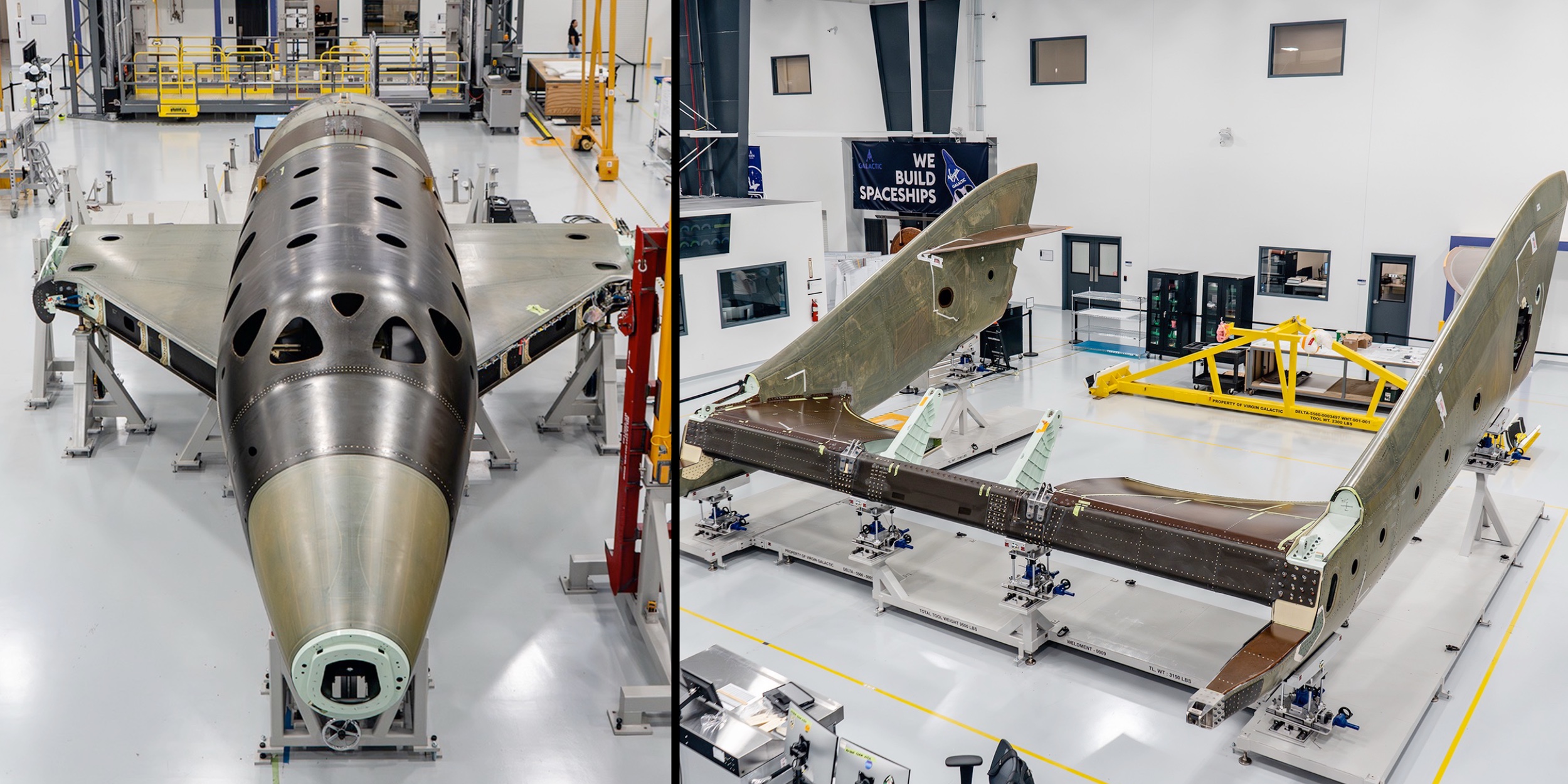

ORLANDO, Fla. — Virgin Galactic still expects to resume commercial suborbital flights by the end of the year as its first next-generation spaceplane nears completion.
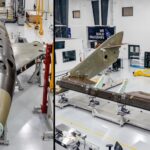
In a March 30 earnings call, company executives outlined the status of the development of its first SpaceShip suborbital spaceplane, which is in final assembly in a factory near Phoenix.
“With structural assembly set to finish over the next week or two, we expect to bring this ship into ground testing in April, which has it on track for our first spaceflight in Q4 2026,” Michael Colglazier, chief executive of Virgin Galactic, said in the call.
Those ground tests will examine performance of vehicle subsystems and the integrated vehicle. That work is expected to conclude in July, after which the vehicle will be formally rolled out and then transported to Spaceport America in New Mexico.
While the ground tests are in progress, Virgin plans to perform pilot training at Spaceport America using its earlier spaceplane, Unity. The company said it is hiring new pilots, who will use Unity to gain proficiency on SpaceShip, which has the same outer mold line.
Glide tests of the first SpaceShip will begin later in the third quarter, followed by powered flight tests. Mike Moses, president of spaceline at Virgin, said the company is planning a partial-duration powered flight of the vehicle to test its performance at speeds of Mach 1 to 1.5.
That will be followed by two full-duration burns that will take the vehicle on a complete suborbital flight. The first will have two pilots as well as research payloads from NASA’s Flight Opportunities program, while the second will instead have two pilots and six company employees to “validate the cabin experience” as well as procedures and processes.
“And then we’ll be ready for commercial service,” he said. Those three powered tests will be sufficient because of the company’s experience with Unity. That experience, along with a faster turnaround time between SpaceShip flights, “means that’ll be a fairly expeditious program as we move through test space flights,” he concluded.
In the company’s previous earnings call in November, the company said commercial research flights would begin in the fourth quarter of 2026, followed by private astronaut flights six to eight weeks later.
Colglazier said that, once the new vehicle enters service, Virgin will gradually ramp up its flight rate. It will start with four flights a month, later going to eight a month and then 10 or more a month in the second quarter of 2027.
The aircraft that takes the spaceplane aloft, Eve, has gone through upgrades and can now handle 12 to 15 flights a month. Those upgrades have also extended the service life of the plane, introduced in 2008, to at least 2032.
The company announced last August it had started design work on a replacement aircraft or “launch vehicle” known as LV-X. That design work has been “advancing modestly,” he said, with a goal of having the first LV-X ready in 2030 along with additional spaceplanes.
With the start of commercial flights of the new vehicle approaching, Virgin Galactic announced it will reopen ticket sales. The company is offering 50 tickets at $750,000 each, up from the $600,000 it previously charged.
“These spaceflights will be slotted in our manifest immediately after we fly the current members of our founding astronaut community, many of whom have been anticipating their spaceflight for several years,” he said.
The company started ticket sales about two decades ago and says it currently has a backlog of more than 650 customers. In its annual report for 2024, filed in February 2025, the company said it had a backlog of about 700 customers as of the end of 2024.
Virgin Galactic reported $2 million in revenue for 2025 and a net loss of $279 million. It ended the year with $338 million in cash and equivalents on hand.
The company’s annual report filed with the Securities and Exchange Commission included a “going concern” warning that the company may not have sufficient cash to continue operations over the next 12 months.
Doug Ahrens, chief financial officer at Virgin Galactic, downplayed any concerns, noting that under accounting rules it could not include revenue expected from commercial flights or the ability to raise $138 million through an existing agreement for “at-the-market” sale of stock.
“We forecast the start of commercial service in the fourth quarter of this year. We expect significant cash inflows in connection with that milestone,” he said. “Throughout the year, we plan to maintain appropriate strength in our balance sheet, and we are thrilled to be on the cusp of ramping commercial spaceline operations.”










Related Posts


Stay Informed With the Latest & Most Important News
Previous Post
Next Post

Advertisement
-
 01Two Black Holes Observed Circling Each Other for the First Time
 -
 02From Polymerization-Enabled Folding and Assembly to Chemical Evolution: Key Processes for Emergence of Functional Polymers in the Origin of Life
 -
 03Astronomy 101: From the Sun and Moon to Wormholes and Warp Drive, Key Theories, Discoveries, and Facts about the Universe (The Adams 101 Series)
 -
 04True Anomaly hires former York Space executive as chief operating officer
 -
 05Φsat-2 begins science phase for AI Earth images
 -
 06Hurricane forecasters are losing 3 key satellites ahead of peak storm season − a meteorologist explains why it matters
 -
 07Binary star systems are complex astronomical objects − a new AI approach could pin down their properties quickly