
Now Reading: Artemis 2 launches on first human mission to the moon in more than 50 years
-
01
Artemis 2 launches on first human mission to the moon in more than 50 years


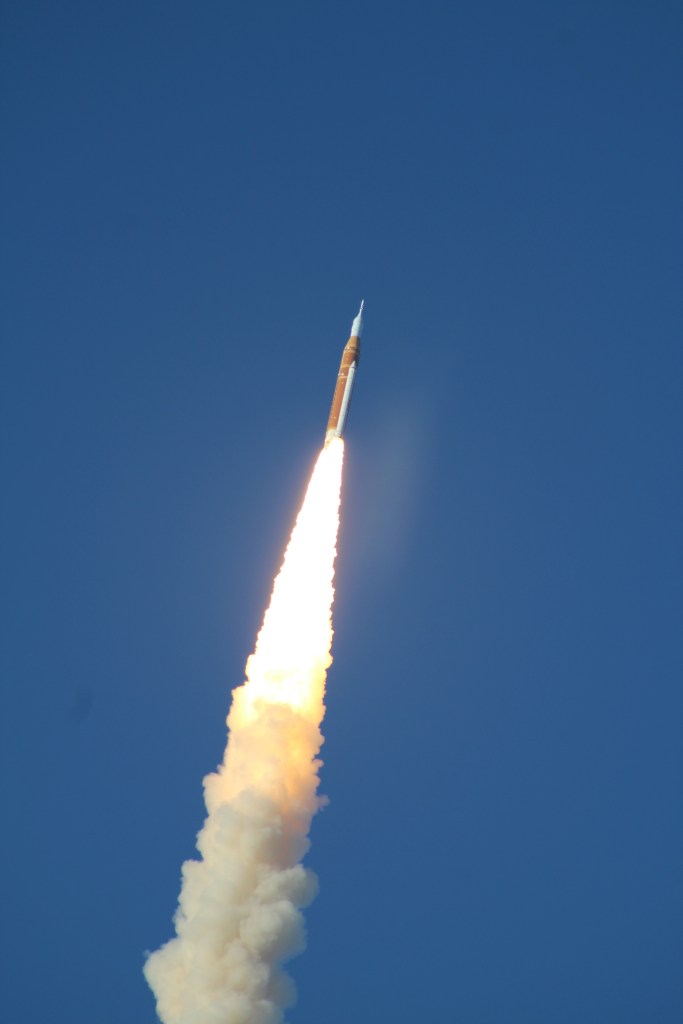
KENNEDY SPACE CENTER, Fla. — The first human mission beyond Earth orbit in more than 50 years is underway with an April 1 launch of four astronauts on a flight around the moon.
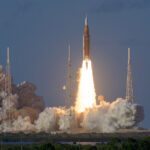
The Space Launch System rocket lifted off from Launch Complex 39B here at 6:35 p.m. Eastern on the Artemis 2 mission. After a normal ascent, the SLS upper stage and Orion spacecraft separated from the core stage about eight minutes later in a low transfer orbit.
During the countdown controllers reported an issue with the rocket’s flight termination system and, later, with one of the batteries in the launch abort system. Both issues were resolved before the opening of the launch window. Controllers also addressed a brief loss of telemetry from the vehicle.
On board the Orion spacecraft, called Integrity by its crew, are NASA astronauts Reid Wiseman, Victor Glover and Christina Koch and Canadian Space Agency astronaut Jeremy Hansen. Wiseman is the commander of Artemis 2 and Glover the pilot, with Koch and Hansen serving as mission specialists.
The upper stage, called the Interim Cryogenic Propulsion Stage or ICPS, is scheduled to perform a burn of its RL10 engine 49 minutes after liftoff to raise its perigee to 185 kilometers, ensuring it is in a stable orbit. A second burn about an hour later will raise its apogee to more than 70,000 kilometers.

Orion will spend a day in this highly elliptical orbit, separating from the ICPS nearly three and a half hours after liftoff. The four astronauts will manually maneuver Orion around the ICPS and test spacecraft systems before Orion’s main engine fires to send the spacecraft on a free-return trajectory around the moon, with a splashdown off the coast from San Diego, California, late April 10.
Once Orion successfully performs that maneuver, the Artemis 2 crew will be the first humans to travel beyond Earth orbit since the three-man Apollo 17 crew in December 17.
Artemis 2 is key test of Orion for future missions that send humans to the surface of the moon. When the Artemis 2 crew was named three years ago, the mission was scheduled to launch in late 2024 as a prelude to a landing attempt on Artemis 3 a year later. However, Artemis 2’s launch slipped by more than a year, primarily because of work to characterize the heat shield on the uncrewed Artemis 1 mission in late 2022 that suffered more erosion than expected.
Under revised plans NASA announced in late February, Artemis 3 will instead test Orion’s ability to rendezvous and dock with lunar landers under development by Blue Origin and SpaceX while in Earth orbit. That mission is projected to launch in mid-2027.
NASA’s first attempt to land humans on the moon since Apollo 17 is planned for Artemis 4 in early 2028, with a second landing attempt on Artemis 5 in late 2028. NASA will determine whether to use Blue Origin’s or SpaceX’s landers based on the progress the two companies make.
The Artemis 2 crew endorsed the revisions to the upcoming Artemis missions and plans by NASA announced March 24 to establish a moon base over the next decade.
“That fired us up. That gave us a lot of hope,” Wiseman said at a March 28 briefing. He said the crew changed their schedule to meet with planners for the revamped Artemis 3 “to go through all the things we want to feed forward in Artemis 3.”
“All of a sudden, the tempo has picked up. We are fired up. We are ready to go,” he said.










Related Posts

Stay Informed With the Latest & Most Important News
Previous Post
Next Post

Advertisement
-
 01Two Black Holes Observed Circling Each Other for the First Time
 -
 02From Polymerization-Enabled Folding and Assembly to Chemical Evolution: Key Processes for Emergence of Functional Polymers in the Origin of Life
 -
 03Astronomy 101: From the Sun and Moon to Wormholes and Warp Drive, Key Theories, Discoveries, and Facts about the Universe (The Adams 101 Series)
 -
 04True Anomaly hires former York Space executive as chief operating officer
 -
 05Φsat-2 begins science phase for AI Earth images
 -
 06Hurricane forecasters are losing 3 key satellites ahead of peak storm season − a meteorologist explains why it matters
 -
 07Binary star systems are complex astronomical objects − a new AI approach could pin down their properties quickly