
Now Reading: SuperCam Identifies Corundum In Jezero Crater, Mars, Using Time-Resolved Luminescence Spectroscopy
-
01
SuperCam Identifies Corundum In Jezero Crater, Mars, Using Time-Resolved Luminescence Spectroscopy

SuperCam Identifies Corundum In Jezero Crater, Mars, Using Time-Resolved Luminescence Spectroscopy

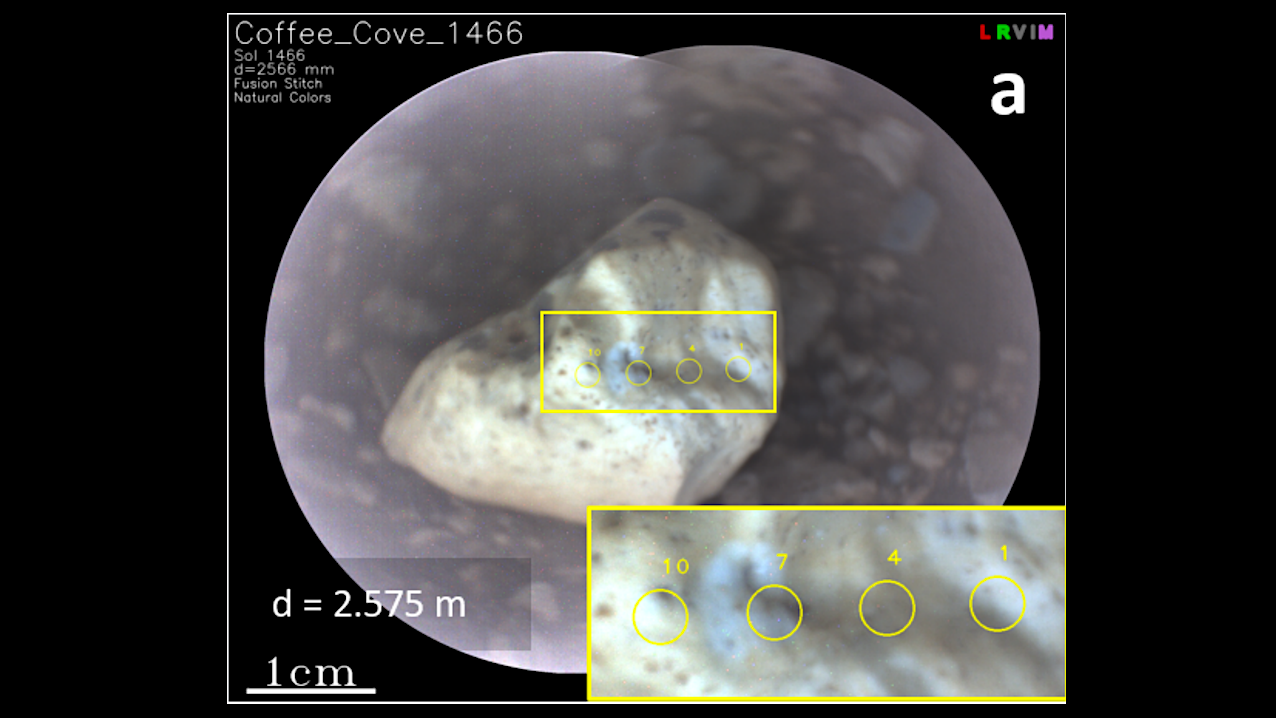
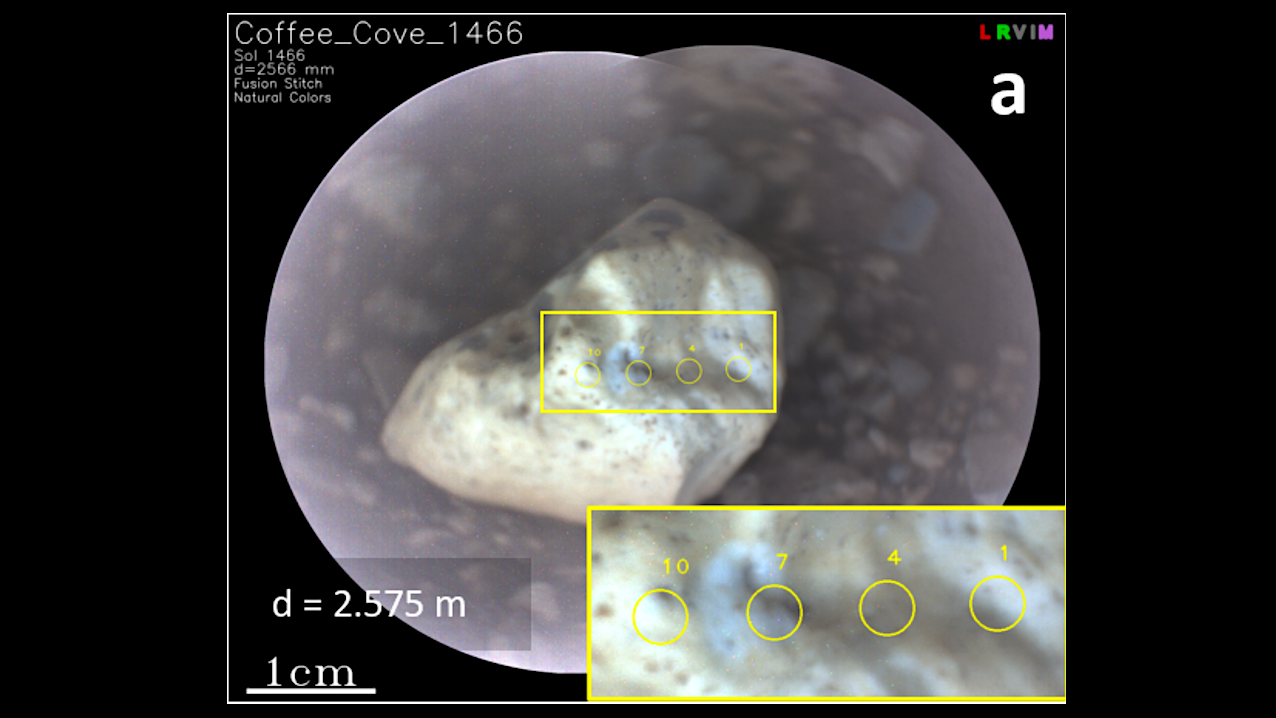
Image of Coffee_Cove (Sol 1466) with the locations and fields of view for the luminescence analyses (a). Comparison of the luminescence spectra taken on Hampden_River and Coffee_Cove compared to lab spectra collected on a pure ruby, ruby in an amphibolite rock, and diaspore — LPSC
The Perseverance rover recently began exploring the Jezero crater rim after traversing the crater floor, fan deposits, and margin unit. In the rim deposits, several plagioclase-rich light-toned float rocks (LTF) were encountered.
SuperCam used timeresolved luminescence (TRL) spectroscopy, which is very sensitive to trace elements in minerals, to further characterize these rocks.
While TRL signatures, including those commonly found in plagioclase (Fe3+), are often broad and non-unique [1,2], there are minerals with very distinct luminescence features [2].
Very unexpectedly, SuperCam’s TRL analysis of three plagioclase-rich float rocks in the crater rim were found to exhibit clear signatures of Cr-bearing corundum (Al2O3).
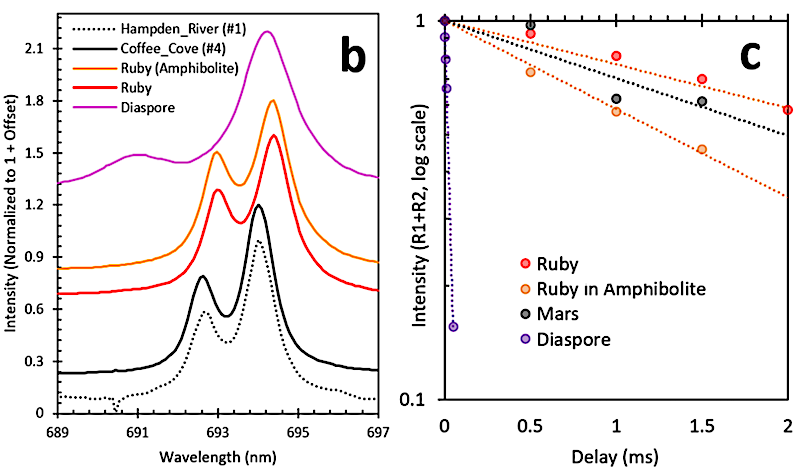
Image of Coffee_Cove (Sol 1466) with the locations and fields of view for the luminescence analyses (b). Comparison of luminescence lifetimes for Cr3+ peaks identified in Smiths_Harbour (Mars) spectra compared to lab data (c). — LPSC
SuperCam Identifies Corundum In Jezero Crater, Mars, Using Time-Resolved Luminescence Spectroscopy , LPSC
Astrobiology,











Related Posts
Stay Informed With the Latest & Most Important News
Previous Post
Next Post

Advertisement
-
 01Two Black Holes Observed Circling Each Other for the First Time
 -
 02From Polymerization-Enabled Folding and Assembly to Chemical Evolution: Key Processes for Emergence of Functional Polymers in the Origin of Life
 -
 03Astronomy 101: From the Sun and Moon to Wormholes and Warp Drive, Key Theories, Discoveries, and Facts about the Universe (The Adams 101 Series)
 -
 04True Anomaly hires former York Space executive as chief operating officer
 -
 05Φsat-2 begins science phase for AI Earth images
 -
 06Hurricane forecasters are losing 3 key satellites ahead of peak storm season − a meteorologist explains why it matters
 -
 07Binary star systems are complex astronomical objects − a new AI approach could pin down their properties quickly