
Now Reading: Europe’s strategic autonomy in space will define its role in the ‘second space age’
-
01
Europe’s strategic autonomy in space will define its role in the ‘second space age’


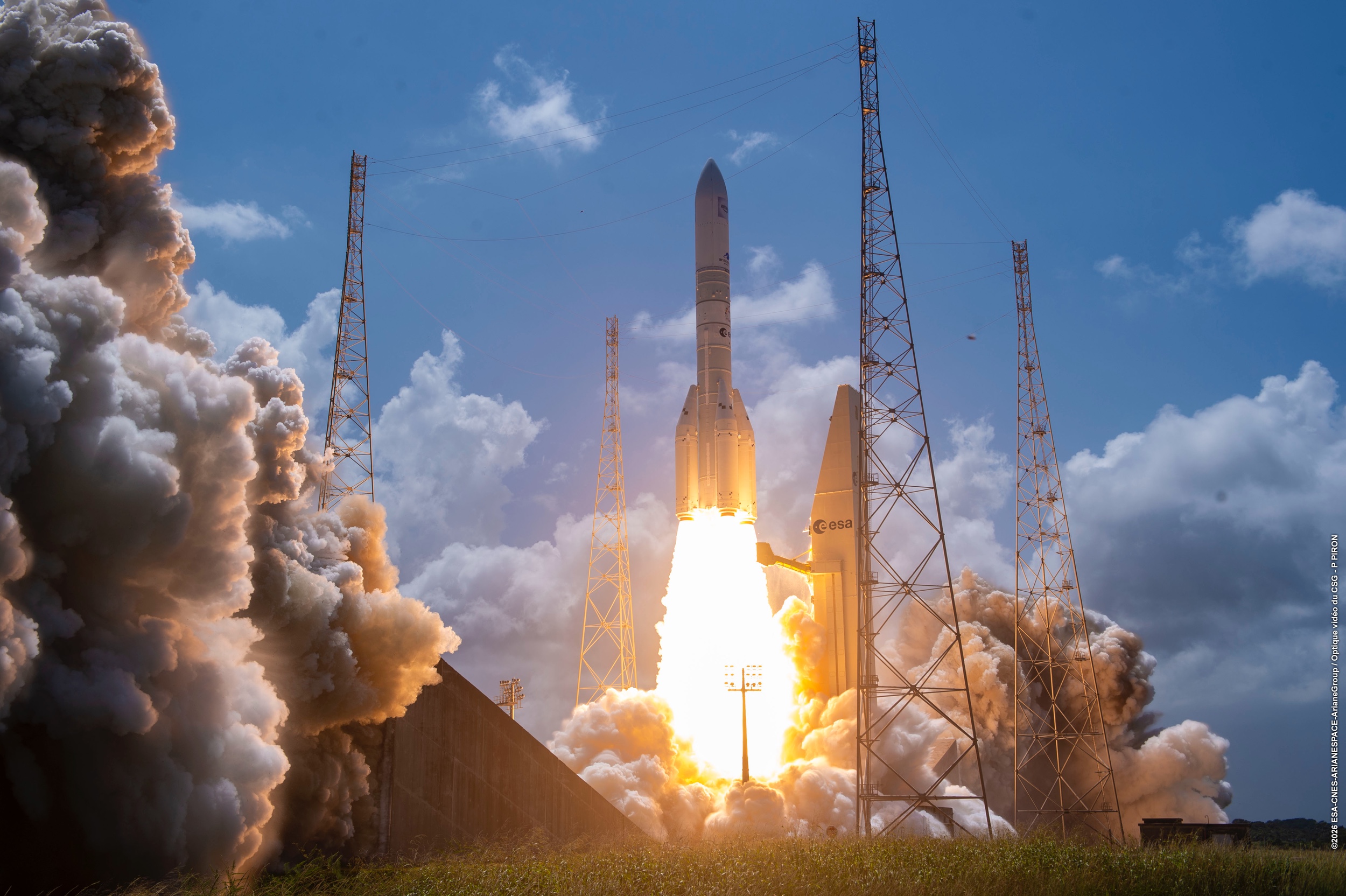

Europe’s future in space really boils down to one question: can it stay ahead without relying on technology made somewhere else? As we step into what experts call the “second space age,” strategic autonomy is suddenly front and center for the European Union. And it is increasingly essential that Europe can get to, control and protect its own space systems — no strings attached.
Space as a strategic infrastructure
Here’s where things stand. Space used to be mostly about science or business, but now it’s a high-stakes asset for the EU. Almost everything — finance, communications, transport, national security — depends on space tech. IRIS2 satellites keep military and civilian communications safe. Galileo provides pinpoint navigation for logistics and banking. Copernicus tracks climate, disasters and borders. These projects put Europe’s ambitions on display, but there’s a catch: A lot of crucial parts and services still come from outside Europe. That kind of dependence just won’t work if Europe wants real sway on the global stage.
Why does this matter now? Space has changed. It’s more crowded and competitive than ever. The United States leads the pack thanks to companies like SpaceX. China’s moving fast, building its own launch systems and space stations. Private firms launch satellites, run huge constellations and offer services that used to be government-only.
For Europe, leaning on providers from outside the continent is risky. When things get tense, that vulnerability is glaring — politically and operationally. It’s a gap the EU just can’t afford.
Getting real autonomy, though, is messy business. Europe’s space governance is scattered between EU institutions, the European Space Agency, member countries and private companies. Money’s another sticking point. EU budgets lag behind those of the U.S. and China, especially in defense and security. And Europe’s business culture is more cautious, so startups don’t get the same backing or risk-taking vibe they’d find across the Atlantic.
As competition heats up, whoever controls space infrastructure gets to call the shots. For the EU, autonomy is about being both responsible and independent.
If Europe pulls this off, it keeps a major say in shaping the rules and technology of space. If not, it falls behind and depends on others for abilities that are crucial to sovereignty.
Strategic investment to achieve strategic autonomy
The second space age is not going to wait for Europe. Europe has to decide. Does it want to be a leader or just watch what is happening from the sidelines?
To establish European leadership and autonomy in space, politicians and the space industry need to make serious changes. Especially when the next European Union budget is coming up. Europe needs to have its own launch systems, make its satellite networks safer and more reliable and use European-made technology instead of technology from other countries. Also, the public and private sectors need to work like they never have before. In space, the people who are brave and come up with ideas are the ones who win. And Europe cannot afford to fall behind.
The next European Union budget must make space a top priority for security and the economy. This means spending money on space programs that are related to defense, like IRIS² and future Galileo projects, so Europe can compete with other countries. Europe needs to create financial tools that combine European Union, national and private money to help new space companies in Europe grow and reduce the risks of innovation. Europe must also make sure that projects like Ariane 6 and the European Launch Challenge have money for many years so they are not stopped by political or budget problems.
Europe needs to reduce its dependence on technology and services from other countries as soon as possible. It needs to focus on developing its supply chains for critical technologies like special computer chips, advanced propulsion systems, secure encryption and safe ground infrastructure. Europe should also increase its private research efforts, especially in areas like reusable launch systems, in-orbit servicing and satellite cybersecurity using programs like Horizon Europe and the European Union Space Fund. By giving priority to companies for institutional missions when possible, Europe can help its own space industry grow and rely less on launchers or components from other countries.
The European space ecosystem is fragmented because of the split between the European Space Agency, national agencies and the space industry. This needs to be fixed by clarifying roles and making decision-making more efficient to avoid duplication, speed up procurement and align civilian, commercial and defense space goals. Europe can do this by creating testing environments to help new companies navigate standards and certification hurdles while keeping security and interoperability in mind.
Europe should encourage a culture of taking risks, where venture capital and public contracts support new and innovative companies instead of traditional contractors. Being autonomous does not mean being isolated. It means being resilient through trusted partnerships and diversified capabilities. Europe can build satellite constellations with built-in redundancy, cyber-hardening and anti-jamming features to withstand disruptions.
Europe should work closely with reliable international partners, like Canada, Japan and India on specific technologies or missions while making sure European systems remain under European control. Europe should also promote innovation that can be used for both defense purposes, like the Galileo Public Regulated Service.
The second space age is not going to slow down for Europe to catch up. To avoid depending on countries and to keep its strategic influence, the European Union must act now: it must spend money ambitiously, innovate urgently, govern cohesively and build space capabilities that are both independent and resilient. The opportunity for Europe to lead is open. It is closing fast.
Lt. Col. Mihail Istvanovics Várdai is the Deputy Branch Head of the Arms Control Branch of the Hungarian Defense Staff Operations Directorate.
SpaceNews is committed to publishing our community’s diverse perspectives. Whether you’re an academic, executive, engineer or even just a concerned citizen of the cosmos, send your arguments and viewpoints to opinion (at) spacenews.com to be considered for publication online or in our next magazine. If you have something to submit, read some of our recent opinion articles and our submission guidelines to get a sense of what we’re looking for. The perspectives shared in these opinion articles are solely those of the authors and do not necessarily represent their employers or professional affiliations.










Related Posts
Stay Informed With the Latest & Most Important News
Previous Post
Next Post




Advertisement
-
 01Two Black Holes Observed Circling Each Other for the First Time
 -
 02From Polymerization-Enabled Folding and Assembly to Chemical Evolution: Key Processes for Emergence of Functional Polymers in the Origin of Life
 -
 03Astronomy 101: From the Sun and Moon to Wormholes and Warp Drive, Key Theories, Discoveries, and Facts about the Universe (The Adams 101 Series)
 -
 04True Anomaly hires former York Space executive as chief operating officer
 -
 05Φsat-2 begins science phase for AI Earth images
 -
 06Hurricane forecasters are losing 3 key satellites ahead of peak storm season − a meteorologist explains why it matters
 -
 07Binary star systems are complex astronomical objects − a new AI approach could pin down their properties quickly