
Now Reading: Hot Rocks Survey V: Secondary Eclipse Photometry of GJ 3473 b with JWST/MIRI
-
01
Hot Rocks Survey V: Secondary Eclipse Photometry of GJ 3473 b with JWST/MIRI


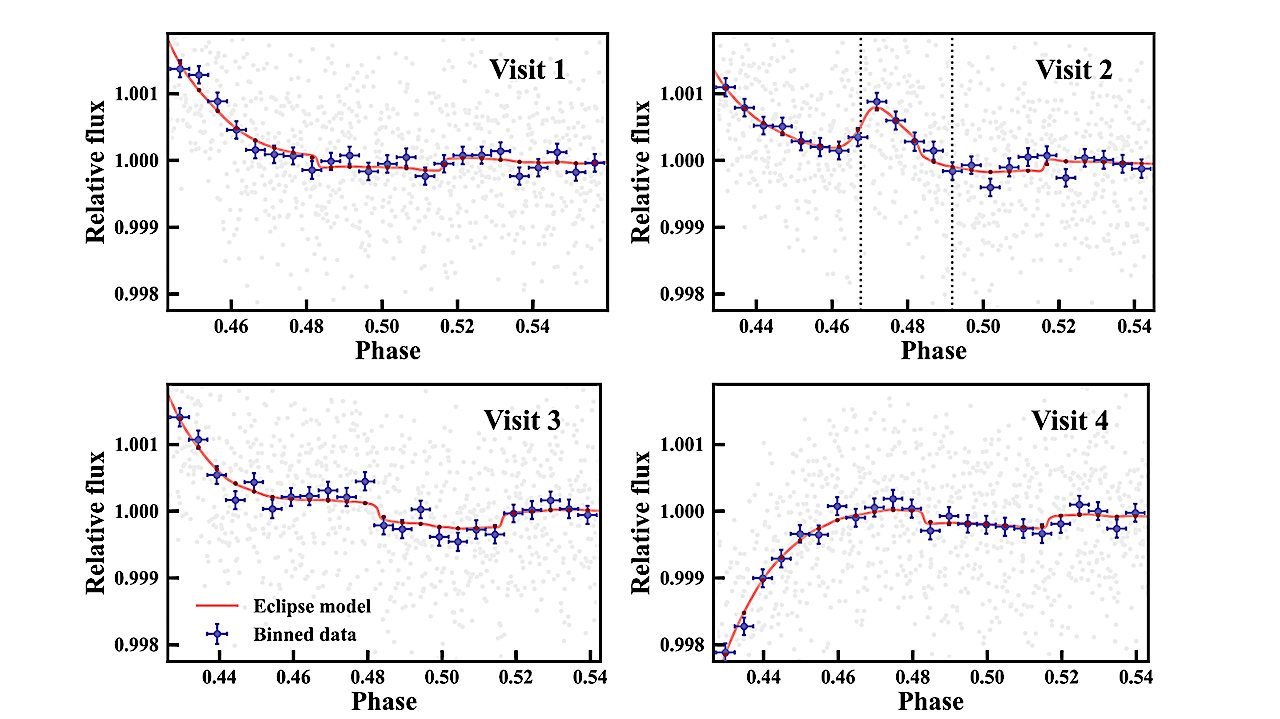

MIRI F1500W light curves of GJ 3473 b at secondary eclipse. The raw and binned data are shown in light grey and purple, respectively. The pink curves correspond to the median model predictions from the joint fit, while the brown data points depict the binned model. The model shown here corresponds to the G. Tovar Mendoza et al. (2022) flare model case, as described in Appendix C, used to model the flare-like feature during the second visit. The dotted vertical lines show the nominally masked region in the second visit. Compared to Figure 2, this figure displays the data without correcting for systematics. — astro-ph.EP
JWST is transforming our ability to characterise small exoplanets, from sub-Neptunes to rocky worlds. A key open question is whether highly irradiated rocky planets can retain atmospheres or are stripped bare by stellar irradiation — a boundary that remains to be mapped observationally.
Here we present the first JWST secondary eclipse observations of the rocky exoplanet GJ 3473 b, obtained with MIRI F1500W photometry. Using four visits, we confidently detect the eclipse at an average depth of 186±45 ppm, somewhat lower than expected for a blackbody. We test a wide range of data reduction and analysis assumptions and provide new insights into MIRI detector settling behaviour that will benefit future observations.
We model a suite of airless surfaces with varied compositions, textures, and degrees of space weathering, as well as idealised atmospheric scenarios including the possibility of atmospheric collapse.
Both atmospheric and bare-rock interpretations remain consistent with the data, but we exclude thick CO2 atmospheres, placing a 95 % credible upper limit of 1.2-6.5 bar on the surface pressure.
We also find tentative evidence for visit-to-visit variability in eclipse depth (33-371 ppm), though additional data are required to confirm this. Our results highlight the challenges and intrinsic degeneracies in interpreting MIRI F1500W eclipse measurements of rocky exoplanets, indicating that such observations alone may not uniquely distinguish between bare-rock and atmospheric scenarios.
Future spectroscopic or phase-curve observations will be required to determine whether or not GJ 3473 b hosts a substantial atmosphere
Måns Holmberg, Hannah Diamond-Lowe, João M. Mendonça, Daniel Kitzmann, Néstor Espinoza, Natalie H. Allen, Prune C. August, Mark Fortune, Amélie Gressier, Jegug Ih, Erik Meier Valdés, Merlin Zgraggen, Lars A. Buchhave, Brice-Olivier Demory, Chloe Fisher, Neale P. Gibson, Kevin Heng, Bibiana Prinoth, Adam J. Burgasser
Comments: Published in AJ
Subjects: Earth and Planetary Astrophysics (astro-ph.EP)
Cite as: arXiv:2604.02332 [astro-ph.EP] (or arXiv:2604.02332v1 [astro-ph.EP] for this version)
https://doi.org/10.48550/arXiv.2604.02332
Focus to learn more
Related DOI:
https://doi.org/10.3847/1538-3881/ae4c45
Focus to learn more
Submission history
From: Måns Holmberg Dr
[v1] Thu, 2 Apr 2026 17:59:59 UTC (1,473 KB)
https://arxiv.org/abs/2604.02332
Astrobiology, Astronomy,










Related Posts
Stay Informed With the Latest & Most Important News
Previous Post
Next Post



Advertisement
-
 01Two Black Holes Observed Circling Each Other for the First Time
 -
 02From Polymerization-Enabled Folding and Assembly to Chemical Evolution: Key Processes for Emergence of Functional Polymers in the Origin of Life
 -
 03Astronomy 101: From the Sun and Moon to Wormholes and Warp Drive, Key Theories, Discoveries, and Facts about the Universe (The Adams 101 Series)
 -
 04True Anomaly hires former York Space executive as chief operating officer
 -
 05Φsat-2 begins science phase for AI Earth images
 -
 06Hurricane forecasters are losing 3 key satellites ahead of peak storm season − a meteorologist explains why it matters
 -
 07Binary star systems are complex astronomical objects − a new AI approach could pin down their properties quickly