
Now Reading: The Role Of Inner Disk Edges In Shaping Ultra-short-period Planet Systems Around Late M Dwarfs
-
01
The Role Of Inner Disk Edges In Shaping Ultra-short-period Planet Systems Around Late M Dwarfs

The Role Of Inner Disk Edges In Shaping Ultra-short-period Planet Systems Around Late M Dwarfs

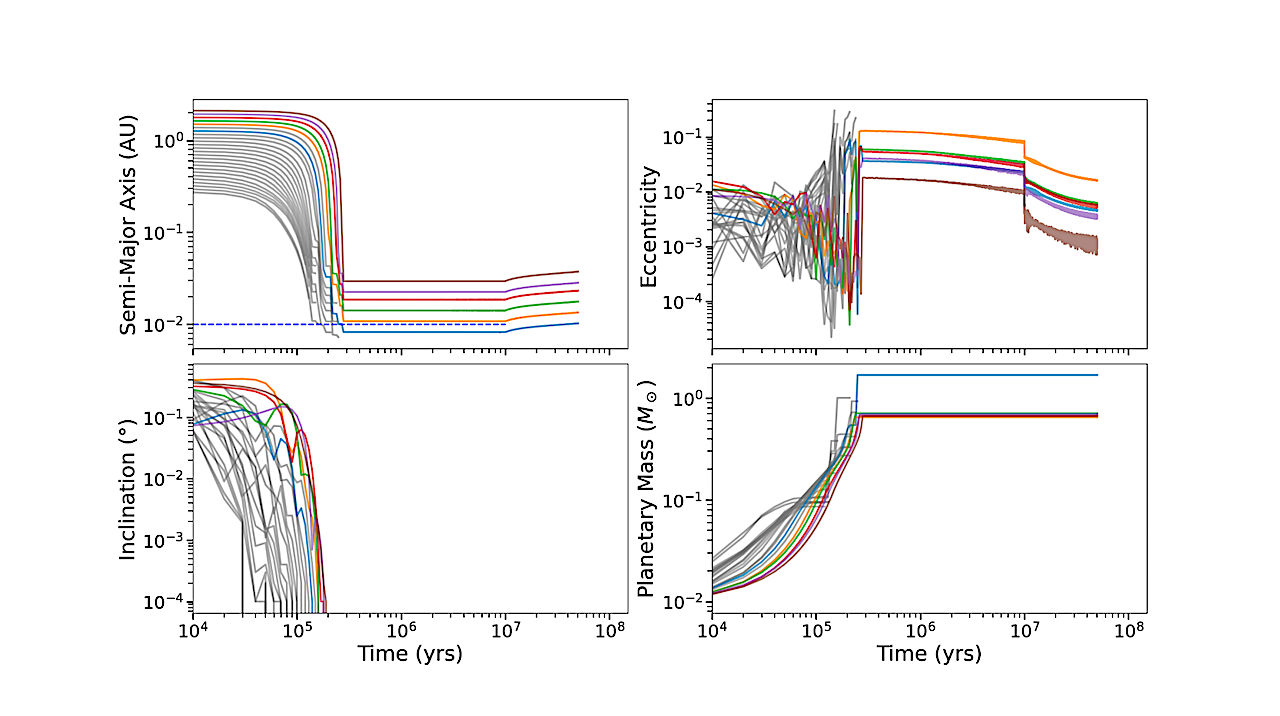

Dynamical evolution of planetary embryos in a representative simulation of Scenario FIX. Each line corresponds to one embryo: gray lines show all embryos, while colored lines highlight those that survive until the end of the integration at ∼ 50 Myr. Panels display the semi-major axis (top left), eccentricity (top right), inclination (bottom left), and planetary mass (bottom right). The horizontal dashed blue line in the semi-major-axis panel marks the fixed inner disk edge at 0.01 au, which is applied only during the gas-disk phase (up to 10 Myr). — astro-ph.EP
Close-in rocky planets are the most common type of exoplanets around late M dwarfs, ranging from more temperate worlds to highly irradiated lava planets with molten surfaces, and many theoretical studies have attempted to explain their formation.
However, the origin of rocky planets with orbital periods shorter than one day, known as ultra-short-period (USP) planets, remains uncertain.
We aim to investigate whether the formation and survival of USP planets is connected to the location of the inner edge of the protoplanetary disk, considering different disk edge prescriptions.
We use N-body simulations that include planet-disk interactions, star-planet tidal interactions, and relativistic corrections, applied to a sample of lunar-mass planetary seeds growing via pebble accretion in a low-viscosity disk (αt=10−4).
The inner edge of the disk is modeled in three ways: as a fixed close-in edge, as an outward-evolving edge set by the magnetospheric truncation radius, and as an inward-evolving edge defined by the corotation radius. USP planet formation appears to be tightly controlled by the location of the disk’s inner edge.
Our simulations show that only the close-in-fixed-edge Scenario and the inward-evolving-edge Scenario are capable of producing USP planets, as planets tend to follow the movement of the disk’s inner edge. This suggests that USP planet formation is favored when the inner edge remains close to the corotation radius of a rapidly rotating star.
S. N. Brandenberger, M. Sanchez, N. Van der Marel, A. A. Vidotto, Y. Miguel
Comments: Accepted for publication in Astronomy & Astrophysics
Subjects: Earth and Planetary Astrophysics (astro-ph.EP)
Cite as: arXiv:2603.26204 [astro-ph.EP] (or arXiv:2603.26204v1 [astro-ph.EP] for this version)
https://doi.org/10.48550/arXiv.2603.26204
Focus to learn more
Submission history
From: Saphira Natalie Brandenberger
[v1] Fri, 27 Mar 2026 09:26:38 UTC (3,707 KB)
https://arxiv.org/abs/2603.26204
Astrobiology, exoplanet,










Related Posts

Stay Informed With the Latest & Most Important News


Advertisement
-
 01Two Black Holes Observed Circling Each Other for the First Time
 -
 02From Polymerization-Enabled Folding and Assembly to Chemical Evolution: Key Processes for Emergence of Functional Polymers in the Origin of Life
 -
 03Astronomy 101: From the Sun and Moon to Wormholes and Warp Drive, Key Theories, Discoveries, and Facts about the Universe (The Adams 101 Series)
 -
 04True Anomaly hires former York Space executive as chief operating officer
 -
 05Φsat-2 begins science phase for AI Earth images
 -
 06Hurricane forecasters are losing 3 key satellites ahead of peak storm season − a meteorologist explains why it matters
 -
 07Binary star systems are complex astronomical objects − a new AI approach could pin down their properties quickly