
Now Reading: Military space programs confront hidden supply constraints
-
01
Military space programs confront hidden supply constraints


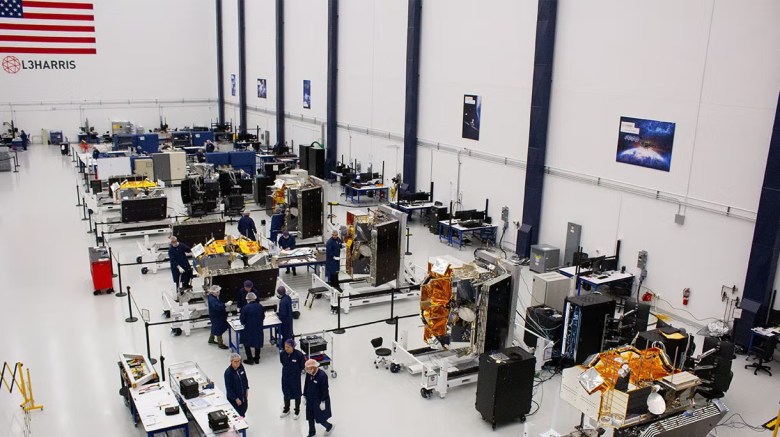
While the Pentagon’s push to rebuild the nation’s industrial base has centered on missiles, munitions and shipyards, another set of vulnerabilities is emerging: the supply chain that underpins U.S. military satellites.
As the Space Force envisions accelerated satellite production, officials are warning that key parts of the space industrial base may not be mature enough to keep up.
A surge of private capital into commercial space ventures has created the perception of a revitalized sector. Yet inside national security programs, concerns persist over the availability of highly specialized components, including optical inter-satellite communication terminals, infrared sensor arrays and radiation-hardened microelectronics.
The vulnerabilities often lie beyond the large defense contractors that assemble satellites. Instead, officials say, the risks are concentrated among smaller, lower-tier suppliers that can remain mostly invisible until a disruption halts production.
That lack of visibility poses a growing challenge for the Space Force, which is shifting its doctrine toward treating satellites as replaceable assets rather than scarce, long-lived systems. The concept depends on the ability to surge production quickly — an approach analogous to stockpiling munitions or maintaining a war reserve.
But unlike traditional weapons systems, the supply chain for space hardware is more difficult to map, raising questions about whether such a surge capacity is likely.
Maj. Gen. Stephen Purdy, a senior space acquisition adviser to the Secretary of the Air Force, has argued that the issue goes beyond logistics.
“The supply chain is a domain of war,” Purdy said.
Bottlenecks in constellations
Supply chain strains in recent years became particularly visible in the Space Development Agency’s Proliferated Warfighter Space Architecture, a network of satellites in low Earth orbit designed to support missile tracking and communications. The constellation is projected to cost nearly $35 billion through fiscal year 2029.
The agency’s acting director, GP Sandhoo, said at the SmallSat Symposium in February that supply chain constraints continue to hurt the program after seemingly routine control systems failed to pass the necessary inspections, revealing the struggle government and commercial operators face.
The most significant bottlenecks involve optical communications terminals — systems that enable laser crosslinks between satellites — as well as encryption devices used to secure data.
Sandhoo also pointed to challenges in satellite checkout, the post-launch process used to verify that spacecraft subsystems and payloads are functioning properly before entering operational service.
Traditional military satellite programs typically perform checkout on one or two spacecraft at a time. The new architecture requires verifying dozens.
“In the first deployment of PWSA satellites in 2024, the biggest challenge we had was the buses, which were supposed to be a commodity, and none of them were,” Sandhoo said. “They all had challenges. Every single one of them.” The agency’s first deployment, known as Tranche 0, included satellites made by L3Harris, Lockheed Martin, York Space and SpaceX.
In some cases, guidance, navigation and control systems and thermal control systems did not perform as expected. “These issues are supposed to be easy,” he said.
Investment gaps in components
Industry analysts say the areas most in need of investment are often not the headline technologies that attract attention from policymakers or venture capital.
Jamie Morin, vice president of defense strategic space at Aerospace Corp., said investors need clearer signals from the government about where the industrial base has gaps.
“Areas where the national security space enterprise really needs private sector investment are not necessarily the highest profile mission areas that are getting lots of mentions in senior leader speeches and in news articles,” Morin told SpaceNews.
“We still have challenges in building at large scale, the high reliability, high precision valves we need for satellites, that’s still a gap,” he said, adding that longstanding weaknesses remain unresolved. “We still have a fragile, solid rocket motor industrial base. We still have key challenges in microelectronics for space at scale.”
Morin said Aerospace is “going to try to help the government get clearer demand signals out to the finance sector of what future government purchases might look like in some of these critical technology areas.”
“If we’re going to ramp up the scale of U.S. space activity even more dramatically than we have in the last several years, we’re going to hit a whole bunch of critical constraints in the industrial base.”
The fragmented nature of the space market complicates the picture, said Morin. “It’s a complex market that they’re selling across.” Government leaders often describe demand in terms of large programs, but determining how that demand translates into orders for specialized suppliers “is a different and deeper problem.”
Concerns about supply-chain vulnerabilities across the defense sector have drawn attention on Capitol Hill as well.
Rep. Rob Wittman (R-Va.), vice chairman of the House Armed Services Committee, said the issue is expected to feature prominently as lawmakers begin shaping the fiscal 2027 National Defense Authorization Act.
“One of the things in this year’s NDAA is going to be a focus on how we grow the industrial base, and how we make sure that we grow it at all levels, with the foundational framework being the supplier base,” Wittman said at the recent National Security Innovation Base conference hosted by the Ronald Reagan Institute.
“In many places we have single points of failure,” he said. “You can talk about growing the small and mid tier and primes, but you don’t grow that without growing those supplier companies.”
Logistics system catching up
Within the military, the Defense Logistics Agency manages the Pentagon’s global supply system, purchasing and distributing millions of spare parts, raw materials and components.
For decades, space logistics were embedded largely within the Air Force’s supply structure. With the creation of the Space Force and a surge in space programs, the agency is now working to identify and track the distinct supply demands associated with satellites and launch systems.
The effort is complicated by the way demand is recorded. Components are tracked through supply-chain coding systems, and it is unclear whether space-related demand has been consistently categorized.
“Our analytics are only as good as the data that is ingested in them,” Maj. Gen. David Sanford, director of logistics operations at the Defense Logistics Agency, said at the Air & Space Forces Association’s warfare conference. “You have to have it coded properly so that we’re looking at the right data. We are still working through that.”
Fuel is one example. Hydrazine, commonly used in spacecraft propulsion, is monitored by the agency to ensure sufficient supply not only for current launches but also for possible wartime demand.
“If there’s a fight, there’s going to be some on-orbit losses,” Sanford said. Replacement components and fuel must be available if satellites need to be rebuilt quickly.
Bradley Leonard, director of installations, logistics and product support at Space Systems Command, said the government also faces a visibility problem because much of the supply data is held by contractors in proprietary databases.
The plan, he said, is to work more closely with industry “to make sure that we have that overall visibility into that data … so that we have the total picture of where the entire supply chain is.”
Managing supplier risk
Defense contractors say they are trying to reduce vulnerabilities by expanding supplier networks and investing in smaller companies.
Lockheed Martin, which works with thousands of vendors, uses its venture arm to support firms that could otherwise become bottlenecks in the satellite supply chain.
Jeff Schrader, vice president of strategy and business development at Lockheed Martin Space, said investments are often aimed at companies working in propulsion, spacecraft subsystems and communications hardware.
“Instead of doing a ton of sole source, which I think has hurt a number of programs … we are looking at supplier diversification,” Schrader said. That can mean supporting two or three vendors so “in case one gets behind.”
Voyager Technologies, a space and defense firm involved in NASA and military programs, warned of supply risks in a recent filing with the Securities and Exchange Commission.
“At times, we rely on a single vendor or a limited number of vendors to provide certain key products or services and the inability of these key vendors to meet our needs could have a material adverse effect on our business,” the company said in an email.

“Our manufacturing operations depend on specific technologies and companies for which there may be a limited number of vendors,” Voyager added. “While alternative sources for these products, services and technologies may exist, we may not be able to develop these alternative sources quickly and cost effectively, which could materially impair our ability to operate our business.”
Like other aerospace and defense contractors seeking to strengthen their supply chains, Voyager has moved to acquire suppliers and specialized technology firms. Over the past year the company has completed several deals, including the $93 million acquisition of spacecraft propulsion and space structures specialist ExoTerra Resource, the $64 million purchase of energetics and propulsion materials supplier Estes Energetics, the $33 million acquisition of synthetic aperture radar data exploitation firm ElectroMagnetic Systems, and the $9.5 million purchase of precision optics specialist Optical Physics.
Growth outpacing capacity
A new report from Aerospace Industries Association (AIA) and the consulting firm PwC highlighed systemic supply-chain problems.
“The industry’s supply network, built for smaller volumes and slower production cycles, is struggling to keep pace,” said Steve Jordan Tomaszewski, vice president of space systems at AIA.
Among the issues cited by the authors are inconsistent funding and demand signals.
Government space procurement fluctuates with budget cycles, policy changes and funding disruptions, Tomaszewski said, making it difficult for companies to justify large manufacturing investments.
“Every time we have a government shutdown or a continuing resolution, it makes it more difficult for companies to invest,” he said.
The Space Foundation estimated that the global space economy hit a record $613 billion in 2024, with government customers representing roughly one-fourth of the demand. Yet that demand can be unpredictable, Tomaszewski noted.
The Space Development Agency’s shift to proliferated constellations provides long-term forecasts, the AIA report pointed out, but can also create sudden demand surges tied to contract timing and production readiness.
The report identifies switchgear, transformers, valves, actuators, connectors and integrated circuits as high-impact bottlenecks. Optical inter-satellite links — key components that enable satellites to exchange data through laser communications — are particularly constrained because the number of suppliers is small and the underlying parts supply chain is complex.
The stakes are high if satellites are disabled in a conflict and the Pentagon needs replacements quickly.
“These things don’t grow on trees,” Tomaszewski said. “You really have to have enough foresight about the demand, the contingent scenarios, what you would need to replace in wartime.”
In the space sector, he added, “these types of questions really haven’t been properly addressed and unpacked.”
Recent geopolitical events have illustrated how fragile certain supply sources can be.
One example involved xenon, a propellant used in electric propulsion systems on many satellites. After Russia invaded Ukraine in 2022, supply disruptions emerged as Russia and Ukraine together accounted for a large share of global output.
The disruption did not halt satellite programs, but it underscored how specialized materials often produced in small volumes can become strategic chokepoints.
Seeking greater visibility
To address these risks, AIA recommends that the Space Force and NASA create a shared platform linking government demand signals with verified industrial capacity across the supplier network.
For the military, the challenge is particularly acute because most spacecraft require specialized parts.
“Supply chains for spacecraft are very unique, especially when we start talking about the unique environment that we operate in,” said Col. Bryon McClain, program executive officer for space combat power at Space Systems Command.
As the Space Force accelerates procurement of next-generation satellites, the availability of radiation-tolerant electronics remains a central concern.
Chris Long, deputy general manager for space, cyber and intelligence at General Dynamics Mission Systems, said securing those components often requires buying parts far in advance.
“For low Earth orbit spacecraft, there’s more parts that are more resilient to radiation, but even in those orbits, we see some issues,” Long said.
Prime contractors are always searching for alternative suppliers, he said. “One of the things that we do at conferences is we walk around and we find anybody that we can find that we think has some other alternatives, and then we invest in them.
“It’s really making sure that you have some backups.”
This article first appeared in the April 2026 issue of SpaceNews Magazine.










Related Posts
Stay Informed With the Latest & Most Important News
Previous Post
Next Post



Advertisement
-
 01Two Black Holes Observed Circling Each Other for the First Time
 -
 02From Polymerization-Enabled Folding and Assembly to Chemical Evolution: Key Processes for Emergence of Functional Polymers in the Origin of Life
 -
 03Astronomy 101: From the Sun and Moon to Wormholes and Warp Drive, Key Theories, Discoveries, and Facts about the Universe (The Adams 101 Series)
 -
 04True Anomaly hires former York Space executive as chief operating officer
 -
 05Φsat-2 begins science phase for AI Earth images
 -
 06Hurricane forecasters are losing 3 key satellites ahead of peak storm season − a meteorologist explains why it matters
 -
 07Binary star systems are complex astronomical objects − a new AI approach could pin down their properties quickly