
Now Reading: Artemis 2 ready to fly around the moon
-
01
Artemis 2 ready to fly around the moon


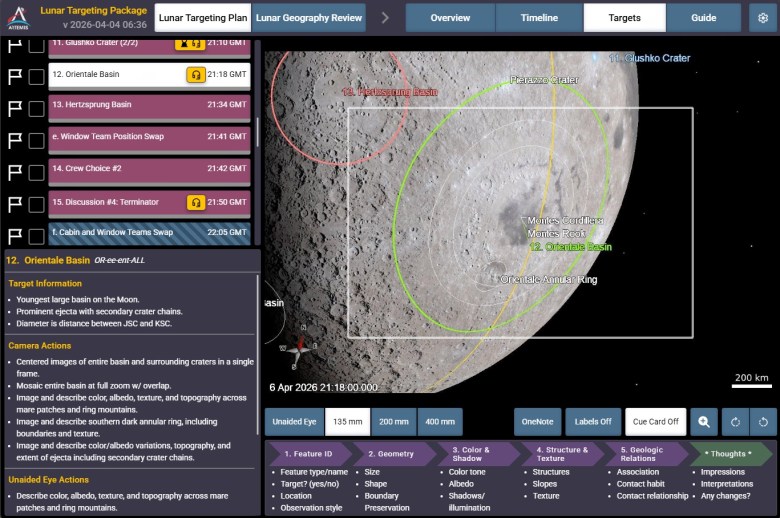
WASHINGTON — The Artemis 2 mission will swing around the moon April 6, setting a distance record as astronauts study part of the lunar farside.
The Orion spacecraft performed a trajectory correction maneuver at 11:03 p.m. Eastern April 5, firing auxiliary thrusters on its service module for 17.5 seconds. The maneuver was officially designated Outbound Trajectory Correction-3, but was the first such maneuver after controllers canceled the first two planned burns because of the accuracy of the spacecraft’s trajectory.
That maneuver lined up Orion for its flyby of the moon on April 6. The spacecraft entered the lunar “sphere of influence,” where lunar gravitational forces exceed those from Earth, at 12:41 a.m. Eastern.
At 1:56 p.m. Eastern, Artemis 2 will break the record for the furthest distance humans have traveled from Earth, set by the Apollo 13 mission in 1970 at 400,171 kilometers. The spacecraft will reach its furthest distance from the Earth at 7:07 p.m. Eastern, at 406,778 kilometers. Five minutes before that, Orion will make its closest approach to the lunar surface, at 6,550 kilometers.
On the outbound leg of the Artemis 2 trajectory, the four-person crew has been working on various tests, which recently included a manual piloting demonstration as well as seeing how quickly they can get into their spacesuits in the microgravity environment in the event of an emergency.
The crew also prepared for the lunar flyby, where they will spend about seven hours observing the moon during that closest approach. At an April 5 briefing, Kelsey Young, lunar science lead for Artemis 2, said the mission’s science team had finalized that observing plan and uploaded it to the crew for their review.
“This is just a guide. They are the field scientists, and they’re encouraged to go look at what they’re seeing in front of them, what compels them,” she said. The science plan includes “crew choice” targets that are up to the astronauts to decide to observe.

In early phases of planning for the flyby, scientists proposed having the astronauts observe different regions of the moon every five to six minutes. “That was pretty fast, and didn’t allow them time to settle into the observation,” she said. “The longer they look at the moon, the more their eyes adjust and the more they’re able to discern.”
Under the current plan, astronauts will spend at least eight minutes looking at each region of the moon, with some observations scheduled for up to 20 minutes. For the first five hours of the flyby, when illuminated regions of the moon are in view, the crew will work in pairs: Reid Wiseman and Jeremy Hansen as one team and Victor Glover and Christina Koch as the other. One pair will focus on observing while the other assists.
They will swap places hourly. “That way, they keep fresh with what they’re doing,” Young said. After that five-hour block, there will be a one-hour break before a final hour of observations when the moon eclipses the sun.
On the ground, the science team will be monitoring the flyby in an evaluation room near Mission Control. “You’re going to see some very excited scientists,” she said, including regular discussions between the astronauts and the science team. “We’ll be able to have a bit of a science dialogue.”
While the mission has 10 science objectives for the flyby, part of it is also gaining experience for future, longer missions at the moon. Young said that on the Artemis 2 flyby, it’s unlikely scientists will ask the crew to deviate significantly from the prepared plan of observations.
“When we have longer stays, both in orbit and on the lunar surface, that longer-term presence will enable us to flex the plan,” she said, allowing astronauts to “audible” based on what they see. “Tomorrow, the science evaluation room is going to have that future in mind. They’re going to be listening to what the crew has to say and they’re going to be passing up follow-up questions.”
The Orion spacecraft has been performing well so far, with only minor issues. That has included the spacecraft’s toilet, although Rick Henfling, an Artemis 2 flight director, said there are “no liens” on the toilet’s use by the astronauts.
“We are still trying to figure out the wastewater vent line problem,” he said, where that line was clogged, apparently by a buildup of ice. “This is a good opportunity to learn now on a shorter mission, and if changes are needed to be made to the spacecraft, we have opportunities before Artemis 3 to make those changes.”
Engineers are also still investigating a mysterious smell in the vicinity of the toilet, but not associated with the toilet itself. The smell is not hazardous, and officials said at an April 4 briefing it might be associated with the outgassing of materials like tape.
Henfling said April 5 that they had yet to correlate the smell to a specific system, noting that it did not appear related to heaters in the area or use of the toilet. “Right now, there isn’t any root cause identified as to what that source is,” he said. “We’re continuing to proceed with the mission and the use of the toilet nominally.”










Related Posts
Stay Informed With the Latest & Most Important News
Previous Post
Next Post

Advertisement
-
 01Two Black Holes Observed Circling Each Other for the First Time
 -
 02From Polymerization-Enabled Folding and Assembly to Chemical Evolution: Key Processes for Emergence of Functional Polymers in the Origin of Life
 -
 03Astronomy 101: From the Sun and Moon to Wormholes and Warp Drive, Key Theories, Discoveries, and Facts about the Universe (The Adams 101 Series)
 -
 04True Anomaly hires former York Space executive as chief operating officer
 -
 05Φsat-2 begins science phase for AI Earth images
 -
 06Hurricane forecasters are losing 3 key satellites ahead of peak storm season − a meteorologist explains why it matters
 -
 07Binary star systems are complex astronomical objects − a new AI approach could pin down their properties quickly