
Now Reading: Ichnofossils in Volcanic Glass From Palaeoproterozoic Hydrothermal Vents Were Burrowed By Microorganisms Probably Seeking Phosphate
-
01
Ichnofossils in Volcanic Glass From Palaeoproterozoic Hydrothermal Vents Were Burrowed By Microorganisms Probably Seeking Phosphate

Ichnofossils in Volcanic Glass From Palaeoproterozoic Hydrothermal Vents Were Burrowed By Microorganisms Probably Seeking Phosphate

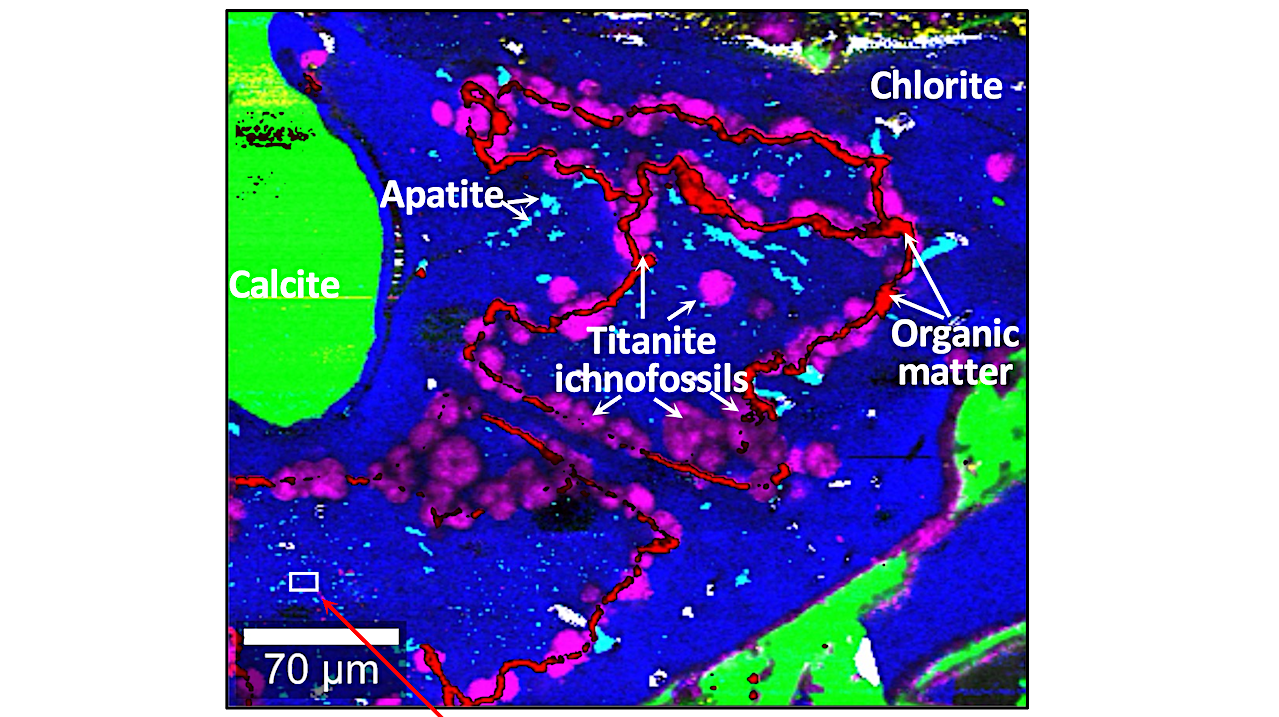
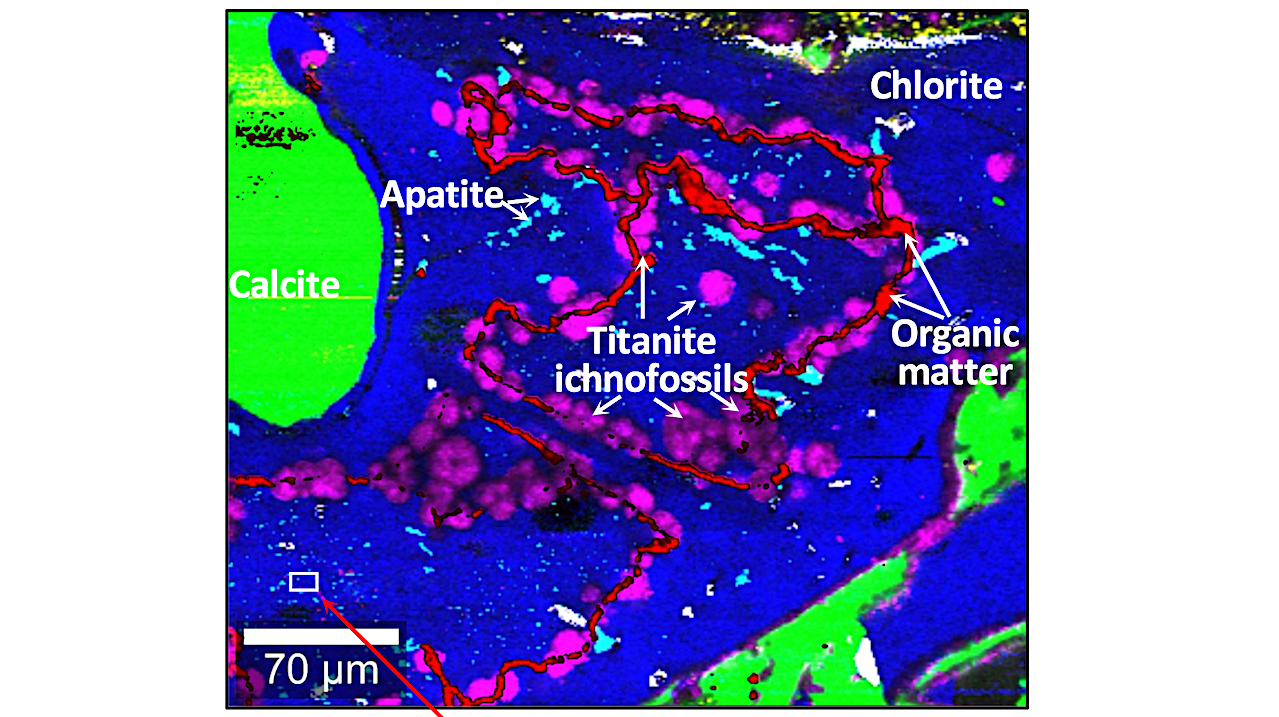
Raman images showing the distribution of OM (red) and titanite (Ttn, purple) inside spheroids immediately adjacent to apatite (Ap, turquoise) and lepidocrocite (Lpc, white) embedded in the basaltic glass fragment composed of chlorite (Chl, blue). Note the surrounding matrix of calcite (Cal, green) does not contain apatite, the presence of microscopic size apatite and of nanoscopic size apatite crystals, and the location of the two regions of interest (ROI) for each. — Nature Communications Earth & Environment
Ichnofossils in basaltic glass are putative microscopic trace fossils occurring on modern seafloor and throughout Earth history. While their biological origin remains debated, it is unknown why microorganisms thrive in volcanic glass.
Here we show ichnofossils associated with biosignatures from sedimentary interbeds of pillow basalt in the ~ 1870 million years old Flaherty Formation, Belcher Group, Canada. These rocks are associated with metre-size, pinnacle-shaped structures of silicified basalt, pahoehoe basalt with paleo-caliche, and isolated pods of gossan indicating shallow marine hydrothermal venting.
Trails of spheroidal ichnofossils composed of titanite and organic matter surround abundant nanoscopic-size apatite and lepidocrocite, suggesting they caused rock dissolution to obtain phosphate. Stable isotopes provide complementary biosignatures for possible chemolithotrophy.
While there is evidence for abiotic carbon-based reactions, the biological origin of spheroidal ichnofossils is supported by 13C-depleted organic matter and calcite, suggesting they were burrowed by microorganisms likely seeking phosphate in volcanic glass near hydrothermal vents.
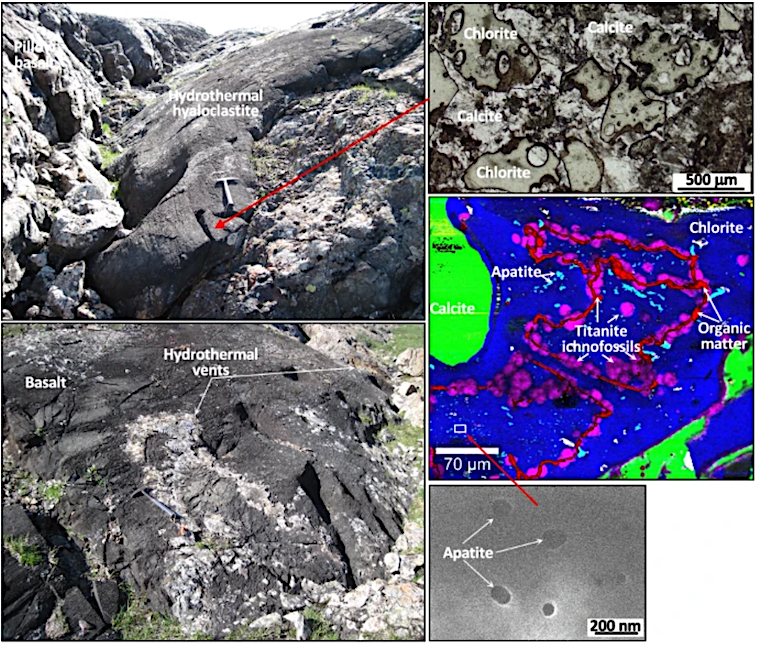
Spheroidal ichnofossils in chloritised basaltic glass fragment from concretionary hyaloclastite associated with nanoscopic apatite and lepidocrocite (BgFl11005B). a) PPL image of volcanic glass fragment from hyaloclastite (BgFl11005B) with a trail of microscopic spheroids and b) magnified spheroids with consistent diameters. c-d) Raman images showing the distribution of OM (red) and titanite (Ttn, purple) inside spheroids immediately adjacent to apatite (Ap, turquoise) and lepidocrocite (Lpc, white) embedded in the basaltic glass fragment composed of chlorite (Chl, blue). Note the surrounding matrix of calcite (Cal, green) does not contain apatite, the presence of microscopic size apatite and of nanoscopic size apatite crystals, and the location of the two regions of interest (ROI) for each. e) Raman spectra of minerals — Nature Communications Earth & Environment
Ichnofossils in volcanic glass from palaeoproterozoic hydrothermal vents were burrowed by microorganisms probably seeking phosphate, Nature Communications Earth & Environment (open access)
Astrobiology, biosignatures, fossil, microbiology,











Related Posts
Stay Informed With the Latest & Most Important News
Previous Post
Next Post



Advertisement
-
 01Two Black Holes Observed Circling Each Other for the First Time
 -
 02From Polymerization-Enabled Folding and Assembly to Chemical Evolution: Key Processes for Emergence of Functional Polymers in the Origin of Life
 -
 03Astronomy 101: From the Sun and Moon to Wormholes and Warp Drive, Key Theories, Discoveries, and Facts about the Universe (The Adams 101 Series)
 -
 04True Anomaly hires former York Space executive as chief operating officer
 -
 05Φsat-2 begins science phase for AI Earth images
 -
 06Hurricane forecasters are losing 3 key satellites ahead of peak storm season − a meteorologist explains why it matters
 -
 07Binary star systems are complex astronomical objects − a new AI approach could pin down their properties quickly