
Now Reading: CO and N2 Produced from H2O, CO2, and NH3 Cometary Ice Analogs
-
01
CO and N2 Produced from H2O, CO2, and NH3 Cometary Ice Analogs


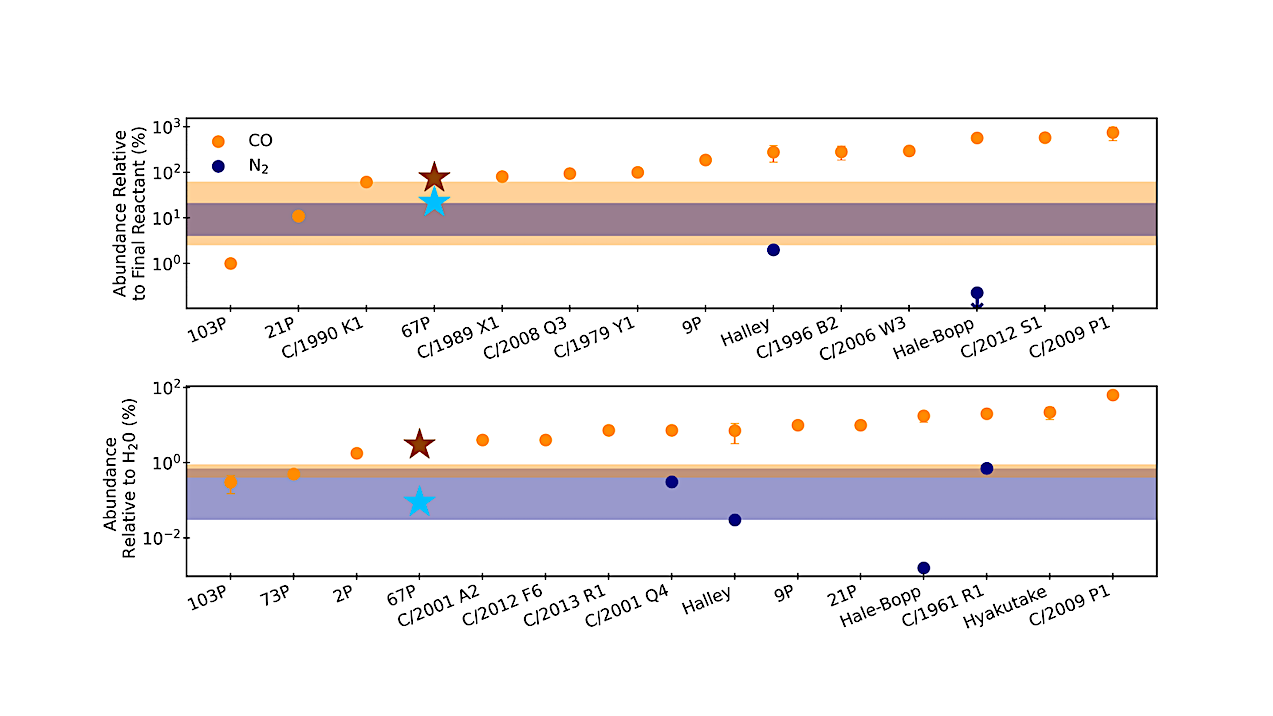
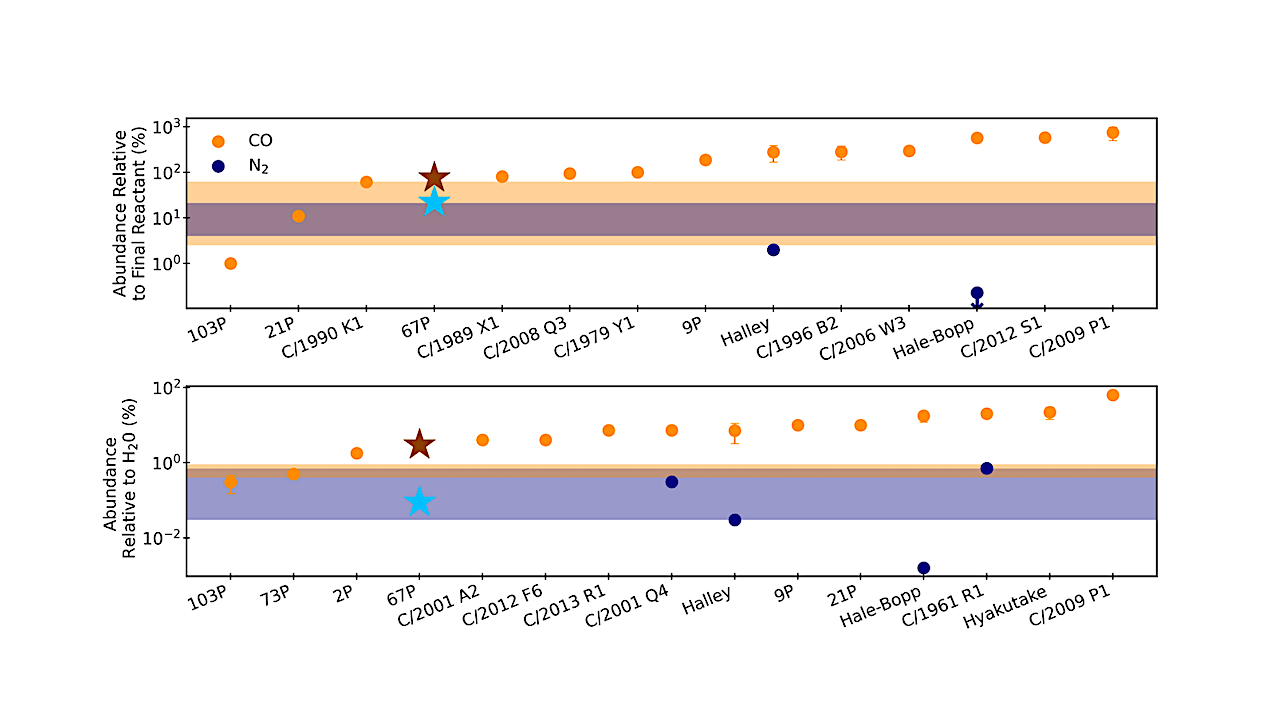
A summary of the CO and N2 reported in various comets with respect to parent molecule (top) and with respect to water (bottom). The CO/CO2 ratios are reported by O. H. Pinto et al. (2022) and references within. N2 abundances with respect to water are directly reported for three of these comets (N. Iro et al. 2003; L. Le Roy et al. 2015; A. J. McKay et al. 2019), and we calculated the N2 abundances for C/2001 Q4 and C/1961 R1 from the N2/CO and CO/H2O ratios compiled by S. Anderson et al. (2023). For Comet 67P, we use the N2 abundance reported by M. Rubin et al. (2019), and the CO, CO2, and NH3 values reported by M. L¨auter et al. (2020). For clarity, we exclude the results from Comet C/2016 R2, which report CO and N2 abundances relative to water of (30800 ± 3500) % and (1550 ± 370) %, respectively (A. J. McKay et al. 2019). Comet 67P markers are star shaped for emphasis. Shaded orange and blue regions represent the CO and N2 abundances reported following photolysis and radiolysis, respectively. Downward-pointing arrows indicate upper limits on reported hypervolatile abundances. — astro-ph.EP
Hypervolatile species such as carbon monoxide (CO) and molecular nitrogen (N2) have been detected in comets, and could be used to constrain comet formation temperature conditions if their presence is due to freeze-out and/or entrapment.
Here we instead explore another plausible origin of cometary hypervolatiles: photodissociation of less volatile species. We characterize CO and N2 formation following ultraviolet (UV) irradiation and electron bombardment of carbon dioxide (CO2), ammonia (NH3), H2O:CO2, H2O:NH3, and H2O:CO2:NH3 cometary ice analogs.
We find that CO and N2 form in all photoprocessed ices at temperatures between 10 K and 100 K, resulting in 0.4-0.9 % CO and 0.03-0.7 % N2 relative to water, and CO/CO2 and N2/NH3 mixing ratios of 2.5-62 % and 0.7-9 %, respectively, across the experiments.
Because our initial ices are reasonably well-matched to interstellar ices and we use UV exposure similar to a dark cloud, we can compare the resulting ratios directly to cometary abundances.
Such a comparison shows that while only a few of CO observations in comets are readily explained by photodissociation, almost all observed cometary N2 can be accounted for by photodissociation of NH3 embedded in water ice. The latter result is also consistent with observed similarly elevated isotopic ratios of N2 and NH3 in 67P.
Taken together, our results suggest that N2/H2O ratios less than 1 % should be used cautiously when inferring a comet’s formation location, while the more substantial CO abundances seen in many comets do likely imply entrapment at low ice temperatures.
Alexandra McKinnon, Alexia Simon, Michelle R. Brann, Elettra L. Piacentino, Karin I. Oberg, Mahesh Rajappan
Comments: Accepted for ApJ
Subjects: Earth and Planetary Astrophysics (astro-ph.EP); Instrumentation and Methods for Astrophysics (astro-ph.IM); Solar and Stellar Astrophysics (astro-ph.SR); Chemical Physics (physics.chem-ph)
Cite as: arXiv:2604.03207 [astro-ph.EP] (or arXiv:2604.03207v1 [astro-ph.EP] for this version)
https://doi.org/10.48550/arXiv.2604.03207
Focus to learn more
Related DOI:
https://doi.org/10.3847/1538-4357/ae53e1
Focus to learn more
Submission history
From: Alexandra McKinnon
[v1] Fri, 3 Apr 2026 17:32:12 UTC (4,635 KB)
https://arxiv.org/abs/2604.03207
Astrobiology, Astrochemistry,










Related Posts
Stay Informed With the Latest & Most Important News
Previous Post
Next Post

Advertisement
-
 01Two Black Holes Observed Circling Each Other for the First Time
 -
 02From Polymerization-Enabled Folding and Assembly to Chemical Evolution: Key Processes for Emergence of Functional Polymers in the Origin of Life
 -
 03Astronomy 101: From the Sun and Moon to Wormholes and Warp Drive, Key Theories, Discoveries, and Facts about the Universe (The Adams 101 Series)
 -
 04True Anomaly hires former York Space executive as chief operating officer
 -
 05Φsat-2 begins science phase for AI Earth images
 -
 06Hurricane forecasters are losing 3 key satellites ahead of peak storm season − a meteorologist explains why it matters
 -
 07Binary star systems are complex astronomical objects − a new AI approach could pin down their properties quickly