
Now Reading: Earth observation operators push to deliver satellite images within minutes
-
01
Earth observation operators push to deliver satellite images within minutes


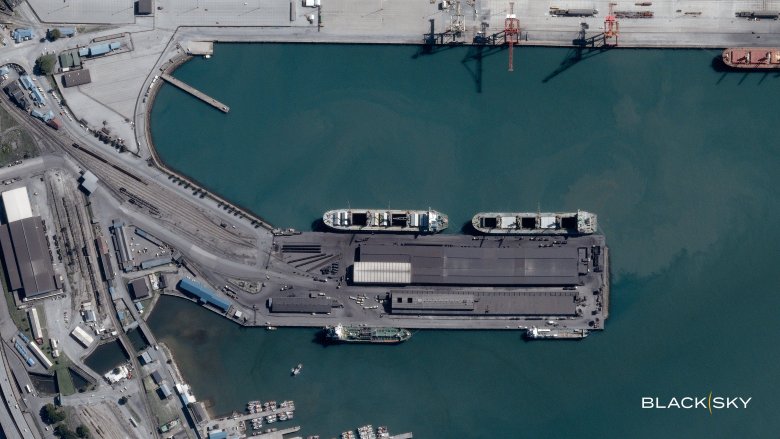
Vantor employees were gathered for a sales kickoff in January, when an executive announced that a WorldView Legion satellite passing overhead would snap a photo of the California venue. Later, a buzzer sounded to alert the audience that the 30-centimeter-resolution image was available on the Vantor Hub portal. It had been 13 minutes.
The demonstration was meant to show how quickly satellite imagery can move from collection to delivery — since commercial and government customers want data quickly.
Data latency, the time between image capture and delivery, has long been a key metric for Earth observation customers. But expectations are shifting as customers want intelligence they can use in real time.
Two years ago, government customers called for image delivery in 90 minutes or an hour. Now, those same offices are pushing contractors to provide data in minutes, industry executives said.
“We’re seeing strong calls from both the U.S. government and international partners for it to be sub-20 minutes or sub-10 minutes,” said Jen Templeton, Vantor’s vice president for tasking.
The shift reflects a growing reliance on satellite imagery in operations where speed determines the value of the data.

“This information is being used more and more to drive tactical decisions,” Emiliano Kargieman, Satellogic founder and CEO, said in an interview.
The rate and breadth of applications for Earth imagery have “increased as conflicts around the world have escalated,” James Mason, Planet chief space officer, said by email. “From shorter news cycles to the integration of AI to increasingly dynamic geopolitics, the world is getting faster — quickly.”
Speed matters
To meet growing demand for immediate and continuous data delivery, companies are scrutinizing every aspect of their businesses from satellite design and construction to launch, commissioning, tasking, ground-station networks and image processing.
“Latency has to be driven across your whole architecture: your planning, your ability to operate the system, your ability to process and exploit that information, transport it to where it needs to be and then do it again,” Nick Merski, BlackSky chief operating officer, said in an interview.
BlackSky’s fourth Gen-3 satellite, launched March 5, began gathering first-light imagery within hours of reaching orbit and was fully commissioned in less than a week. BlackSky has touted that by bringing new satellites online it can help organizations “monitor activity, respond to emerging events and compress the decision cycle.”
BlackSky also maintains radio-frequency links with satellites to accelerate tasking and confirm that imagery was obtained.
“Was it a successful image capture, or do we need to plan another one immediately?” Merski asked. “Those are the types of insights that you need to keep latency low, but also to keep that decision cycle going. It’s latency from one decision to another. It’s not just about moving the data around. It’s about acting on it and determining what you do next.”
For downlinks, BlackSky maintains a distributed, global network of ground stations and delivers imagery directly to customer ground stations, “which is incredibly important for some of our more demanding customers,” Merski said.
Cloud processing
Another strategy to help customers obtain imagery quickly is eliminating backhaul, which is what Vantor’s Direct Access Program is doing.
“We deploy an entire physical infrastructure to a customer’s environment alongside an antenna so that they can handle their own order, uplink to the satellite, downlink and process on-site,” Templeton said. “The Direct Access Program today can do all of that in a 15- to 20-minute timeline, no problem.”
Recently, since customers want rapid deliveries without the infrastructure, Vantor engineers studied the path imagery travels on the ground before reaching customers.
By eliminating the backhaul and processing data in the cloud-based infrastructure of antenna-as-a-service providers, Vantor WorldView Access is clocking deliveries in 11 to 15 minutes for an unnamed customer. “There’s a lot of interest from other customers as well,” Templeton said.
Adapting on the fly
While every customer wants speedy access to imagery, the trick is determining “how fast is fast enough because cost and operational complexity increase as latency decreases,” Mason said. “Historically, requirements are driven by that intersection: which applications require fast latency, and who’s willing to pay and can handle/act on that fast data?”
Overall, though, most customers want data faster than ever. To meet the demand, Planet is “continuously improving aggregate global latency, and developing targeted solutions like Direct Access and AI Edge Compute to analyze imagery and deliver insights in minutes,” Mason said. “These will enable us to more effectively conduct traditional activities, like improved maintenance of ship custody, or actively managing firefighting and disaster relief efforts from space.”
To further reduce latency to minutes, Planet is “boosting our revisit times, expanding our ground station network, and exploring exciting new tech and hardware opportunities such as inter-satellite connectivity,” Mason said. “This multilayered approach provides a flexible, software-definable architecture, allowing us to very quickly adapt our operations to the needs of our customers as they continue to evolve in this dynamic moment in time.”
Brave new world
Satellogic’s NextGen satellites, scheduled to reach orbit next year to image the Earth at a 30-centimeter resolution, will be equipped with AI edge-computing devices. Through onboard processing, the NextGen satellites could help customers detect patterns, anomalies or objects.
By pairing that capability with intersatellite links, “you’re suddenly in the place where you can start delivering alerts and image chips to customers in a matter of minutes from capture, which is a brave new world in terms of capabilities,” Kargieman said.
With intersatellite links on two satellites, Satellogic is examining its ability to transmit instructions. For example, the satellite that passes over a site first can task the following satellite to capture additional imagery.
“In this test, we are able to deliver data within a couple of minutes of capture,” Kargieman said. “Now, not every image needs to be delivered at that speed. But obviously it’s a tool that you can use at the right time.”
This article first appeared in the April 2026 issue of SpaceNews Magazine with the title “Tactical Timelines.”










Related Posts

Stay Informed With the Latest & Most Important News
Previous Post
Next Post




Advertisement
-
 01Two Black Holes Observed Circling Each Other for the First Time
 -
 02From Polymerization-Enabled Folding and Assembly to Chemical Evolution: Key Processes for Emergence of Functional Polymers in the Origin of Life
 -
 03Astronomy 101: From the Sun and Moon to Wormholes and Warp Drive, Key Theories, Discoveries, and Facts about the Universe (The Adams 101 Series)
 -
 04True Anomaly hires former York Space executive as chief operating officer
 -
 05Φsat-2 begins science phase for AI Earth images
 -
 06Hurricane forecasters are losing 3 key satellites ahead of peak storm season − a meteorologist explains why it matters
 -
 07Binary star systems are complex astronomical objects − a new AI approach could pin down their properties quickly