
Now Reading: Relive Artemis 2’s epic moon flyby with these amazing photos
-
01
Relive Artemis 2’s epic moon flyby with these amazing photos


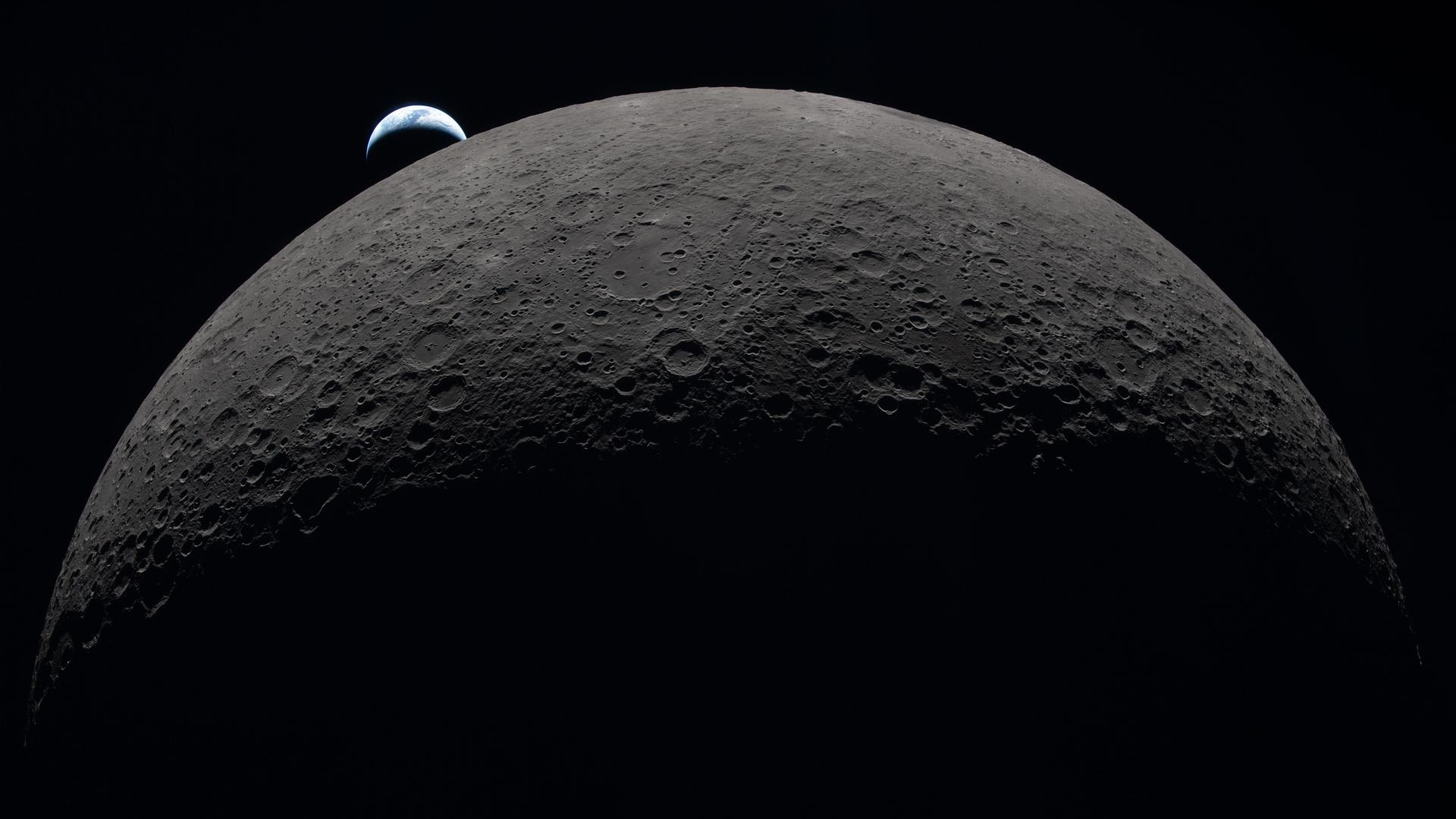
The Artemis 2 astronauts’ photography skills were up to the epic task.
The spaceflyers — NASA’s Reid Wiseman, Victor Glover and Christina Koch, and Canadian astronaut Jeremy Hansen — flew around the far side of the moon on Monday (April 6), something no humans had done since NASA’s Apollo 17 mission back in 1972.
Article continues below

Let’s start with the above photo, which provides a new and mind-bending perspective on our home planet. Have you ever seen it like this, tiny and crescent-shaped, perched above a seemingly huge and dominant moon?
The Artemis 2 crew snapped that spectacular shot a little more than halfway into the flyby on Monday. It captures the moments before Earthset, when our home planet disappeared behind the lunar limb from the astronauts’ perspective. (The photo at the top of this story is also an Earthset shot.)

This flyby photo highlights the Orientale Basin, a 600-mile-wide (965-kilometer-wide) feature known as the “Grand Canyon of the moon.”
Human eyes had never seen Orientale in sunlight before, so the Artemis science team asked the astronauts to observe it very thoroughly. And they did, as Wiseman’s description of one of the basin’s features indicates.
“The annular ring, which I think everybody kind of describes as like a pair of lips or a kiss on the far side of the moon, from here is very circular in nature,” Wiseman, the Artemis 2 commander, radioed to Mission Control.
“The northern part of it is wider, darker; the southern part is much lighter,” he added. “It is very neat-looking — far more circular than I remember it looking in our training.”

The crewmembers also got great looks at the moon’s terminator — not a murderous cyborg roaming the gray landscape but rather the boundary line between day and night on the lunar surface. And it made quite an impression on them, especially Glover.
“Boy, I’m loving the terminator,” he told Mission Control. “I’ve probably spent the most time describing into my recordings and thinking about and looking at the terminator.
“There’s just so much magic in the terminator,” he added. “The islands of light, the valleys that look like black holes — you’d fall straight to the center of the moon if you stepped in some of those. It’s just so visually captivating. The terminator is the most striking thing that I’ve seen so far.”

The astronauts also got looks at parts of the South Pole-Aitken Basin, one of the most dramatic features on the moon. It’s the largest confirmed impact crater in the solar system, stretching more than 1,550 miles (2,500 km) from rim to rim.
And the south polar area is of great interest to scientists and Artemis mission planners. The region is thought to harbor large amounts of water ice, on the permanently shadowed floors of many of its craters. NASA plans to build one or more bases in the area in the 2030s, tapping into that water ice to support crews and to fuel rockets. (Water ice can be split into hydrogen and oxygen, key components of rocket fuel.)

Toward the end of Monday’s flyby, the Artemis 2 astronauts were treated to a rare celestial spectacle: A total solar eclipse, seen from beyond the moon.
The eclipse wasn’t visible to anyone on Earth; it was a consequence of Artemis 2’s trajectory, which happened to line the moon and sun up in the proper way.
And it was very different than solar eclipses seen from our planet. Because the moon loomed so large to the Artemis 2 crew, it blocked out the sun for much longer — about 54 minutes, compared to 7.5 minutes, which is the approximate maximum period of totality for eclipses seen from terra firma.

The crew captured gorgeous photos of the eclipse, including one (shown above) in which Venus is visible. But they went about their business safely, donning eclipse glasses at the proper times, just as we must do here on Earth to protect our eyes.

The Artemis 2 astronauts are now on their way home, helped out by the historic flyby, which served to slingshot them back toward Earthj. They’ll arrive here on Friday (April 10), ending their 10-day mission with a splashdown in the Pacific Ocean off the coast of San Diego.
But they’ll doubtless carry the lunar flyby, and the entire mission, with them for the rest of their lives.
“It was an incredible experience,” Koch said shortly after the flyby. “I just had an overwhelming sense of being moved by looking at the moon.”










Related Posts


Stay Informed With the Latest & Most Important News
Previous Post
Next Post



Advertisement
-
 01Two Black Holes Observed Circling Each Other for the First Time
 -
 02From Polymerization-Enabled Folding and Assembly to Chemical Evolution: Key Processes for Emergence of Functional Polymers in the Origin of Life
 -
 03Astronomy 101: From the Sun and Moon to Wormholes and Warp Drive, Key Theories, Discoveries, and Facts about the Universe (The Adams 101 Series)
 -
 04True Anomaly hires former York Space executive as chief operating officer
 -
 05Φsat-2 begins science phase for AI Earth images
 -
 06Hurricane forecasters are losing 3 key satellites ahead of peak storm season − a meteorologist explains why it matters
 -
 07Binary star systems are complex astronomical objects − a new AI approach could pin down their properties quickly