
Now Reading: Clade Dynamics Support An Early Origin Of Crown Eukaryotes
-
01
Clade Dynamics Support An Early Origin Of Crown Eukaryotes


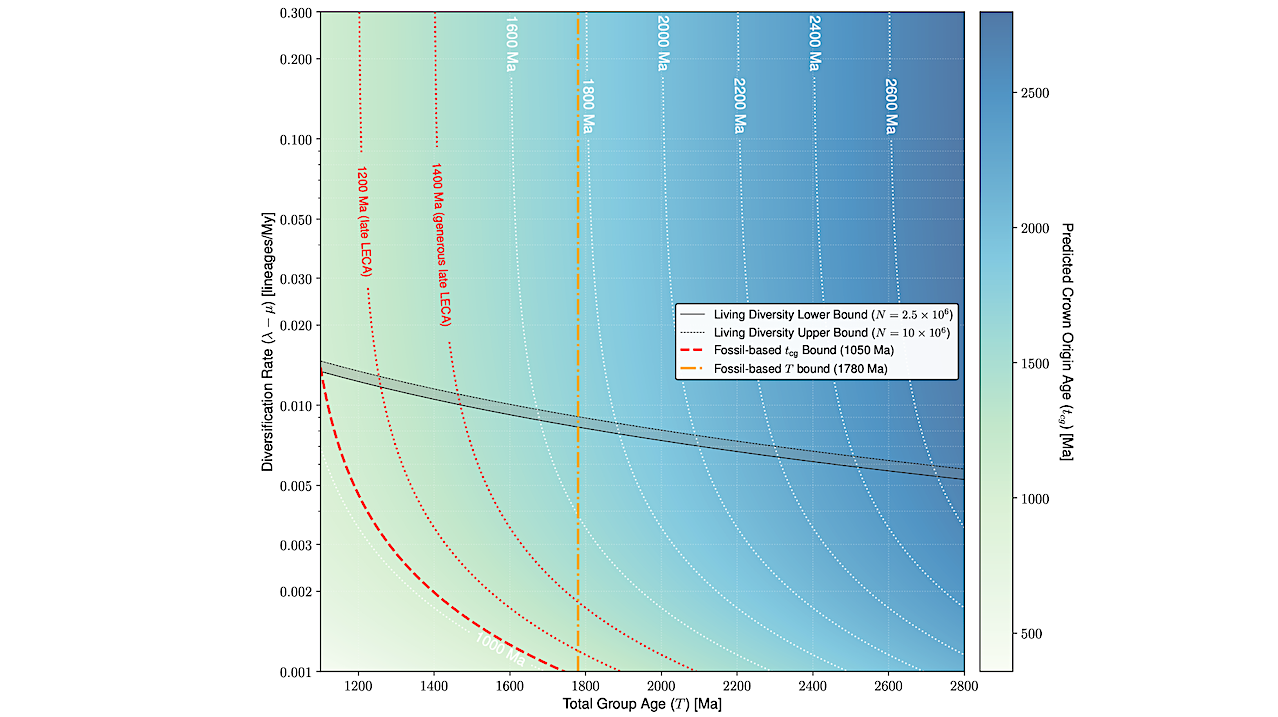
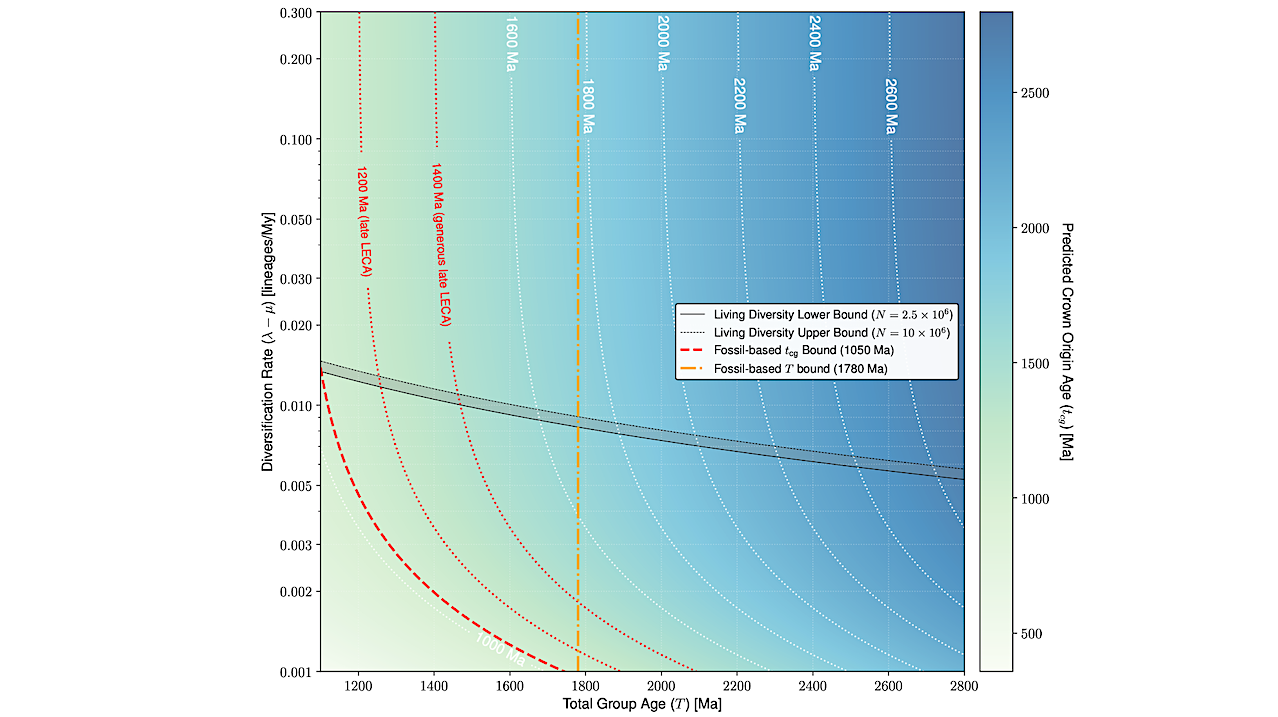
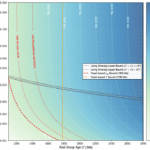
Relationship between total group age T and crown group age tcg across various diversification rates λ − µ, equation 4. The heatmap represents the crown group age for a given rate and total group age (isolines are presented for reference). The orange dot-dashed line is the minimum value for T to fit the observed eukaryotic-grade fossil record of the late Palaeoproterozoic (1780 Ma), the red-dashed isoline is the minimum age for tcg fitting the observed crown-eukaryote fossil record from the end of the Mesoproterozoic (1050 Ma), and the grey interval is the range of possible tcg require to obtain the living diversity for a given rate and total age. The isolines for late LECA (tcg = 1200) or generous late LECA (tcg = 1400 Ma) are the red-dotted lines. — biorxiv.org
The timing of the last eukaryotic common ancestor (LECA) remains a fundamental question in evolutionary biology and palaeontology. Unambiguous eukaryotic-grade fossils appear from 1780 Ma, but no crown-group supergroups are confidently identified before the end of the Mesoproterozoic (ca. 1050 Ma).
The late LECA hypothesis suggests that this absence of crown-assignable fossils and biosignatures implies a late Mesoproterozoic origin of the crown. Here we show that this hypothesis is incompatible with the evolutionary dynamics of the eukaryote clade, even under the limited constraints of the fossil record.
Studying stem-crown dynamics based on a birth-death model, we show that a late crown age requires diversification rates well below the minimum rate needed to generate observed living eukaryote diversity (~2.5 – 10 million species) for any plausible total group age. Our results suggest that only an early LECA can bridge evolutionary dynamics with the eukaryotic-grade fossil record, the living diversity, and the molecular clock estimates.
Based on these constraints, we suggest a feasible minimum age estimate for LECA of ca. 1696 Ma, supported by current fossil evidence and supporting molecular clock estimates. These results also provide a fossil-testable prediction: crown-group eukaryotes likely exist in early Mesoproterozoic assemblages, albeit undetected with current morphology-based approaches.
Clade dynamics support an early origin of crown eukaryotes, biorxiv.org (open access)
Astrobiology, evolution,











Related Posts

Stay Informed With the Latest & Most Important News





Advertisement
-
 01Two Black Holes Observed Circling Each Other for the First Time
 -
 02From Polymerization-Enabled Folding and Assembly to Chemical Evolution: Key Processes for Emergence of Functional Polymers in the Origin of Life
 -
 03Astronomy 101: From the Sun and Moon to Wormholes and Warp Drive, Key Theories, Discoveries, and Facts about the Universe (The Adams 101 Series)
 -
 04True Anomaly hires former York Space executive as chief operating officer
 -
 05Φsat-2 begins science phase for AI Earth images
 -
 06Hurricane forecasters are losing 3 key satellites ahead of peak storm season − a meteorologist explains why it matters
 -
 07Binary star systems are complex astronomical objects − a new AI approach could pin down their properties quickly