
Now Reading: The Zhamanshin Impact Event: Potential Implications for Environmental Responses and Biological Linkages on Earth and Beyond
-
01
The Zhamanshin Impact Event: Potential Implications for Environmental Responses and Biological Linkages on Earth and Beyond

The Zhamanshin Impact Event: Potential Implications for Environmental Responses and Biological Linkages on Earth and Beyond

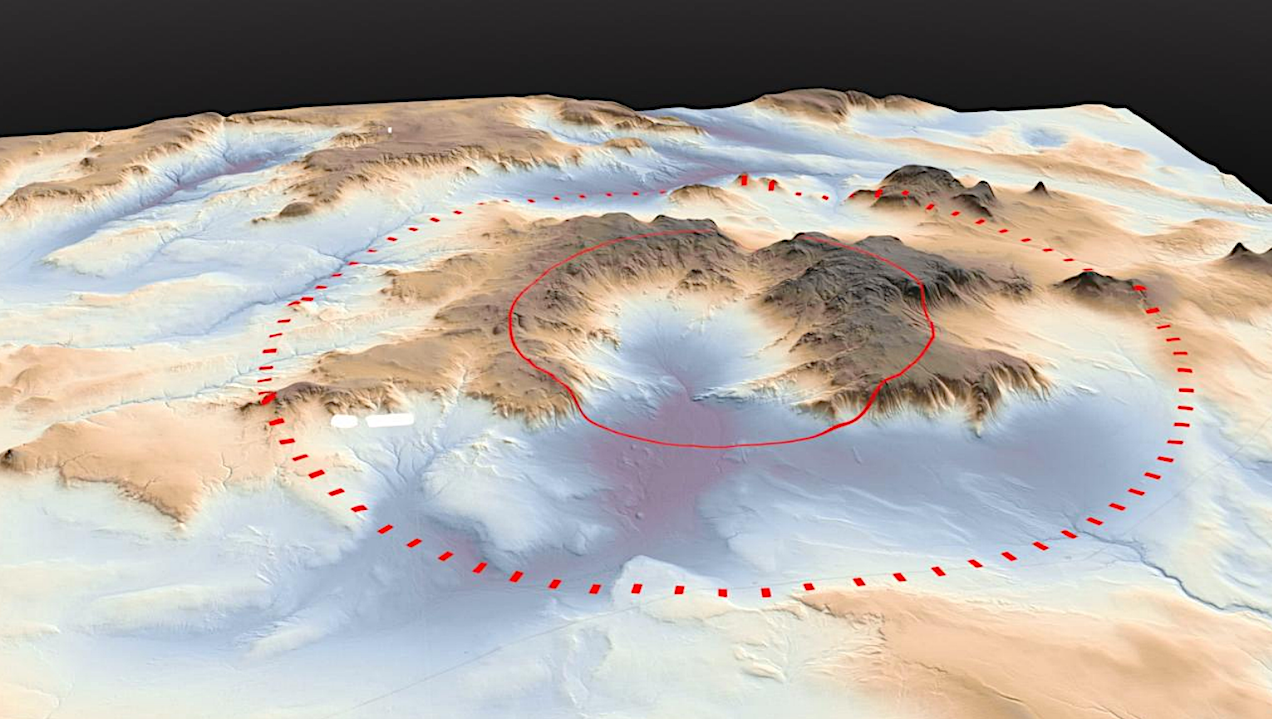
Oblique perspective view from southeast of the 2 m EarthDEM dataset (Figure 4) showing the topology of the impact structure with the 26.4-26.8 km predicted outer tectonic rim in red dashes. The width of the red dashes represents the 400 m prediction interval. The solid red line indicates the 12.5 km inner ring diameter. Note the correlation of drainage directional changes with the dashed red outer ring computed via the Radial Profile analysis System in this view. — astro-ph.EP
At least one large-body (diameter > 1.1 km) hypervelocity cratering event occurred during ~ 0.8-0.90 Ma (Zhamanshin, Kazakhstan) in the Middle Pleistocene Transition period.
Analysis designed to reduce uncertainty in the dimensions of the Zhamanshin structure employing high resolution topography demonstrated that it likely generated a ~ 26.5 km diameter multi-ring crater.
This is at least two times larger than the current best estimates. Using a range of accepted impactor sizes, velocities, compositions, and angles of impact, such impacts typically yield kinetic energies of impact over 240,000 Megatons (TNT).
Explosive energetic events of this magnitude (e.g., Yellowstone Caldera) at other times (K-Pg) have created global environmental effects. The factor of two discrepancy in the dimensions of Zhamanshin increases the kinetic energy yield by factors of 7-10, with significantly larger environmental consequences.
This justifies examination of rapid climate transitions linked to biological consequences, including those related to environmental perturbations, at ~0.9 Ma.
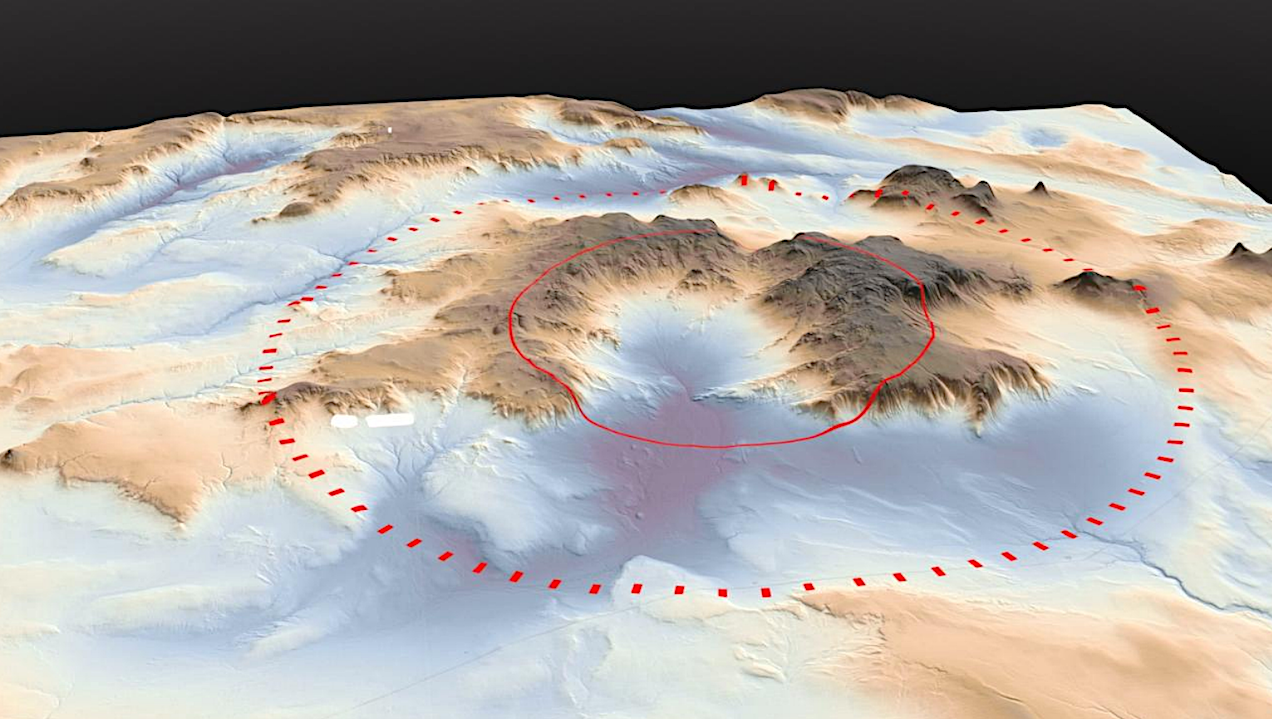
Highest spatial resolution surface elevation data (2 m x,y) EarthDEM of the Zhamanshin area with a dashed red predicted outer ring as the putative tectonic rim with width of the red dashes representing the range of solutions (~400 m long). Color scale covers a ~120 m range of local topography, with an apparent inner ring at 12.5 km (not shown). Note breaks in slope in the high-resolution DEM with termination of drainages and associated features around the location of the putative outer rim at ~26.4 km as discovered via the Radial Profile Analysis System. See Appendix 1 for ground views of regions where the red dashes denote expression of an outer rim. — astro-ph.EP
James B. Garvin, Connor J. Anderson, Katherine A. Melocik, Devin R. McClain, Scott S. Sinno, Myoung-Jong Noh, Compton J. Tucker
Comments: Submitted to Planetary Science Journal
Subjects: Earth and Planetary Astrophysics (astro-ph.EP)
Cite as: arXiv:2604.04884 [astro-ph.EP] (or arXiv:2604.04884v1 [astro-ph.EP] for this version)
https://doi.org/10.48550/arXiv.2604.04884
Focus to learn more
Submission history
From: Connor Anderson
[v1] Mon, 6 Apr 2026 17:33:06 UTC (2,227 KB)
https://arxiv.org/abs/2604.04884
Astrobiology,










Related Posts

Stay Informed With the Latest & Most Important News
Previous Post
Next Post




Advertisement
-
 01Two Black Holes Observed Circling Each Other for the First Time
 -
 02From Polymerization-Enabled Folding and Assembly to Chemical Evolution: Key Processes for Emergence of Functional Polymers in the Origin of Life
 -
 03Astronomy 101: From the Sun and Moon to Wormholes and Warp Drive, Key Theories, Discoveries, and Facts about the Universe (The Adams 101 Series)
 -
 04True Anomaly hires former York Space executive as chief operating officer
 -
 05Φsat-2 begins science phase for AI Earth images
 -
 06Hurricane forecasters are losing 3 key satellites ahead of peak storm season − a meteorologist explains why it matters
 -
 07Binary star systems are complex astronomical objects − a new AI approach could pin down their properties quickly