
Now Reading: Influence Of CO Versus CH4 On Organic Haze Formation In Atmospheres Of Diverse Terrestrial Exoplanets
-
01
Influence Of CO Versus CH4 On Organic Haze Formation In Atmospheres Of Diverse Terrestrial Exoplanets

Influence Of CO Versus CH4 On Organic Haze Formation In Atmospheres Of Diverse Terrestrial Exoplanets

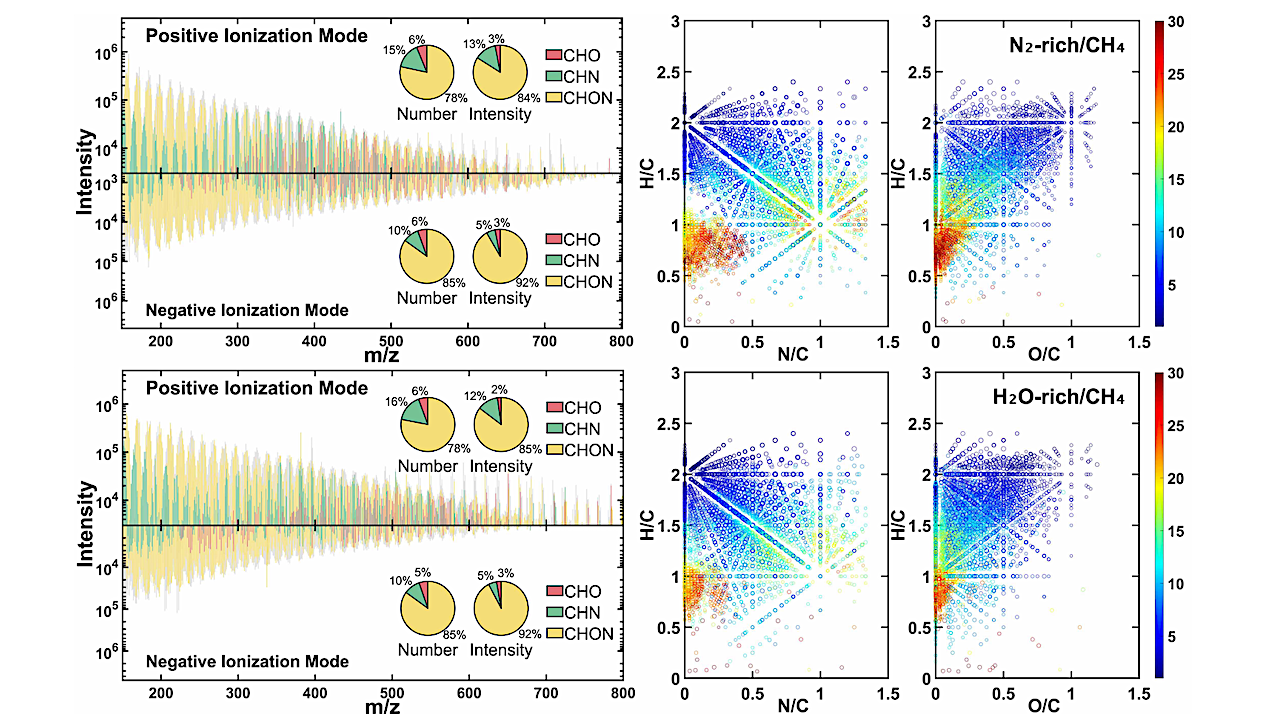
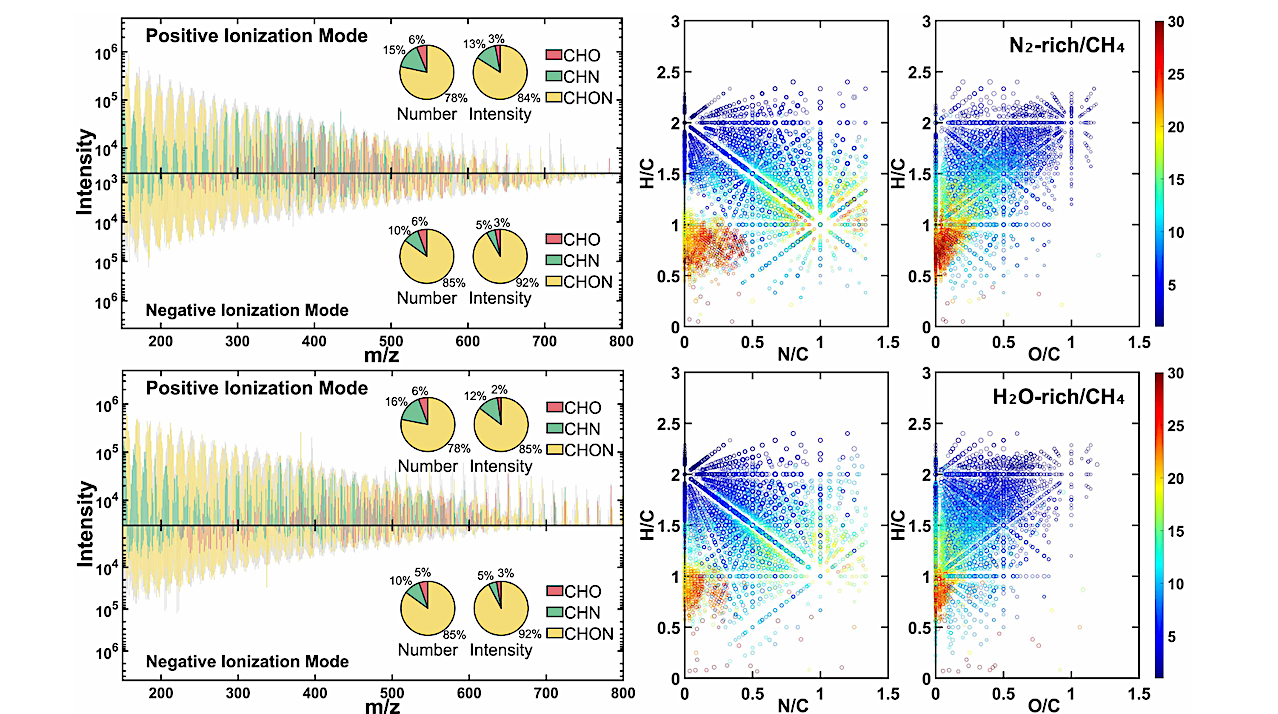
Molecular composition of haze samples from the N2-rich/CH4 and H2O-rich/CH4 experiments. Left panels: Very high-resolution mass spectra (m/z 150–800) of haze particles produced from the N2-rich/CH4 and H2O-rich/CH4 experiments, acquired in both positive and negative ionization modes. Assigned CHO, CHN, and CHON species are shown in red, green, and yellow, respectively, while grey data points correspond to mass peaks with no formula matched within the mass accuracy threshold ( 0.0001 Da). For each spectrum, the adjacent pie charts summarize the percentage of molecular formulas and their relative abundances based on summed peak intensities of the assigned organic species. Right panels: Corresponding van Krevelen diagrams combining matched formulas from both ionization modes, shown as H/C vs. N/C and H/C vs. O/C. Each circle represents an assigned formula, where color denotes the degree of unsaturation and marker size scales with peak intensity. — astro-ph.EP
Context. Terrestrial exoplanets are expected to host secondary, high-metallicity atmospheres derived from outgassing of volatiles such as N2, CO2, H2O, CH4, and CO. Photochemical organic hazes are likely to form in such environments, significantly affecting atmospheric observations and planetary habitability.
Aims. We investigate haze formation in representative terrestrial exoplanet atmospheres and assess how CH4 versus CO as the primary carbon source affects haze production rates, particle properties, and chemical complexity.
Methods. We performed six laboratory simulations by exposing gas mixtures at a few mbar to glow discharge at 300 K. Each atmosphere contained 75% N2, CO2, or H2O, 10% of each of the other two gases, and 5% CH4 or CO. Gas-phase products were analyzed with a residual gas analyzer, and solid products were characterized by production rate, particle density, atomic force microscopy, Fourier-transform infrared spectroscopy, and very high-resolution mass spectrometry.
Results. CH4 experiments produced more diverse gas-phase species and much higher haze yields than the corresponding CO experiments. CO-derived hazes showed a narrow particle size range of 10-80 nm, whereas CH4-derived hazes were denser and chemically more complex. The identified molecular formulas suggest growth pathways linked to gaseous precursors such as HCN, CH2O, and C2H4.
Conclusions. The atmospheric redox state critically controls haze formation in simulated terrestrial exoplanet atmospheres. CH4 is significantly more effective than CO in initiating organic growth, leading to higher haze production rates and greater chemical complexity. These results provide useful constraints for exoplanet atmospheric modeling and spectral interpretation, and further support the possibility that reducing atmospheres may facilitate prebiotic organic chemistry relevant to the emergence of life.
Sai Wang, Zhengbo Yang, Haixin Li, Chao He, Yingjian Wang, Xiaoou Luo, Yu Liu, Sarah M. Horst, Sarah E. Moran, Veronique Vuitton, Laurene Flandinet, Patricia McGuiggan
Subjects: Earth and Planetary Astrophysics (astro-ph.EP); Instrumentation and Methods for Astrophysics (astro-ph.IM)
Cite as: arXiv:2604.03575 [astro-ph.EP] (or arXiv:2604.03575v1 [astro-ph.EP] for this version)
https://doi.org/10.48550/arXiv.2604.03575
Focus to learn more
Submission history
From: Sai Wang
[v1] Sat, 4 Apr 2026 04:00:55 UTC (1,965 KB)
https://arxiv.org/abs/2604.03575
Astrobiology,










Related Posts
Stay Informed With the Latest & Most Important News
Previous Post
Next Post

Advertisement
-
 01Two Black Holes Observed Circling Each Other for the First Time
 -
 02From Polymerization-Enabled Folding and Assembly to Chemical Evolution: Key Processes for Emergence of Functional Polymers in the Origin of Life
 -
 03Astronomy 101: From the Sun and Moon to Wormholes and Warp Drive, Key Theories, Discoveries, and Facts about the Universe (The Adams 101 Series)
 -
 04True Anomaly hires former York Space executive as chief operating officer
 -
 05Φsat-2 begins science phase for AI Earth images
 -
 06Hurricane forecasters are losing 3 key satellites ahead of peak storm season − a meteorologist explains why it matters
 -
 07Binary star systems are complex astronomical objects − a new AI approach could pin down their properties quickly