
Now Reading: Capella Space wins $49 million contract for military communications satellite demo
-
01
Capella Space wins $49 million contract for military communications satellite demo


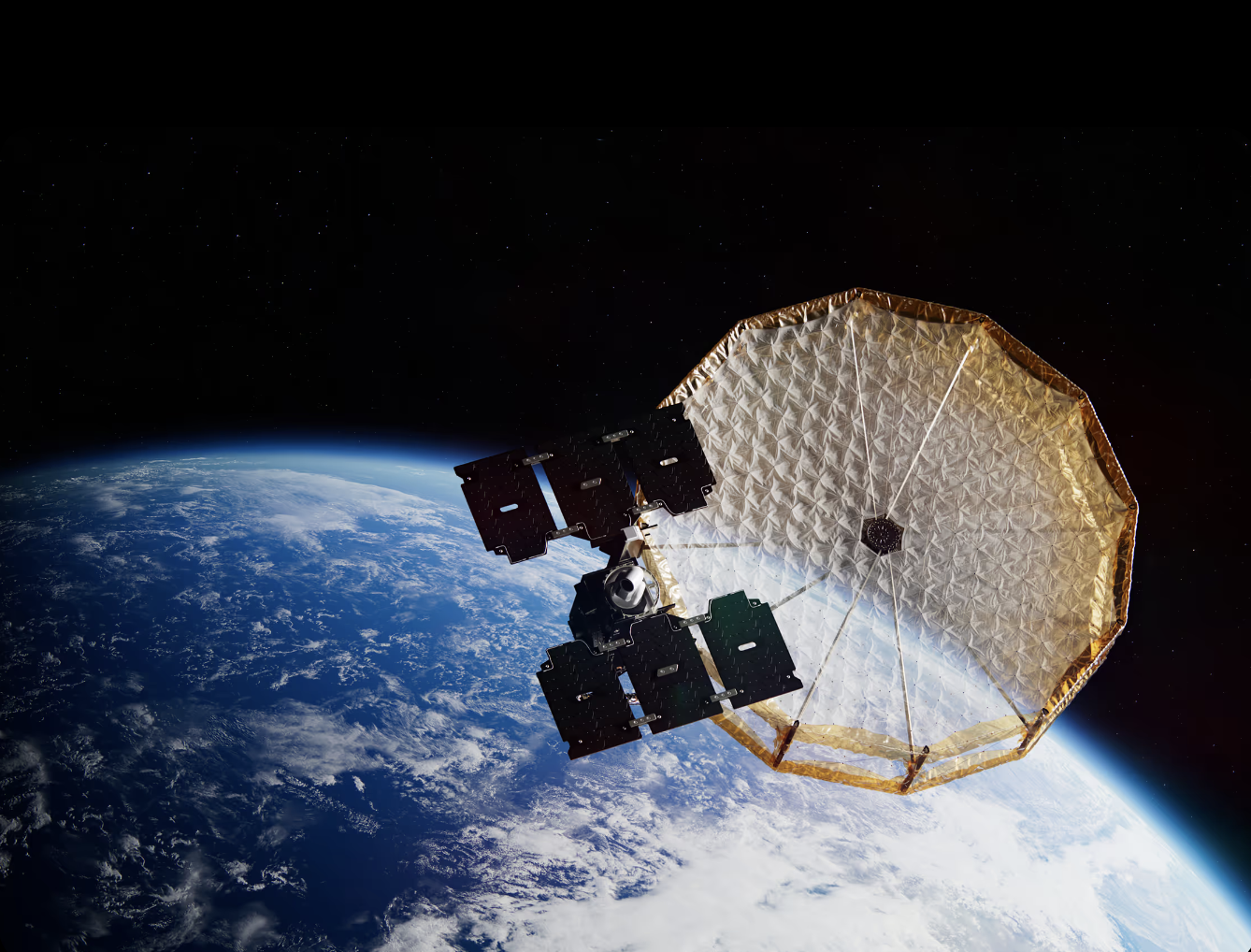

WASHINGTON — The Space Development Agency awarded a contract worth up to $49 million to Capella Space to build two satellites for a demonstration of space-based military communications, the agency said.
The firm-fixed-price agreement was issued under SDA’s Hybrid Acquisition for Proliferated Low Earth Orbit, or HALO, an Other Transaction contracting mechanism used to fund rapid, on-orbit experiments. Capella, a California-based operator of a commercial radar imaging constellation and a subsidiary of IonQ, will design and develop two spacecraft equipped with specialized radio frequency payloads.
The satellites are intended to demonstrate what SDA described as “advanced tactical waveform performance, adaptive beamforming, and secure tactical communications in low Earth orbit,” with tests scheduled for completion by November 2027.
The effort is aimed at showing that satellites in low Earth orbit can support military-grade communications links that remain reliable under interference or jamming. A waveform refers to how information is encoded onto a radio signal, while beamforming allows satellites to direct signals toward specific users rather than broadcasting broadly.
SDA, part of the U.S. Space Force, is building the Proliferated Warfighter Space Architecture, a large constellation of low Earth orbit satellites designed to support missile warning, tracking and data transport. The agency is deploying the system in successive tranches, using early demonstrations to reduce technical risk before committing capabilities to operational layers.
HALO serves as a multi-vendor contract vehicle for those demonstrations. SDA selected 19 companies for the HALO pool, which compete for prototype task orders intended to test technologies that could later be incorporated into the architecture.
Capella’s award falls under HALO’s “Europa” Track 1 program, part of the Tranche 2 Demonstration and Experimentation System, a pipeline of experimental projects feeding into the broader constellation.
This award under Europa Track 1 focuses on building satellites specifically for the demonstration, SDA acting director GP Sandhoo said, contrasting it with Track 2 efforts that rely on existing commercial systems.
The contract is the second Europa award announced by SDA. In February, the agency awarded a $30 million Europa Track 2 contract to AST SpaceMobile to test communications services using its commercial satellites.










Related Posts



Stay Informed With the Latest & Most Important News
Previous Post
Next Post




Advertisement
-
 01Two Black Holes Observed Circling Each Other for the First Time
 -
 02From Polymerization-Enabled Folding and Assembly to Chemical Evolution: Key Processes for Emergence of Functional Polymers in the Origin of Life
 -
 03Astronomy 101: From the Sun and Moon to Wormholes and Warp Drive, Key Theories, Discoveries, and Facts about the Universe (The Adams 101 Series)
 -
 04True Anomaly hires former York Space executive as chief operating officer
 -
 05Φsat-2 begins science phase for AI Earth images
 -
 06Hurricane forecasters are losing 3 key satellites ahead of peak storm season − a meteorologist explains why it matters
 -
 07Binary star systems are complex astronomical objects − a new AI approach could pin down their properties quickly