
Now Reading: There’s less ice in moon’s shadows than 1st thought
-
01
There’s less ice in moon’s shadows than 1st thought


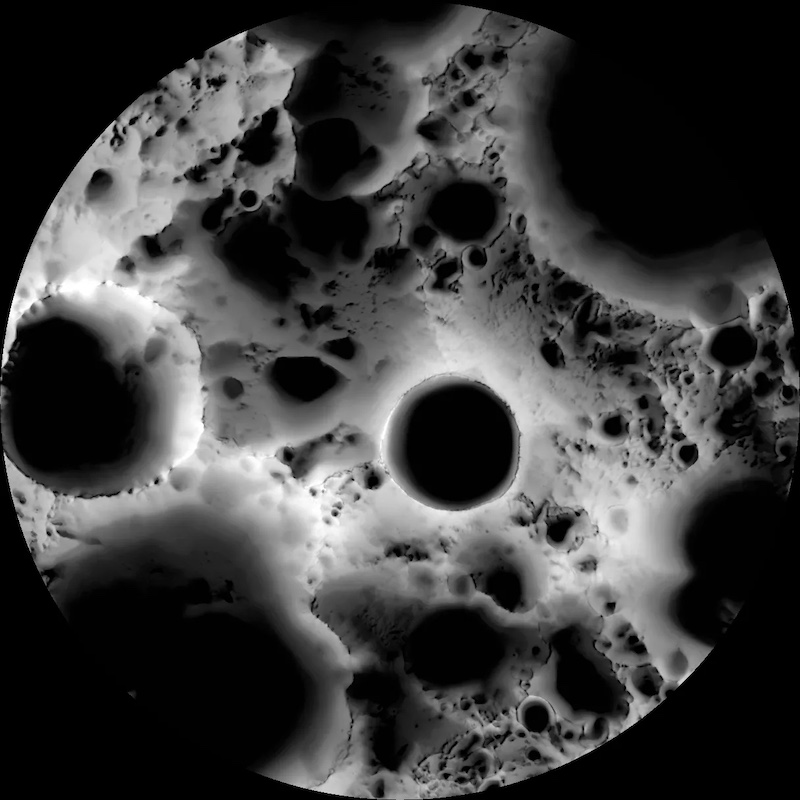
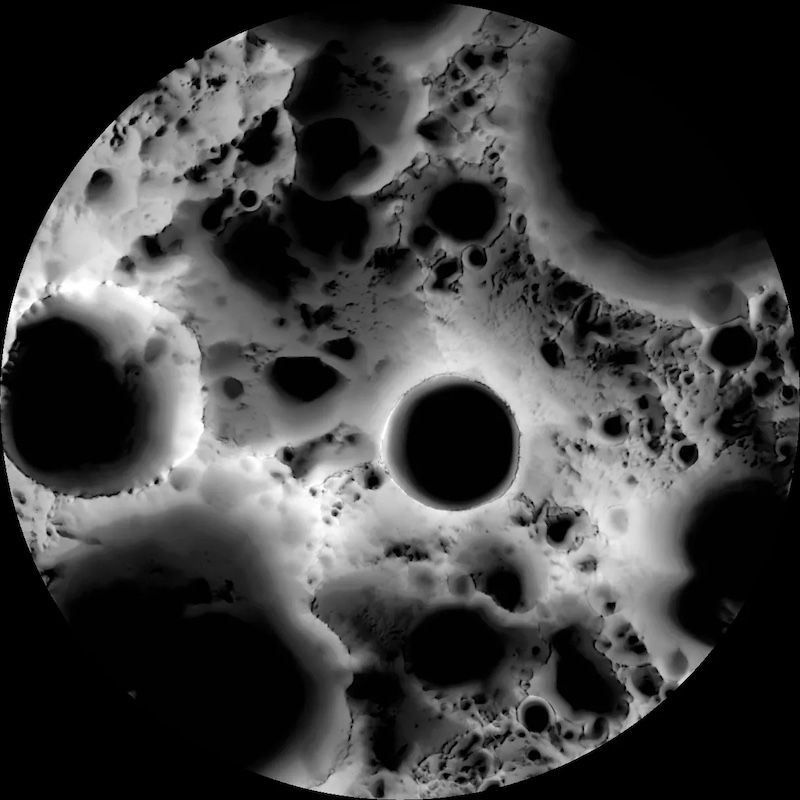
- There are deposits of water ice at the moon’s poles. The ice is in dark, shadowed craters.
- But there’s less ice than previous estimates had suggested, a new study shows.
- Researchers used NASA’s ShadowCam instrument on the Korea Pathfinder Lunar Orbiter, also known as Danuri, to peer into the deep dark moon shadows.
Less ice in moon’s shadows than thought
How much water-ice is there on the moon? That question is important for future exploration of the moon. For a time, scientists spoke of easily accessible and possibly abundant surface water-ice deposits near the moon’s poles. This would have been in permanently shadowed craters at the poles, which are the darkest, coldest regions of the moon. But now researchers at the University of Hawaii at Manoa have confirmed a 2023 study, suggesting significantly less ice at the moon’s poles than we thought. The moon’s poles still likely hold the moon’s largest reservoirs of ice. But recent studies suggest those deposits might be smaller and more patchy than earlier estimates indicated.
The researchers of the new study said in late March 2026 that ice in permanently shadowed moon craters exists only in low concentrations or small, isolated deposits. The researchers used data from NASA’s ShadowCam instrument on the Korea Pathfinder Lunar Orbiter (KPLO), also known as Danuri.
The findings could have an impact on future human exploration of the moon. Astronauts will need water resources, especially for any future habitats on the moon’s surface. If there is less accessible water-ice, mission planners need to know now. Some water can be brought from Earth. But the more in-situ lunar water-ice, the better. Right now, the crew of Artemis 2 has looped around the moon and are now returning to Earth. They didn’t land on the surface, but – starting with Artemis 4 – they soon will.
The latest peer-reviewed results were published in Science Advances on March 18, 2026.

ShadowCam
ShadowCam provided the data to study the ice deposits. NASA-funded engineers led by a team at Arizona State University designed it specifically for this task. It can take images of details in the darkest moon shadows. It does this by capturing sunlight reflected off nearby crater walls.
Contrary to expectations, the researchers found no evidence of widespread water ice in the permanently shadowed regions at the moon’s poles. This was for concentrations above 20-30% by weight.
How about elsewhere on the moon? Previous studies had suggested more widespread lunar ice deposits. And it’s still possible some water-ice exists at mid-latitudes on the moon, but probably only in small, isolated pockets. What’s more, this “widespread” ice is thought to be not only extremely sparse, but also likely locked in glass beads or bound in minerals. That’s in contrast to the thick ice deposits scientists once hoped existed at the moon’s poles.
ShadowCam observations indicate that relatively pure water ice is likely absent from the moon’s permanently shadowed regions, suggesting lunar ice may be less abundant than previously thought. doi.org/hbtbs4
— Science X / Phys.org (@sciencex.bsky.social) 2026-03-20T15:20:20-04:00
Less ice than 1st thought
So the new analysis of ShadowCam images did find some water ice at the moon’s poles, just not a lot of it. In the high-resolution images, the researchers identified a few small deposits, about 65-165 feet (20-50 meters) in size.
That’s a lot smaller than previous estimates had suggested.

Using scattered light to see ice
ShadowCam is designed to peer into the darkest shadows on the moon. And it can use scattered sunlight to help see details in the darkness.
Rocks and dust scatter light differently than ice does. Rocks and dust send more light back toward the direction from which it came. But water ice scatters light forward. And the potential icy spots did exhibit both high reflectance and unique forward-scattering properties. These optical signatures are consistent with ice concentrations greater than 10%.
Lead author of the new study is Shuai Li, an associate researcher at the Hawaii Institute of Geophysics and Planetology in the University of Hawaii’s Manoa School of Ocean and Earth Science and Technology. He said:
Water ice doesn’t just make the surface brighter. The way it scatters light is a fingerprint. By using stereo observations to look at these shadowed craters from different perspectives, we were able to detect this distinctive forward-scattering behavior for the first time.
I thought we’d find more bright, ice-rich areas. So the small number we found was a bit surprising. But the forward-scattering signal was a true and exciting surprise because it required stereo observations that were only possible during the extended mission.

Distinct difference from Mercury and Ceres
The findings are a bit of a mystery. Some other airless bodies, such as Mercury and Ceres, do have substantial water ice at their poles. And that’s despite the fact that the moon’s poles are colder than those of Mercury or Ceres. Ceres is far out in the asteroid belt between Mars and Jupiter. But how could Mercury have any ice, being so close to the sun?
It’s because Mercury is virtually airless. Since there’s no atmosphere, the heat on the dayside doesn’t get trapped and transported to the nightside. So the nightside remains extremely cold, down to -292 degrees Fahrenheit (-180 degrees Celsius) even though Mercury is the closest planet to the sun.
The new study also suggests that the hot dayside surface helps create more water from the solar wind when it impacts Mercury. On the other hand, space weathering from solar wind, volcanic degassing and mixing of rock layers from impacts might tend to destroy or bury surface ice.
Keep searching
The search for more water ice on the moon will continue. Notably, many of the small deposits that scientists have found are near young craters. So it’s possible there’s more ice below the surface.
This would be good news for future crewed missions to the moon. Water will be essential for any long-term habitation, as noted earlier. And while the results to date suggest relatively few pockets of water ice on the surface, the research team does expect to find more of them until 2028. Early that year, the Danuri probe will run out of battery power during a lunar eclipse.
There is also a good new article in the New York Times, with visualizations, of why humans’ return to the moon is important. And the role that water plays in the design of those missions.
Bottom line: Ice in the moon’s shadows is scarce, NASA’s ShadowCam finds, with only small, scattered deposits instead of the abundant ice once expected.
Source: Searching for surficial water ice in lunar permanently shaded regions (PSRs) with ShadowCam
Via University of Hawaii at Manoa
Read more: There may be less water ice on the moon than we thought
Read more: Lunar Flashlight to seek ice on the moon
The post There’s less ice in moon’s shadows than 1st thought first appeared on EarthSky.










Related Posts
Stay Informed With the Latest & Most Important News
Previous Post
Next Post


Advertisement
-
 01Two Black Holes Observed Circling Each Other for the First Time
 -
 02From Polymerization-Enabled Folding and Assembly to Chemical Evolution: Key Processes for Emergence of Functional Polymers in the Origin of Life
 -
 03Astronomy 101: From the Sun and Moon to Wormholes and Warp Drive, Key Theories, Discoveries, and Facts about the Universe (The Adams 101 Series)
 -
 04True Anomaly hires former York Space executive as chief operating officer
 -
 05Φsat-2 begins science phase for AI Earth images
 -
 06Hurricane forecasters are losing 3 key satellites ahead of peak storm season − a meteorologist explains why it matters
 -
 07Binary star systems are complex astronomical objects − a new AI approach could pin down their properties quickly