
Now Reading: Galaxy starves its supermassive black hole, loses 95% of its brightness
-
01
Galaxy starves its supermassive black hole, loses 95% of its brightness


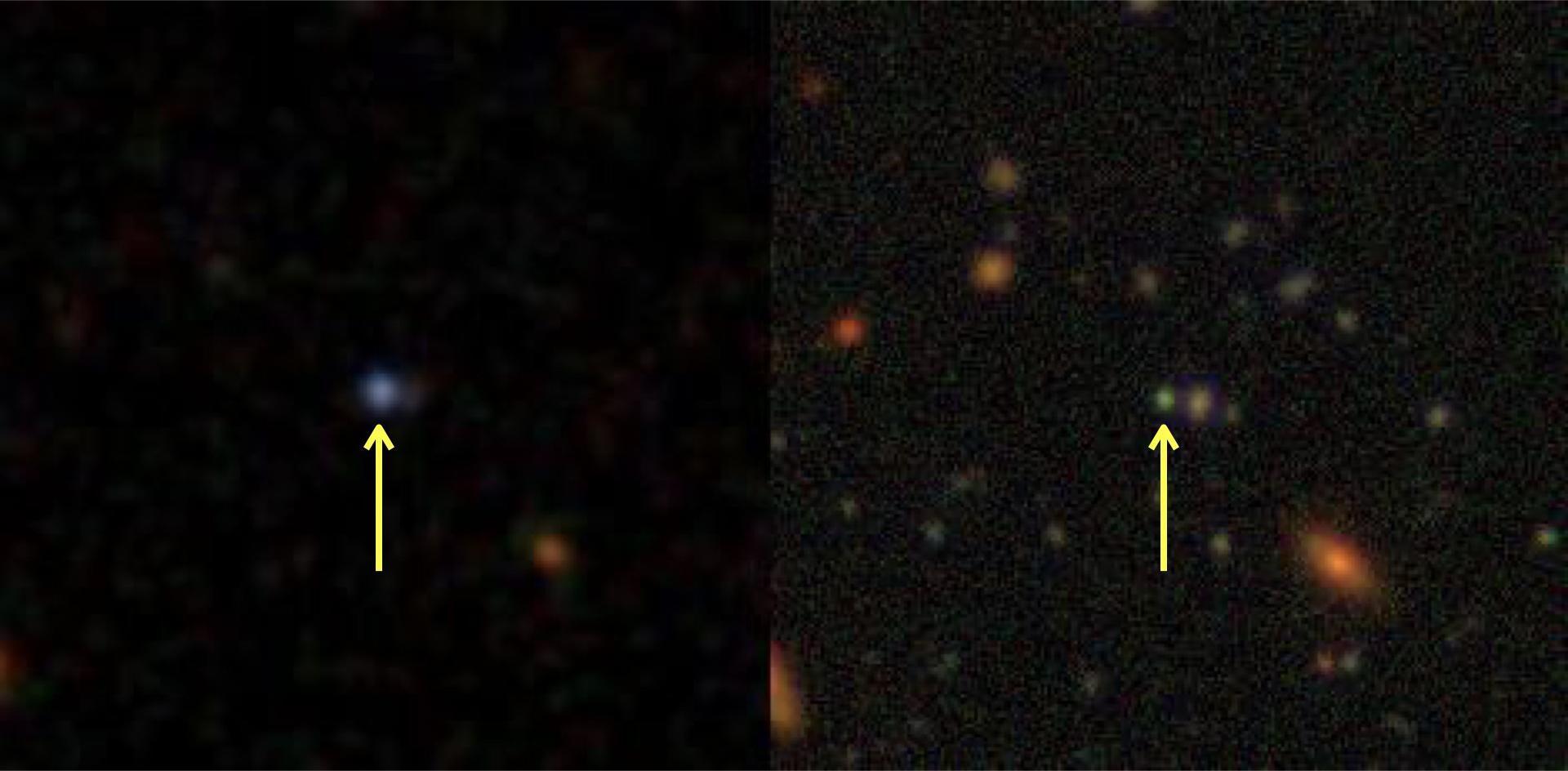
Astronomers watched a distant galaxy cut off the “food,” or general matter, flowing to its central supermassive black hole. As the regions around feeding black holes are often brighter than the combined light of every star in their host galaxy, this led to a radical change in brightness occurring over just 20 years. The starvation of this central black hole was marked by the galaxy dimming by 95%, dropping to 5% of its original brightness.
The discovery is remarkable because it demonstrates that the activity of supermassive black holes can radically change over timespans similar in scale to a human lifetime — rather than over thousands of years as current models suggest. As the first evidence of this rapid “starvation” the discovery could prompt a change in current black hole feeding models that suggest such changes take much longer to proceed.
When supermassive black holes are surrounded by a wealth of gas and dust, their immense gravitational influence causes this disk-shaped structure, called an accretion disk, to glow brightly. This cosmic larder region with a feeding black hole at its heart is called an active galactic nucleus (AGN), and can get so bright it outshines the combined light of every star in the surrounding host galaxy. When the flow of gas to the accretion disk is slowed, and the black hole’s larder is not restocked, the AGN’s brightness lowers. That is exactly what seems to be happening in this galaxy.
“It is fascinating that an active galactic nucleus can change its brightness so dramatically over such a short period of time, and that this fading appears to be caused by a large change in the accretion rate onto the supermassive black hole,” team leader Tomoki Morokuma of Chiba Institute of Technology said in a statement. “Using wide-field survey data, such as those from Hyper Suprime-Cam, we hope to discover more objects like this and learn how the activity of supermassive black holes shuts down and restarts.”
Supermassive black hole is put on a strict diet
The international team of astronomers discovered that this black hole in the galaxy J0218−0036 was gradually being starved when they dived into two decades of archival astronomical data and compared images from the Sloan Digital Sky Survey (SDSS) with those from Hyper Suprime-Cam (HSC) on the Subaru Telescope.
This revealed a decline in brightness of 95% over 20 years. This is extreme compared to the usual variability of AGN brightness, which is around 30%. The team continued their investigation of the AGN using observations taken over 70 years, and by collecting new data from this AGN using the Gran Telescopio Canarias (GTC), the Subaru Telescope and the W. M. Keck Observatory, as well as an array of radio telescopes. This allowed them to track changes in brightness over a range of wavelengths from X-rays to infrared radiation.

Following this investigation, the team determined the rate at which gas was flowing from the accretion disk to this supermassive black hole had been cut by around 98% over the course of just seven years. That told the researchers the supply of matter to the accretion disk was rapidly decreasing.
The researchers confirmed this was a case of the food supply of this black hole being staunched, by ruling out the possibility that a cloud of gas had passed in front of the accretion disk, temporarily blocking its light. They determined that such blocking couldn’t account for changes across all the different wavelengths of light they studied.
Though the cut in gas supply to this AGN and the end of replenishment of the accretion disk that is gradually feeding this supermassive black hole are certain, what the team can’t be completely sure of is what is causing this cessation. Even with that mechanism shrouded in mystery, this research shows that changes in the mass accretion of supermassive black holes don’t always take thousands of years, as previously thought.
“This object shows rapid variability that cannot be explained by standard models. It provides an important test case for developing new theoretical models,” team member Toshihiro Kawaguchi of the University of Toyama said. “We will investigate what physical conditions could reproduce the observed behavior.”
The team’s research was published in the journal Publications of the Astronomical Society of Japan (PASJ).










Related Posts


Stay Informed With the Latest & Most Important News
Previous Post
Next Post




Advertisement
-
 01Two Black Holes Observed Circling Each Other for the First Time
 -
 02From Polymerization-Enabled Folding and Assembly to Chemical Evolution: Key Processes for Emergence of Functional Polymers in the Origin of Life
 -
 03Astronomy 101: From the Sun and Moon to Wormholes and Warp Drive, Key Theories, Discoveries, and Facts about the Universe (The Adams 101 Series)
 -
 04True Anomaly hires former York Space executive as chief operating officer
 -
 05Φsat-2 begins science phase for AI Earth images
 -
 06Hurricane forecasters are losing 3 key satellites ahead of peak storm season − a meteorologist explains why it matters
 -
 07Binary star systems are complex astronomical objects − a new AI approach could pin down their properties quickly