
Now Reading: A lunar base or a lunar economy?
-
01
A lunar base or a lunar economy?


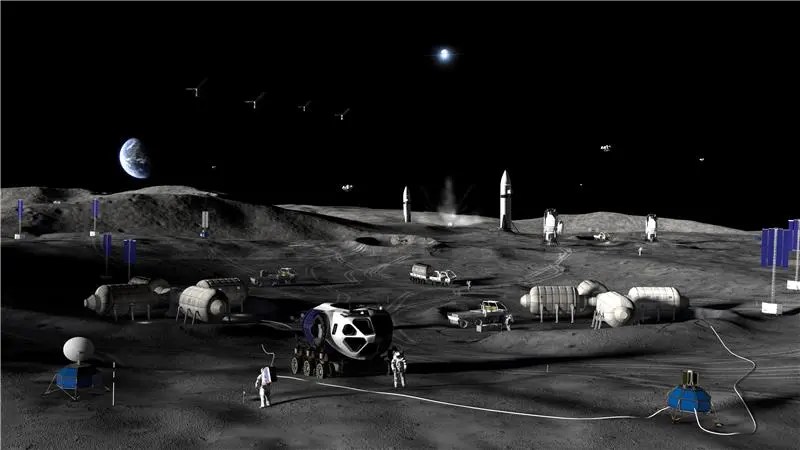

We applaud the lunar base vision laid out by NASA Administrator Jared Isaacman on March 24. Placing this stake in the lunar regolith is long overdue. What is missing from the mission architecture, however, is a vision for long-term economic development on the moon. It will be a profound missed opportunity if NASA does not equally commit its lunar base efforts to supporting commercial development of the moon.
We couldn’t be more excited by NASA’s commitment to establishing a robust human presence on the moon over the next decade. This is refreshing and welcome news for those who have been frustrated by NASA’s lack of articulation on what happens after the flags-and-footprints moment of the eventual crewed moon landing.
The Beyond Earth Institute has been calling for just such a bold commitment for years. We offer heartfelt congratulations to NASA, Isaacman, and the administration for taking the important step toward permanent human presence beyond Earth.
Further, Isaacman’s team has mapped out a detailed plan for the evolution of the lunar base and its related infrastructure. NASA’s plan for the lunar base says that by 2036, the base will include four to five surface habitats (not necessarily co-located), multiple rovers, nuclear and solar power sources, communications and navigation capability, multiple landing systems, sample return capability and in-situ resource utilization capability, including 3D manufacturing.
Remarkably, Isaacman has declared that the moon base program will fit within NASA’s current budget authority. Some of us are old enough to remember how both Presidents Bush unveiled lofty plans for human exploration of the moon and Mars, echoing JFK’s Apollo challenge, only for their respective visions for space to wither under public scrutiny.
NASA intends to pay for the lunar base largely by putting the Lunar Gateway program on hold and repurposing those resources for the lunar surface in support of the base. In shifting the agency’s priorities to meet the moon base requirements, Isaacman could face political resistance both internally and externally. His ability to navigate the politics of the transition may ultimately be the measure of his success.
What most worries us, however, is that Isaacman’s lunar plan gives private actors little consideration beyond serving as potential vendors. The plan appears to be structured as a traditional NASA procurement program. While we expect Isaacman won’t tolerate the open-ended “cost-plus” contracting of the old days, there was no mention of public-private partnerships, other than an expansion of the CLPS program, which was created as a PPP initiative.
There was no aspirational statement about the commercial potential of the moon — an obvious justification for such an expansive commitment. Instead, Isaacman cited our race with China as the sole motivator.
For this reason and others, we recommend that NASA formally declare development of a lunar economy as a co-equal mission objective alongside science and national security, and structure lunar surface contracts to permit private operators to sell services to non-NASA customers. Further, we suggest NASA convene a Lunar Economic Development working group — chaired by the Department of Commerce and vice-chaired by NASA — to actively signal, coordinate and attract private investment throughout the lunar base build-out. The working group would also determine the rules of the road for government and private engagement for the use of lunar assets and for building new ones as demand requires. Such a governance structure can only be built in concert with international partners, and perhaps even China. These are not aspirational wishes. They are the structural choices that will determine whether this initiative will be sustainable.
Certainly, in the near term, NASA must be focused on minimal viability, with operational flexibility to conduct science, prospecting, and technology development on the surface of the moon, all while ensuring astronauts are safe and productive. We suspect this rationale has similarly influenced the reconsideration of the Commercial LEO Destination program (an important and concerning development that we will not try to address here). NASA does need a minute to set up camp with the basic infrastructure and logistics first. In the meantime, there is no reason that entrepreneurs can’t partner with NASA as they refine their business models and be ready to seize on lunar opportunities as they arise. That’s their job, not NASA’s.
We don’t want NASA to be placing bets on specific space ventures. At the same time, NASA should be signaling commercial opportunities throughout the ramp-up period to the lunar base and be ready to support any serious actors who have investable ideas. Isaacman says he wants everyone’s input — and we are sure he does — but is he open to proposals that both serve NASA’s needs while providing services to non-NASA parties?
Even as NASA moves to implement its lunar base plan, the interests and potential of the private sector should be at the forefront. Otherwise, Isaacman may be saddling NASA with a new generation of government-dependent vendors more focused on the next contract than on building a foundation for sustained economic growth.
In selling the lunar base plan to the public, we encourage NASA to emphasize the economic potential of accessing lunar resources. NASA needs to demonstrate how it is looking forward to a time when the private sector takes ownership and continues to develop capabilities for long-term economic sustainability.
The goal of the moon base should not be a moon base. It should be to facilitate the creation of a sustainable and growing lunar economy.
Steve Wolfe is president and co-founder of the Beyond Earth Institute. Courtney Stadd is the executive vice president of the Beyond Earth Institute.
SpaceNews is committed to publishing our community’s diverse perspectives. Whether you’re an academic, executive, engineer or even just a concerned citizen of the cosmos, send your arguments and viewpoints to opinion (at) spacenews.com to be considered for publication online or in our next magazine. If you have something to submit, read some of our recent opinion articles and our submission guidelines to get a sense of what we’re looking for. The perspectives shared in these opinion articles are solely those of the authors and do not necessarily represent their employers or professional affiliations.










Related Posts
Stay Informed With the Latest & Most Important News
Previous Post
Next Post



Advertisement
-
 01Two Black Holes Observed Circling Each Other for the First Time
 -
 02From Polymerization-Enabled Folding and Assembly to Chemical Evolution: Key Processes for Emergence of Functional Polymers in the Origin of Life
 -
 03Astronomy 101: From the Sun and Moon to Wormholes and Warp Drive, Key Theories, Discoveries, and Facts about the Universe (The Adams 101 Series)
 -
 04True Anomaly hires former York Space executive as chief operating officer
 -
 05Φsat-2 begins science phase for AI Earth images
 -
 06Hurricane forecasters are losing 3 key satellites ahead of peak storm season − a meteorologist explains why it matters
 -
 07Binary star systems are complex astronomical objects − a new AI approach could pin down their properties quickly