
Now Reading: Portal Space Systems raises $50 million to accelerate spacecraft development
-
01
Portal Space Systems raises $50 million to accelerate spacecraft development


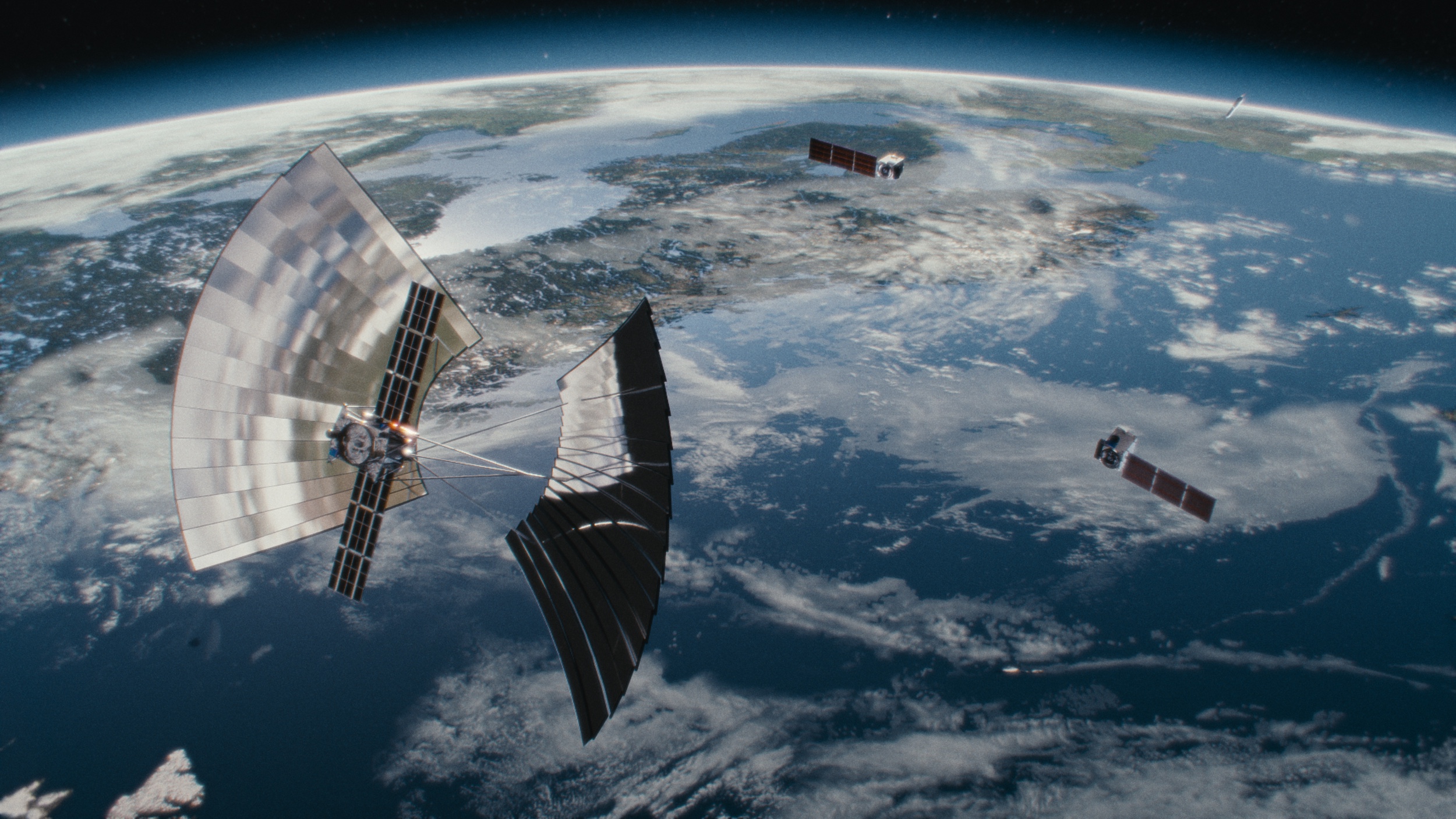

WASHINGTON — Space mobility company Portal Space Systems has raised $50 million to scale up development of its highly maneuverable spacecraft.
The company announced April 9 it closed a Series A round led by Geodesic Capital and Mach33. Several other investors participated in the round, including Booz Allen Ventures, ARK Invest, AlleyCorp and FUSE.
The funding, which comes after the company raised $17.5 million in a seed round a year ago, will allow it to advance development of Starburst, a maneuverable spacecraft bus, and Supernova, a vehicle designed to rapidly move between orbits using a solar thermal propulsion system.
“It allows us to accelerate our spacecraft development,” Jeff Thornburg, founder and chief executive of Portal, said in an interview. “It’s all about faster execution.”
In addition to supporting spacecraft development, he said the funding will go toward setting up a 52,000-square-foot production facility in the Seattle suburb of Bothell, Washington, that the company plans to open in June. That factory, when fully set up, will be able to produce 12 Supernova and 16 Starburst vehicles a year.
Portal launched its first payload, called Mini Nova, as part of the Vigoride-7 mission by Momentus, placed into orbit on a SpaceX rideshare mission March 30. Mini Nova, a hosted payload on Vigoride, will test avionics and related technologies for its future spacecraft. Both Vigoride and Mini Nova are in good condition as they go through post-launch commissioning, Thornburg said.
“It’s the brains, really, of all of our Portal spacecraft,” he said. “We get to spend the next six months figuring out how we want to tackle certain things as they come in terms of software updates and tracking down issues, and do that in an environment that’s very benign.”
Portal plans to launch its first Starburst spacecraft late this year on SpaceX’s Transporter-18 rideshare mission. The first Supernova is slated for launch in 2027, with the company working to finalize a launch opportunity for it. Thornburg noted that 81% of Supernova’s components are also used on Starburst, giving them flight heritage ahead of the first Supernova mission.
The company also plans to use the funding to help diversify its customer base. “The strongest demand is in defense,” he said, citing its interest in dynamic space operations. “I think we’re mature enough now where there’s going to be more and more partnership opportunities with tier one and tier two primes.”
That was one reason that Booz Allen Ventures participated in the round. “Booz Allen Ventures’ investment in Portal Space Systems will advance orbital warfare through the development of rapidly maneuverable spacecraft, something we know our customers need,” Travis Bales, director of Booz Allen Ventures, said in a statement.
Thornburg, who earlier in his career worked at SpaceX, said he wants to explore other customers. “Part of the lessons learned from my years at SpaceX were that you want to have multiple legs of your financial stool,” he said. “It was really important to me that we start to seriously address international interest.”
Geodesic Capital, which funds companies seeking to enter Asian markets, will help with that. “The future of space is dynamic, and that shift is being recognized globally,” said Rayfe Gaspar-Asaoka, partner at Geodesic, in a statement.
Thornburg said the company is now actively seeking customers in Japan and Australia and plans to expand those efforts to Europe later this year.
Portal is also exploring other opportunities for its vehicles. “I think this orbital data center conversation is fascinating. I think there are opportunities there to support, protect, defend, from a logistics and a defense standpoint, some of this critical infrastructure we’re talking about,” he said.
He added the company is also looking at ways to participate in NASA’s Artemis lunar exploration campaign, particularly with the changes announced by the agency last month that seek to increase the pace of missions and establish a lunar base.
“NASA has talked to us in the past and is talking to us now about how we can support their in-space assembly and logistical needs,” he said. “Anything that’s got thrust and delta-v that can get you out toward the moon is going to be important to those architectures.”
In the immediate future, the company is planning to grow from its current 40 employees to as many as 100 by early next year as it moves into its new factory.
“I’ve always wanted to move this company from an R&D tech-development company to a company that has contracts that sell spacecraft,” he said. “That’s how you move away from the endless cycle of investment and have customers that are excited, that are writing contracts to buy products.”










Related Posts
Stay Informed With the Latest & Most Important News
Previous Post
Next Post

Advertisement
-
 01Two Black Holes Observed Circling Each Other for the First Time
 -
 02From Polymerization-Enabled Folding and Assembly to Chemical Evolution: Key Processes for Emergence of Functional Polymers in the Origin of Life
 -
 03Astronomy 101: From the Sun and Moon to Wormholes and Warp Drive, Key Theories, Discoveries, and Facts about the Universe (The Adams 101 Series)
 -
 04True Anomaly hires former York Space executive as chief operating officer
 -
 05Φsat-2 begins science phase for AI Earth images
 -
 06Hurricane forecasters are losing 3 key satellites ahead of peak storm season − a meteorologist explains why it matters
 -
 07Binary star systems are complex astronomical objects − a new AI approach could pin down their properties quickly