
Now Reading: First Light For PoET: Shining (sun)Light On Exoplanet Research
-
01
First Light For PoET: Shining (sun)Light On Exoplanet Research


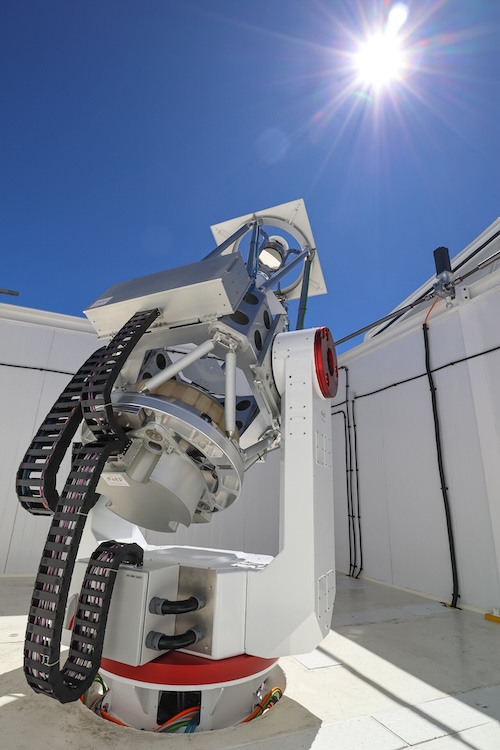
The Paranal solar ESPRESSO Telescope (PoET), installed at the European Southern Observatory’s (ESO’s) Paranal site in Chile, has made its first observations. The telescope will work with ESO’s ESPRESSO instrument to study the Sun in detail. Described as a solar telescope for planet hunters, PoET aims to understand how the variation in the light from stars like the Sun can mask the presence of planets orbiting them, helping us in our search for worlds outside the Solar System.
“One of the greatest challenges for the detection of other Earths orbiting other Suns is the astrophysical ‘noise’ coming from the host stars,” explains Nuno Santos, the Principal Investigator for PoET, based at the Institute of Astrophysics and Space Sciences (Instituto de Astrofísica e Ciências do Espaço [IA])) and the Faculty of Sciences of the University of Porto, Portugal. “PoET observations could be key to the discovery and characterisation of exoplanets, which may currently be hidden in the noise.”
Exoplanets — worlds outside our Solar System — are mostly detected and studied by looking at the light from their host star, often by looking at small changes in the star’s spectrum (the light split into its component colours or frequencies). But stellar activity can produce signals that drown out, or even mimic, those expected from an orbiting planet. Much like sunspots alter sunlight, surface activity on other stars distorts their spectrum in a way that can be measured, as ‘noise’, with current exoplanet-hunting instrumentation. But removing this noise from the spectra of distant stars is challenging, because we don’t fully understand how stellar activity changes the light we observe. The solution: learn from our nearest star, the Sun.
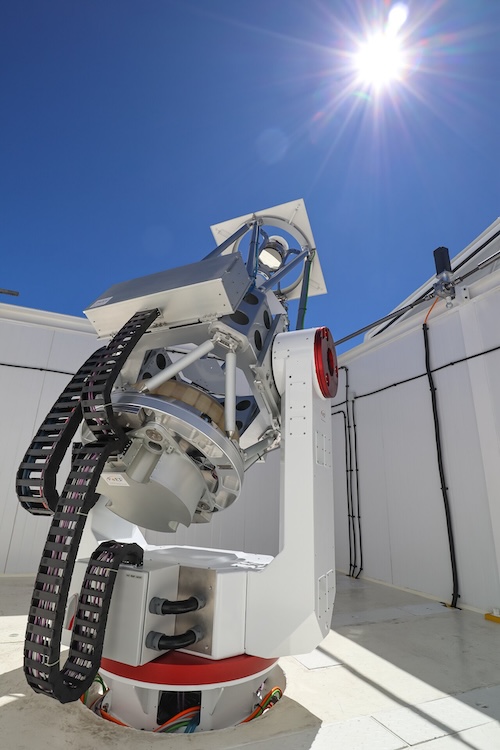
The Paranal solar ESPRESSO Telescope (PoET) is seen here pointing at the Sun. The main telescope has a 60 cm mirror that collects light from small regions of the solar disc and redirects it via optical fibres to ESO’s ESPRESSO spectrograph in a nearby building. ESPRESSO then splits this sunlight into its constituent colours in great detail. The grey box above the main tube contains a smaller telescope with a 6 cm lens. This smaller telescope will gather light from the entire solar disc and redirect it to ESPRESSO. A third smaller telescope with a 5 cm lens, located also inside this box, will take images of the Sun’s disc. The box also contains a device to measure the turbulence caused by Earth’s atmosphere. Credit: A. Cabral/IA
PoET’s design makes it uniquely capable of using the Sun to understand the spectra of distant stars. It has a telescope, with a mirror 60-centimetre in diameter, that gathers light from specific areas of the Sun, such as individual sunspots, probing the signatures of stellar activity. PoET also includes a smaller telescope that collects light from the entire visible surface of the Sun (the solar disc).
“We will be able to analyse very specific areas of the Sun, with a very high resolution, in a way never done before,” says Alexandre Cabral, PoET co-Principal Investigator and a researcher at IA and the Faculty of Sciences of the University of Lisbon, Portugal. By observing simultaneously both the solar disc and individual surface features, astronomers can determine exactly how stellar activity changes the solar spectrum. This can then be used as a guide to precisely remove “noise” from distant stars that may be harbouring exoplanets.
To ensure the Sun can be compared to distant solar-type stars, the team needed a precise instrument designed for exoplanet research. “ESPRESSO is the top instrument in the field, so the choice was obvious,” says Santos. Because ESPRESSO is an extremely precise, high-resolution spectrograph, it is capable of detecting tiny changes in the spectra of stars, typically to find or characterise planets orbiting them. An exoplanet instrument on ESO’s Very Large Telescope (VLT) targeting distant stars by night, ESPRESSO will now also be used with PoET during the day to analyse solar spectra.
“It is a great advantage to have ESPRESSO working in this way. By switching from the VLT at night to PoET during the day, we maximise the usage of this instrument to help us find and characterise exoplanets,” says ESO’s Alain Smette, VLT Operations Staff Astronomer and ESO contact person for PoET. “Thanks to the exceptional location of the Paranal Observatory, the number of available days when weather conditions are suitable for observations of the Sun is expected to be very similar to that for nighttime observations.”
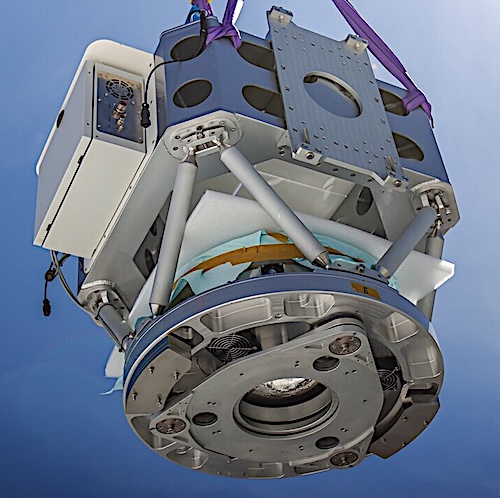
This cell contains the 60-cm mirror of the main telescope of PoET, which will collect sunlight from specific regions on the Sun’s disc. PoET, which stands for Paranal solar ESPRESSO Telescope, is a project hosted at ESO’s Paranal Observatory in Northern Chile. Credit: ESO
PoET successfully completed its test observations, a process known as first light, in early April at ESO’s Paranal Observatory in Chile’s Atacama Desert. The first observations show that the system is working within the requirements and is able to acquire spectra of both the entire solar disc and specific areas of it. During the next weeks the team will test and optimise the system, before starting scientific observations.
PoET was designed and developed in Portugal, with funds from the European Research Council [1], and a team of 12 Portuguese researchers were present at the installation and testing of the solar telescope. Some components of PoET, including the main telescope, were built in Italy while the telescope dome was built by a Chilean company.
The project is now being operated remotely from the Centre for Astrophysics of the University of Porto, Portugal. The PoET data analysed by ESPRESSO will be made available to other scientists via the ESO Science Archive Facility.
Notes
[1] The PoET telescope is funded by the European Union (ERC, FIERCE, 101052347).
Astrobiology, Astronomy, Exoplanet,










Related Posts

Stay Informed With the Latest & Most Important News
Previous Post
Next Post

Advertisement
-
 01Two Black Holes Observed Circling Each Other for the First Time
 -
 02From Polymerization-Enabled Folding and Assembly to Chemical Evolution: Key Processes for Emergence of Functional Polymers in the Origin of Life
 -
 03Astronomy 101: From the Sun and Moon to Wormholes and Warp Drive, Key Theories, Discoveries, and Facts about the Universe (The Adams 101 Series)
 -
 04True Anomaly hires former York Space executive as chief operating officer
 -
 05Φsat-2 begins science phase for AI Earth images
 -
 06Hurricane forecasters are losing 3 key satellites ahead of peak storm season − a meteorologist explains why it matters
 -
 07Binary star systems are complex astronomical objects − a new AI approach could pin down their properties quickly