
Now Reading: Habitability Study of Terrestrial Planets: Application to Venus-like Worlds
-
01
Habitability Study of Terrestrial Planets: Application to Venus-like Worlds


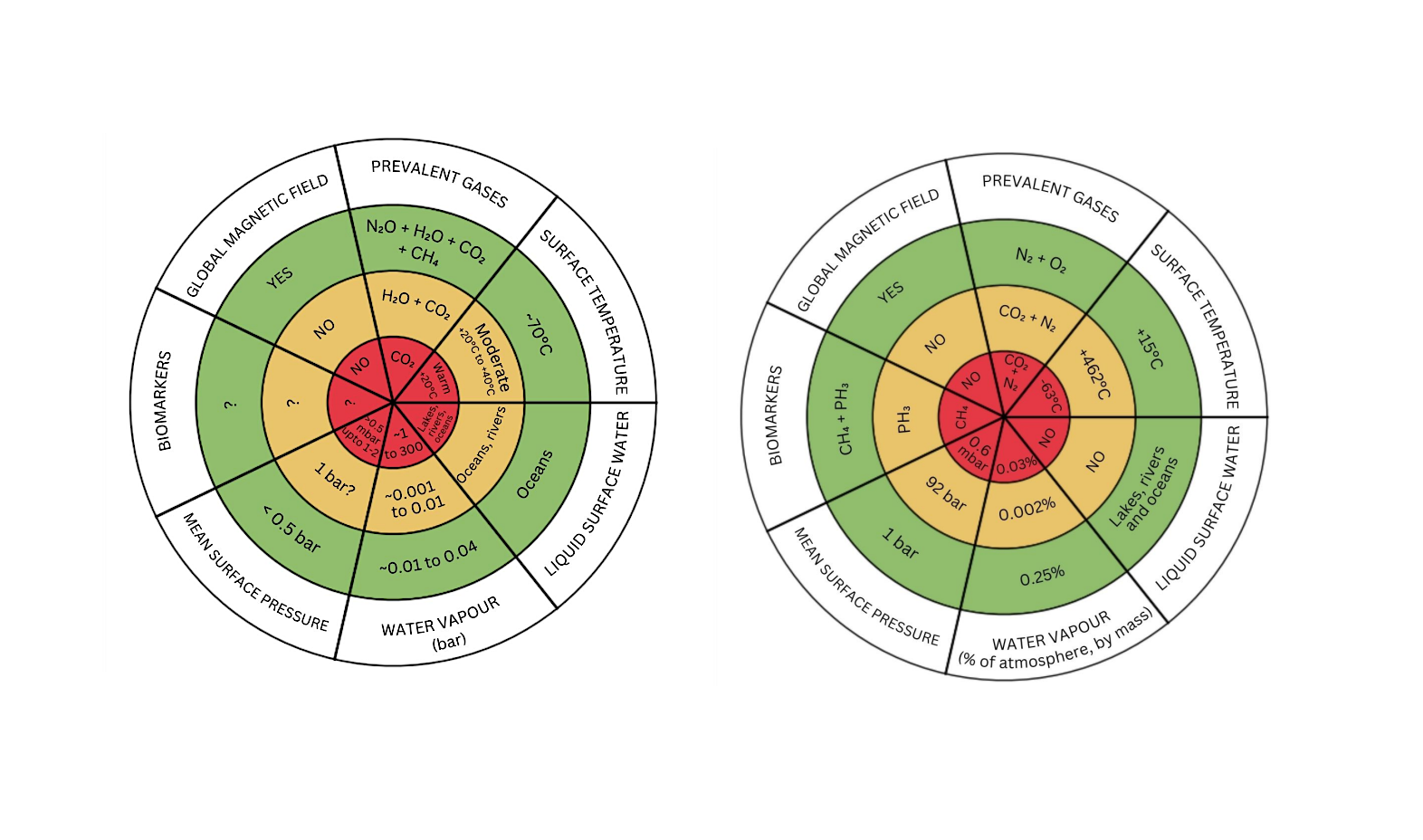
Habitability factors at time period from ∼4.1 Ga till end of LHB (left) and current (right) Earth (green), Venus (yellow), and Mars (red). — astro-ph.EP
The study of planetary habitability beyond Earth remains a central and challenging project in planetary science.
Analysis of large volumes of planetary data from space missions such as CoRoT, Kepler, and JWST is directed ultimately at finding a planet similar to Earth, the Earth’s twin, and answering the question of potential exo-habitability. The Earth Similarity Index (ESI) is a first step in this quest, ranging from 1 (Earth) to 0 (totally dissimilar to Earth). To identify planets that may be habitable to the extreme forms of life, we introduce the Mars Similarity Index (MSI).
However, extreme forms of life have also been hypothesized under specific conditions in the upper atmosphere of Venus, motivating comparative habitability studies beyond Earth and Mars. The Venus Similarity Index (VSI), introduced here, is defined as the geometric mean of radius, density, escape velocity, and surface temperature, normalized in Venus units (VU).
VSI values range from 0 (complete dissimilarity) to 1 (maximum similarity). The VSI provides a comparative framework for identifying Venus-like planetary environments within exoplanet populations. To explore habitability evolution, we further introduce the Ancient Venus Similarity Index (AVSI) and the Future Earth Similarity Index (FESI) to examine early Venusian conditions relative to ancient Earth and to assess potential future evolutionary pathways for Earth-like planets.
Swathi Raviprakash, Madhu Kashyap Jagadeesh, Margarita Safonova, Oleg Kotsyurbenko
Comments: 21 pages, 10 figures, 5 tables
Subjects: Earth and Planetary Astrophysics (astro-ph.EP)
Cite as: arXiv:2604.06792 [astro-ph.EP] (or arXiv:2604.06792v1 [astro-ph.EP] for this version)
https://doi.org/10.48550/arXiv.2604.06792
Focus to learn more
Submission history
From: Swathi Raviprakash
[v1] Wed, 8 Apr 2026 07:57:50 UTC (836 KB)
https://arxiv.org/abs/2604.06792
Astrobiology, Exoplanet,










Related Posts

Stay Informed With the Latest & Most Important News
Previous Post
Next Post


Advertisement
-
 01Two Black Holes Observed Circling Each Other for the First Time
 -
 02From Polymerization-Enabled Folding and Assembly to Chemical Evolution: Key Processes for Emergence of Functional Polymers in the Origin of Life
 -
 03Astronomy 101: From the Sun and Moon to Wormholes and Warp Drive, Key Theories, Discoveries, and Facts about the Universe (The Adams 101 Series)
 -
 04True Anomaly hires former York Space executive as chief operating officer
 -
 05Φsat-2 begins science phase for AI Earth images
 -
 06Hurricane forecasters are losing 3 key satellites ahead of peak storm season − a meteorologist explains why it matters
 -
 07Binary star systems are complex astronomical objects − a new AI approach could pin down their properties quickly