
Now Reading: China conducts pair of Long March launches for Thousand Sails and Guowang megaconstellations
-
01
China conducts pair of Long March launches for Thousand Sails and Guowang megaconstellations

China conducts pair of Long March launches for Thousand Sails and Guowang megaconstellations

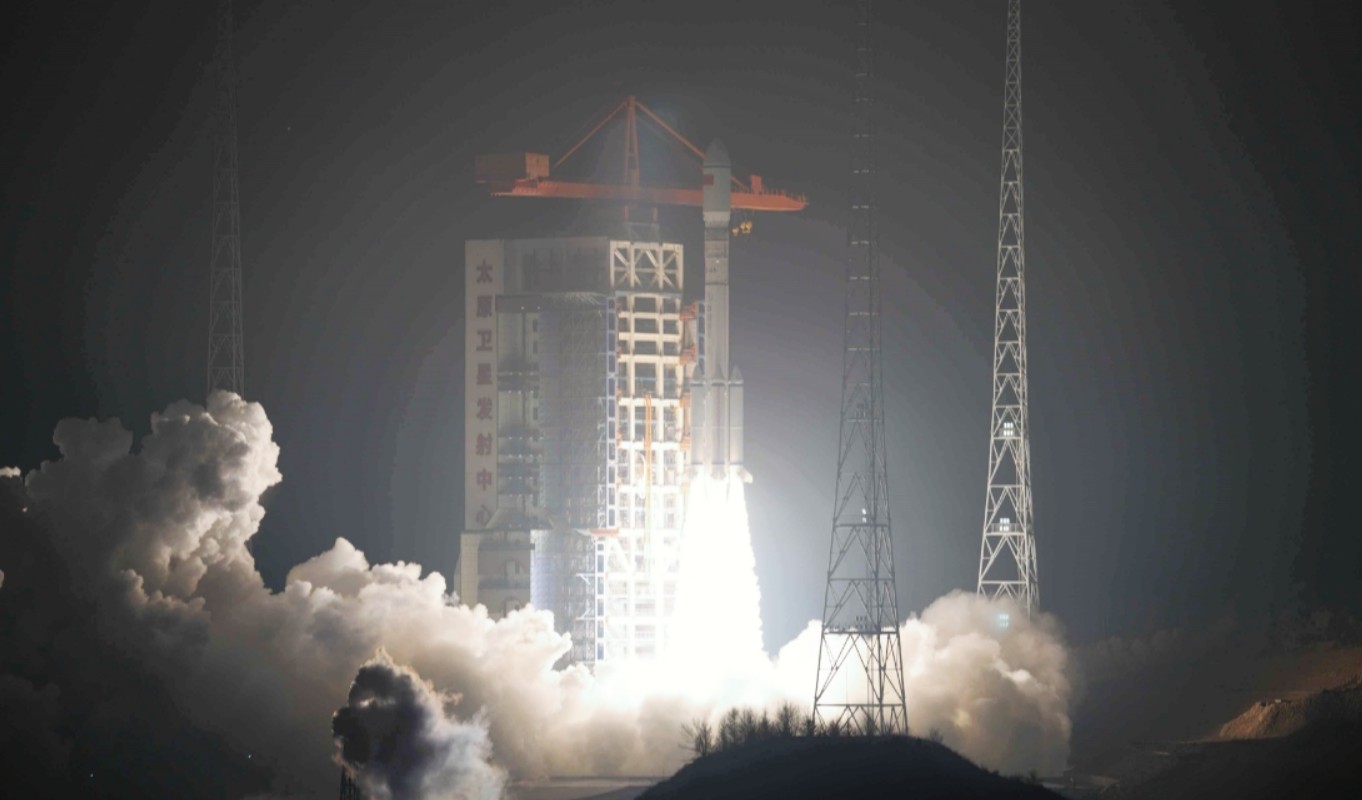

HELSINKI — China carried out separate Long March 8 and Long March 6A launches this week, adding new batches of satellites to the country’s megaconstellation projects.
The missions mark the first launch for the Shanghai-led Thousand Sails, or Qianfan, constellation since October 2025, and the 21st group of satellites for the national Guowang project.
A Long March 8 rocket lifted off at 9:32 a.m. Eastern (1332 UTC) April 7 from the Hainan Commercial Space Launch Site. The China Aerospace Science and Technology Corporation (CASC), which provided the launch services, confirmed launch success, officially revealing the payloads to be for the Thousand Sails constellation.
Further reports state that 18 satellites were aboard the flight, which headed into a near-polar orbit, according to airspace closure notifications. The satellites were manufactured by the Innovation Academy for Microsatellites of the Chinese Academy of Sciences (IAMCAS).
The previous launch for the constellation took place in October 2025, itself following an apparent pause in activity from the fifth launch in March 2025. Earlier launches included a number of satellites which failed to raise their orbits as expected.
The launch was the seventh for Qianfan, which now has 126 satellites in orbit. The project is led by Shanghai Spacecom Satellite Technology (SSST), also known as Spacesail.
Guowang group 21
The Thousand Sails mission was followed the next day by another launch, this time from north China.
A Long March 6A lifted off at 3:38 p.m. Eastern (1938 UTC) April 8 from Taiyuan Satellite Launch Center, climbing into the night sky. CASC reported launch success, revealing the mission to be the 21st group of satellites for the national Guowang constellation. Long March 6A launches for Guowang typically carry five satellites.
The satellites were, as with the Thousand Sails launch a day earlier, manufactured by IAMCAS. Guowang now has 168 operational phase satellites in orbit, along with a number of likely related test satellites. Little is known about the satellites for Guowang, which also includes spacecraft manufactured or overseen by CASC’s China Academy of Space Technology (CAST).
Paperwork filed with the ITU shows Guowang is intended to be a 13,000-satellite constellation, while the near-term target for the constellation is to have 400 satellites in orbit by 2027.
Guowang is part of China’s response to Starlink and other proliferated low Earth orbit constellations. The country has moved to greatly increase its launch capabilities, including reusable launch vehicles. A new Five-Year Plan for the period 2026-2030 highlighted the advancement of satellite internet and reusable launch as priorities.
Megaconstellation launch surge
The launches were China’s 20th and 21st launch attempts of 2026 and followed the April 3 failure of the debut launch of the commercial Tianlong-3 rocket. The country is reported to be targeting as many as 140 launches this year—including major lunar and human spaceflight missions—representing a rapid acceleration in launch cadence. Thousand Sails and Guowang are expected to drive much of the anticipated acceleration.










Related Posts


Stay Informed With the Latest & Most Important News
Previous Post
Next Post




Advertisement
-
 01Two Black Holes Observed Circling Each Other for the First Time
 -
 02From Polymerization-Enabled Folding and Assembly to Chemical Evolution: Key Processes for Emergence of Functional Polymers in the Origin of Life
 -
 03Astronomy 101: From the Sun and Moon to Wormholes and Warp Drive, Key Theories, Discoveries, and Facts about the Universe (The Adams 101 Series)
 -
 04True Anomaly hires former York Space executive as chief operating officer
 -
 05Φsat-2 begins science phase for AI Earth images
 -
 06Hurricane forecasters are losing 3 key satellites ahead of peak storm season − a meteorologist explains why it matters
 -
 07Binary star systems are complex astronomical objects − a new AI approach could pin down their properties quickly