
Now Reading: Orion spacecraft captures stunning lunar flyby snapshot as Artemis II mission sets new distance record
-
01
Orion spacecraft captures stunning lunar flyby snapshot as Artemis II mission sets new distance record

Orion spacecraft captures stunning lunar flyby snapshot as Artemis II mission sets new distance record

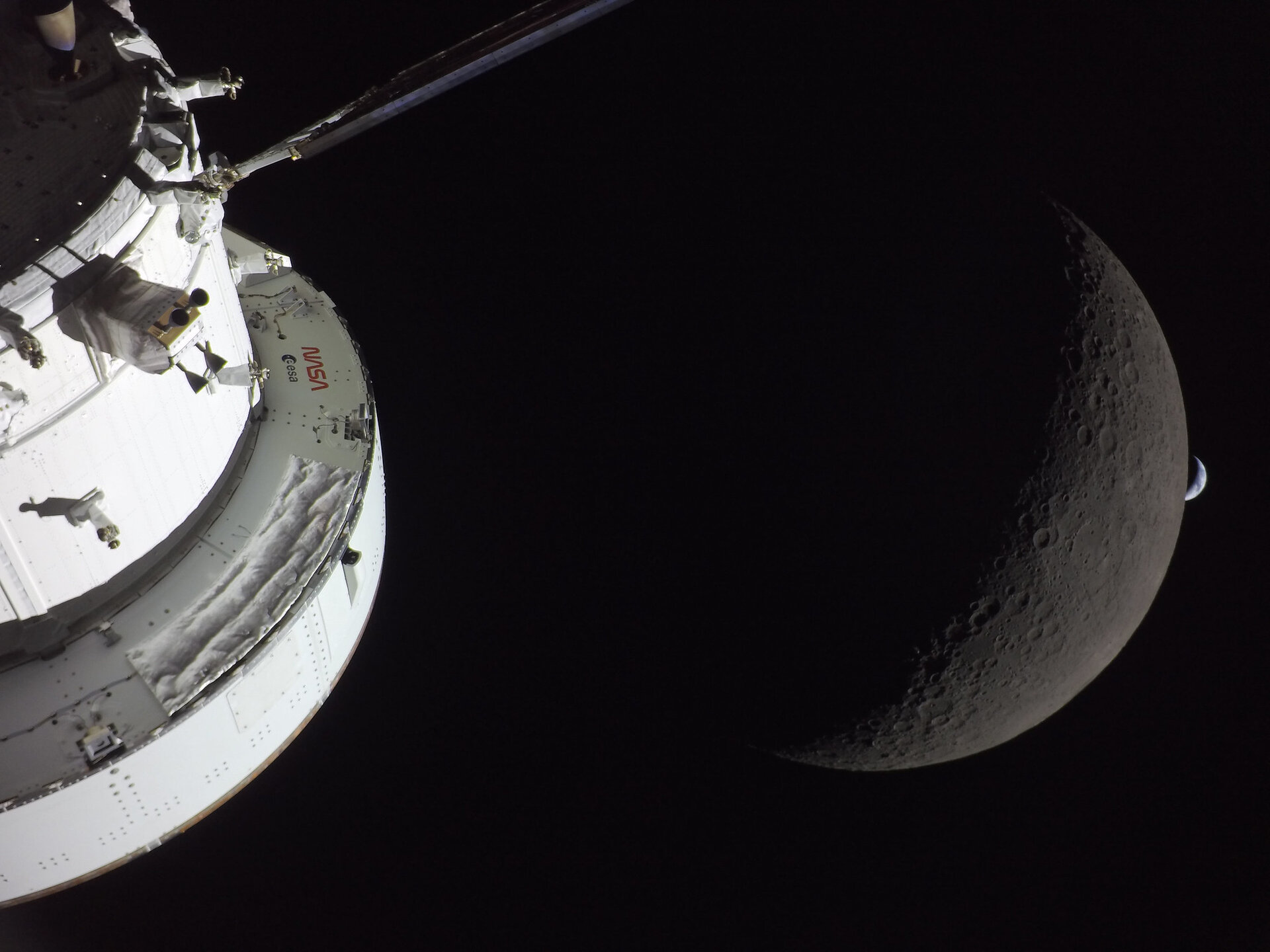

On the sixth day of the Artemis II mission, the Orion spacecraft provided a stunning view of a waxing crescent Moon framed by a smaller crescent Earth, poised to dip below the lunar horizon. This breathtaking shot was captured during Orion’s lunar flyby, as the crew ventured further from Earth than any astronauts before, officially exceeding the distance record set by the Apollo 13 mission at 406,772 kilometers.
In the image, part of Orion’s European Service Module (ESM) can be seen, including one of its four solar arrays and various reaction control system thruster pods. These solar arrays, designed and built in Europe, are crucial for using solar energy to power the spacecraft throughout its mission. The ESM is equipped with six pods containing four reaction control thrusters each, totaling 24 thrusters. These smaller engines are essential for adjusting Orion’s orientation in space.
The Artemis II mission commenced on April 2 at 00:35 CEST (April 1 at 18:35 local time) with the launch of NASA’s Space Launch System rocket, carrying Orion and its four astronauts toward space. Just 20 minutes post-launch, the European solar arrays successfully deployed, beginning their task of supplying electricity to the spacecraft.
On the second day of flight, the main engine executed a critical trans-lunar injection burn, lasting 350 seconds to place Orion and its crew on a free-return path around the Moon before heading back to Earth. Throughout the journey, the ESM’s eight auxiliary thrusters and 24 reaction control thrusters have been used to ensure precise adjustments to Orion’s trajectory.
As the mission progresses toward its conclusion, the crew module and ESM will eventually separate. The ESM is expected to disintegrate upon re-entering Earth’s atmosphere, while the crew module is slated to splash down in the Pacific Ocean. Teams from the European Space Agency and prime contractor Airbus closely monitor these operations from the Eagle room at ESA’s ESTEC technical center in the Netherlands, as well as from the Orion Mission Evaluation Room at NASA’s Johnson Space Center in Houston. The collaboration between these European teams and the ESM is pivotal in humanity’s return to lunar exploration.










Related Posts


Stay Informed With the Latest & Most Important News
Previous Post
Next Post

Advertisement
-
 01Two Black Holes Observed Circling Each Other for the First Time
 -
 02From Polymerization-Enabled Folding and Assembly to Chemical Evolution: Key Processes for Emergence of Functional Polymers in the Origin of Life
 -
 03Astronomy 101: From the Sun and Moon to Wormholes and Warp Drive, Key Theories, Discoveries, and Facts about the Universe (The Adams 101 Series)
 -
 04True Anomaly hires former York Space executive as chief operating officer
 -
 05Φsat-2 begins science phase for AI Earth images
 -
 06Hurricane forecasters are losing 3 key satellites ahead of peak storm season − a meteorologist explains why it matters
 -
 07Binary star systems are complex astronomical objects − a new AI approach could pin down their properties quickly