
Now Reading: Redox distribution Of Asgard Archaea And Co-occurring Taxa In Microbial Mats From An Early Proterozoic Ecosystem Analog
-
01
Redox distribution Of Asgard Archaea And Co-occurring Taxa In Microbial Mats From An Early Proterozoic Ecosystem Analog

Redox distribution Of Asgard Archaea And Co-occurring Taxa In Microbial Mats From An Early Proterozoic Ecosystem Analog

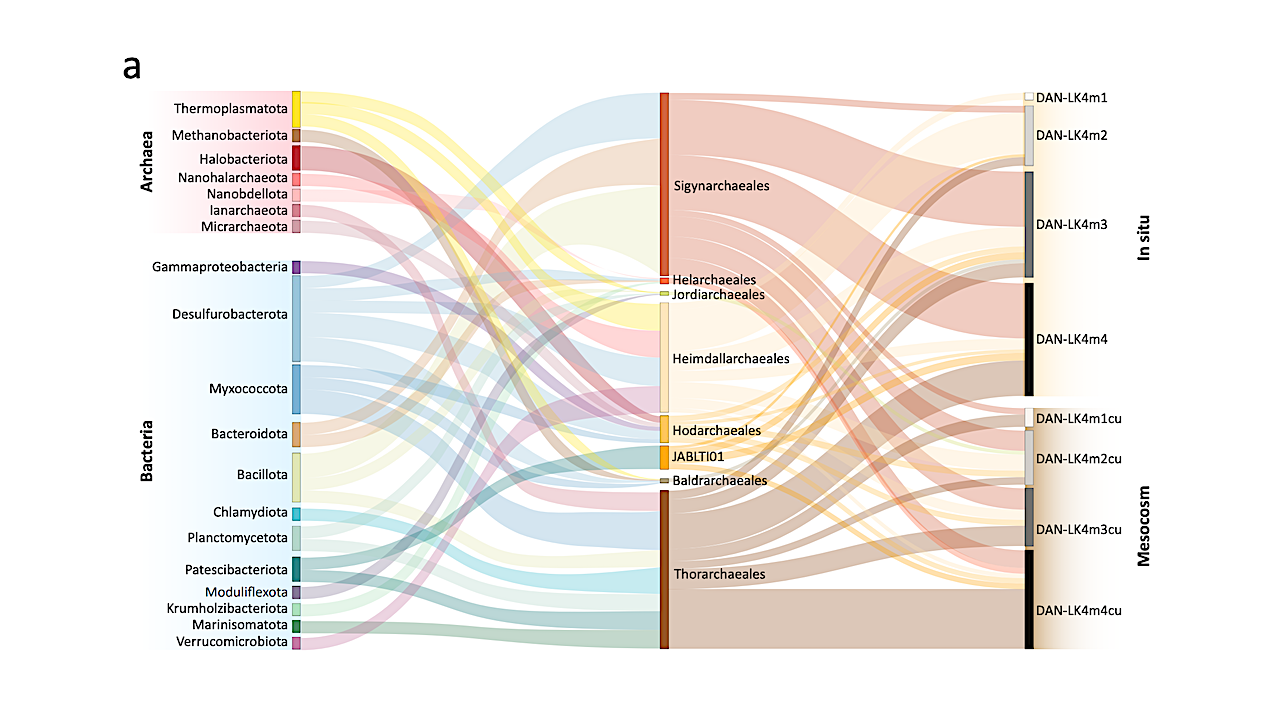
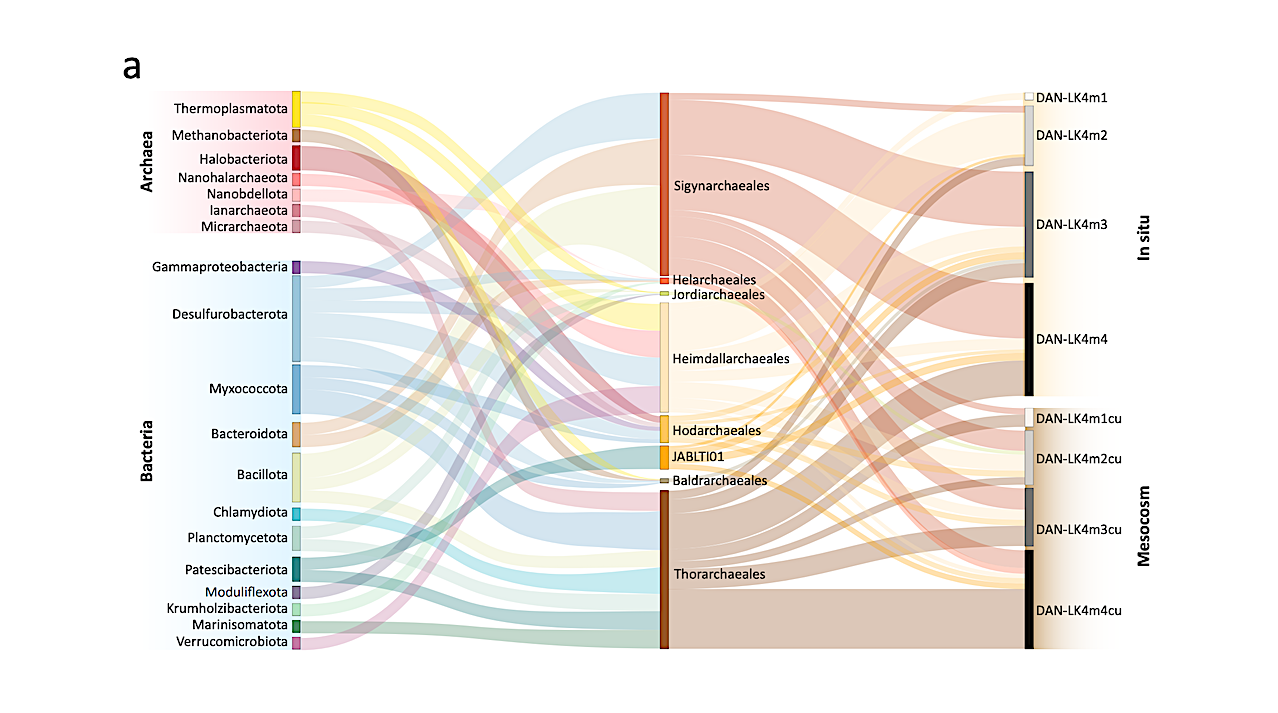
Correlations of Asgardarchaeota with other microbial lineages in DAN-LK4 microbial mats inferred by co-occurrence network analyses. a, Sankey plot showing positive correlations of Asgard archaeal orders based on normalized USCGs (RPKM) inferred by SparCC alongside their distribution across the redox gradient in the indigenous and mesocosm-maintained microbial mat. The size of boxes is proportional to the relative abundance of Asgard archaea (center) and the number of links with prokaryotic taxa (left) in co-occurrence networks. The relative abundance of the different asgardarchaeal orders is indicated by the thickness of links connecting with the different mat layers (right). — biorxiv.org
Eukaryotes originated from the symbiosis of an Asgard archaeon, the alphaproteobacterial ancestor of mitochondria, and possibly additional bacterial contributions.
This transition occurred in redox-transition environments such as microbial mats or shallow sediments ∼2 billion years ago, when atmospheric oxygen was far lower than today. We investigated Asgard-enriched microbial mats from the low-oxygen, sulfidic Catherine volcano lake (Afar region, Ethiopia), mimicking early Proterozoic conditions.
16S rRNA gene metabarcoding, metagenomics, and metagenome-assembled genome analyses across redox-stratified layers of in situ and mesocosm-maintained mats revealed that Asgardarchaeota thrived in the sulfate-reduction zone, mainly co-occurring with Desulfurobacterota-Myxococcota, among others. Lokiarchaeia and Thorarchaeia preferred anoxic layers.
Within Heimdallarchaeia, Heimdallarchaeales were enriched in upper layers, correlating with oxygen-tolerant hydrogenase and sulfate-reduction genes, and Hodarchaeales, in anoxic layers, correlating with methanogenesis.
Although reactive-oxygen-species defense mechanisms were widespread, Asgardarchaeota lacked aerobic respiration. These results support the idea that Asgard archaea engaged primarily in syntrophic interactions with sulfate-reducers under early-Earth-like conditions.
Redox distribution of Asgard archaea and co-occurring taxa in microbial mats from an early Proterozoic ecosystem analog, biorxiv.org (open access)
Astrobiology, genomics, extremophile,











Related Posts
Stay Informed With the Latest & Most Important News
Previous Post
Next Post

Advertisement
-
 01Two Black Holes Observed Circling Each Other for the First Time
 -
 02From Polymerization-Enabled Folding and Assembly to Chemical Evolution: Key Processes for Emergence of Functional Polymers in the Origin of Life
 -
 03Astronomy 101: From the Sun and Moon to Wormholes and Warp Drive, Key Theories, Discoveries, and Facts about the Universe (The Adams 101 Series)
 -
 04True Anomaly hires former York Space executive as chief operating officer
 -
 05Φsat-2 begins science phase for AI Earth images
 -
 06Hurricane forecasters are losing 3 key satellites ahead of peak storm season − a meteorologist explains why it matters
 -
 07Binary star systems are complex astronomical objects − a new AI approach could pin down their properties quickly