
Now Reading: A TESS Test of the Hybrid Ring Strategy for Technosignature Searches Using GRB 221009A
-
01
A TESS Test of the Hybrid Ring Strategy for Technosignature Searches Using GRB 221009A

A TESS Test of the Hybrid Ring Strategy for Technosignature Searches Using GRB 221009A

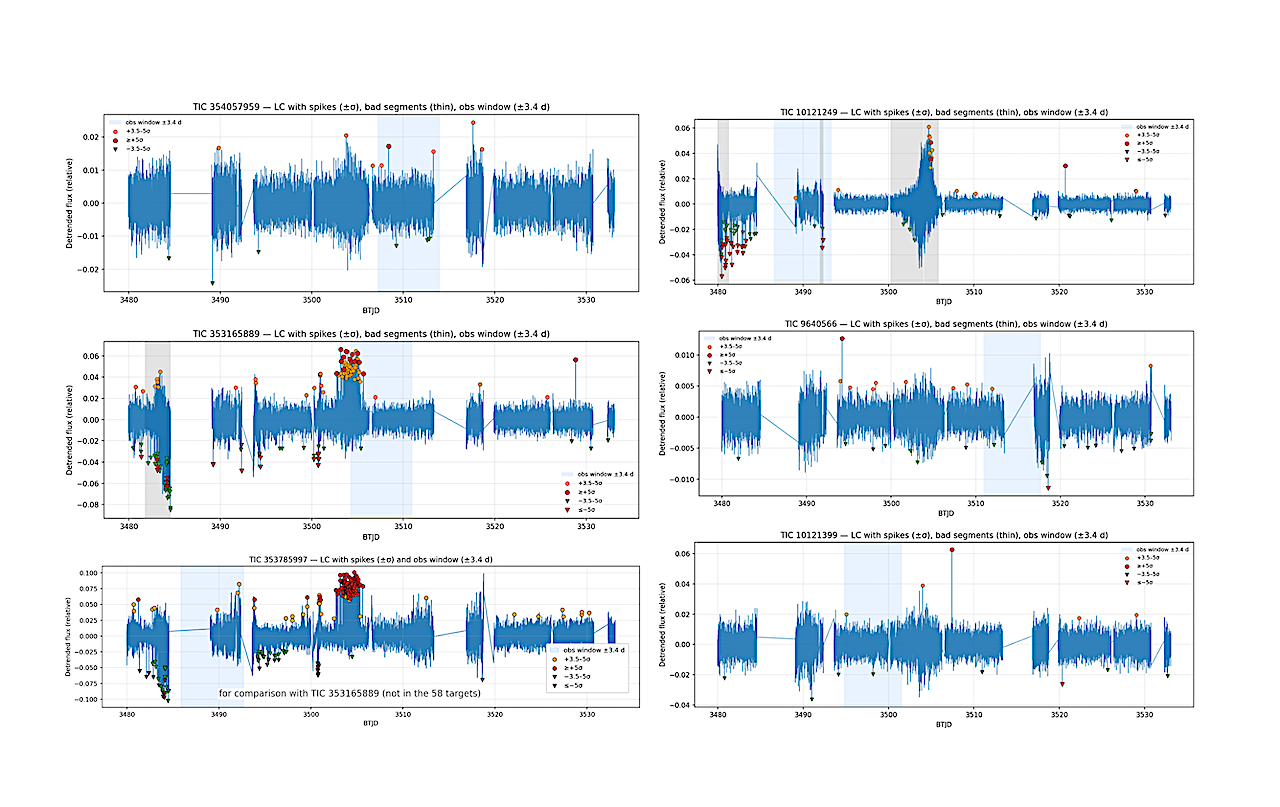

[L] Detrended QLP light curves for (top) TIC 354057959, (middle) TIC 353165889, and (bottom) TIC 353785997. Blue shading indicates the ±3.4 day BOAT search windows, while light gray shading marks bad segments (not excluded from the spike statistics, see Sec. 4.3). Hard spikes (z ≥ 5) are shown in red, soft spikes (3.5 ≤ z 5) in orange, and negative excursions in green (−5 z ≤ −3.5) and dark red (z ≤ −5). TIC 353785997 lies about 771′′ from TIC 353165889 and is not among the 58 ring-selected targets; it is shown here solely for comparison. The two stars exhibit nearly simultaneous positive excursions near BTJD 3503. [R] Detrended QLP light curves for the three targets exhibiting the largest positive excursions in our sample (z ≥ 10): (top) TIC 10121249, (middle) TIC 9640566, and (bottom) TIC 10121399. The three spikes are outside the arrival time windows. — astro-ph.IM
We present the first observational test of the hybrid ring strategy, a general coordinated signaling scheme proposed by Seto (2025), which provides a practical Schelling-point realization for interstellar signaling.
We use the exceptionally bright GRB 221009A as the anchoring flash for the scheme, together with the accurately measured distance to the Galactic center. This combination provides a high-precision relation linking sky position to a tightly constrained arrival-time window.
TESS observed the region around the GRB nearly continuously for ~50 days in 2024, providing survey light curves that enable a direct test of this scheme with sharply predicted arrival-time windows of ∼3.4 days.
Among 58 carefully selected stars, we identify two that show noticeable single-time-bin brightenings inside their predicted windows (where each time bin corresponds to a 200 s integrated TESS exposure).
In both cases the brightenings coincide with excursions in at least one nearby star and are therefore most consistent with instrumental origins. This test demonstrates that the hybrid ring strategy is practical with existing survey data and could serve as a promising basis for future technosignature searches.
Naoki Seto
Comments: 18 pages, 5 figures
Subjects: Instrumentation and Methods for Astrophysics (astro-ph.IM); Popular Physics (physics.pop-ph)
Cite as: arXiv:2604.06807 [astro-ph.IM] (or arXiv:2604.06807v1 [astro-ph.IM] for this version)
https://doi.org/10.48550/arXiv.2604.06807
Focus to learn more
Submission history
From: Naoki Seto
[v1] Wed, 8 Apr 2026 08:21:05 UTC (1,415 KB)
https://arxiv.org/abs/2604.06807
Astrobiology, SETI,











Related Posts
Stay Informed With the Latest & Most Important News
Previous Post
Next Post





Advertisement
-
 01Two Black Holes Observed Circling Each Other for the First Time
 -
 02From Polymerization-Enabled Folding and Assembly to Chemical Evolution: Key Processes for Emergence of Functional Polymers in the Origin of Life
 -
 03Astronomy 101: From the Sun and Moon to Wormholes and Warp Drive, Key Theories, Discoveries, and Facts about the Universe (The Adams 101 Series)
 -
 04True Anomaly hires former York Space executive as chief operating officer
 -
 05Φsat-2 begins science phase for AI Earth images
 -
 06Hurricane forecasters are losing 3 key satellites ahead of peak storm season − a meteorologist explains why it matters
 -
 07Binary star systems are complex astronomical objects − a new AI approach could pin down their properties quickly