
Now Reading: Determining the Host Stars of Planets in Binary Star Systems with Asterodensity Profiling: Investigating the Canonical Radius Gap
-
01
Determining the Host Stars of Planets in Binary Star Systems with Asterodensity Profiling: Investigating the Canonical Radius Gap

Determining the Host Stars of Planets in Binary Star Systems with Asterodensity Profiling: Investigating the Canonical Radius Gap

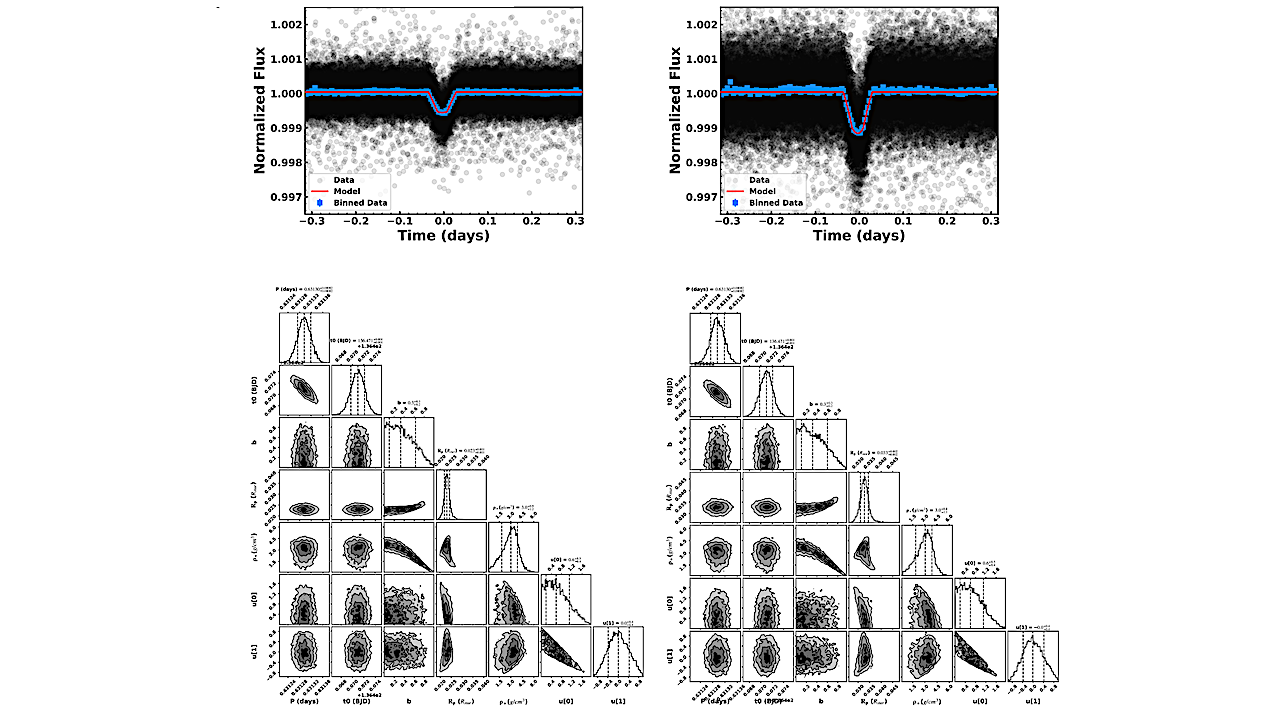
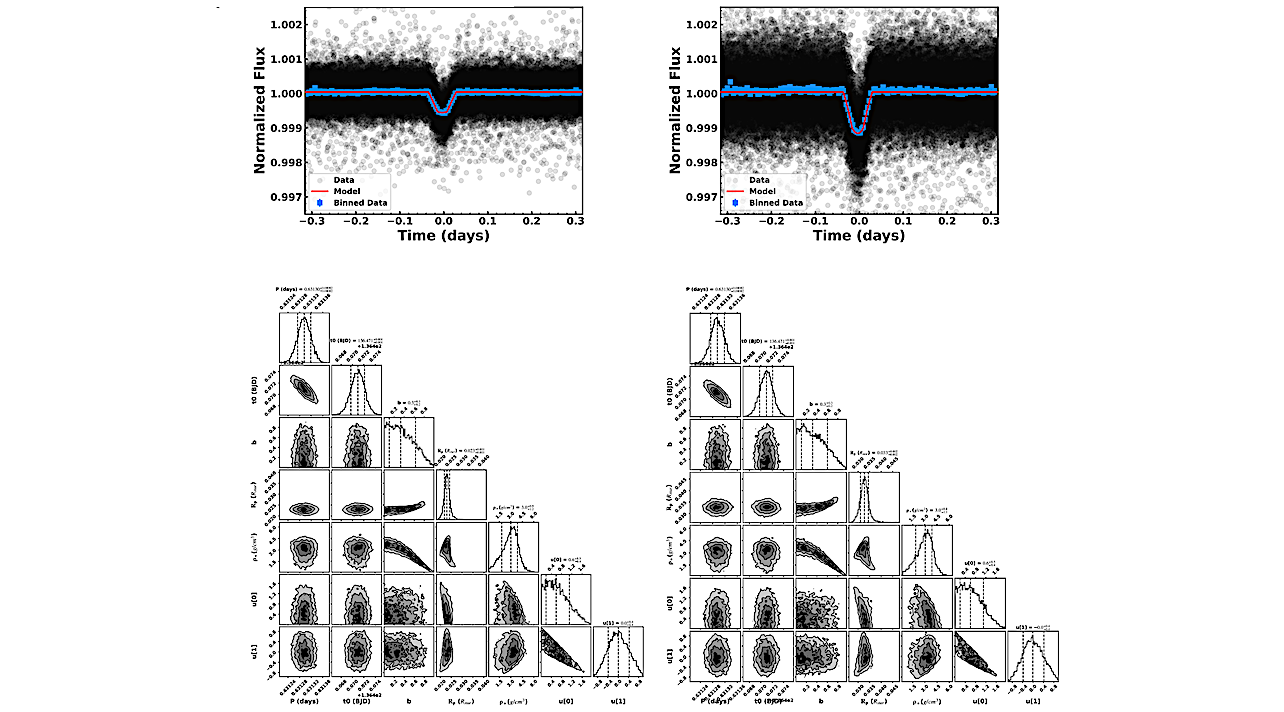
The transit fitting results for KOI-1300.01. The upper right panel shows the phase-folded and contamination-corrected transit lightcurve for the planet’s circumprimary case. The gray circles are the normalized and contamination corrected flux values. The blue squares are the normalized flux values obtained from binning 800 data points at a time. The red line is the model fit to the data. The lower right panel shows the same information for the circumsecondary case. The upper left panels shows the corner plots from the MCMC sampling in the circumprimary case. The lower left shows the corner plots for the circumsecondary case. — astro-ph.EP
Over the past 30 years, thousands of exoplanets have been discovered, revealing detailed demographics of planets outside the Solar System.
One of the most dramatic features of the planet radius distribution is the radius gap, a lack of planets between ∼1.8-2 R⊕. The radius gap is thought to mark the distinction between rocky and gas planets. Recent research has found that the radius gap may not be present in binary star systems.
In past studies of planets in binary star systems, the common assumption has been that all of the planets are hosted by the primary star. In many cases, the radius of the planet would be significantly larger if it were orbiting the companion star, which could potentially affect the true radius distribution. It is possible to identify the host stars of planets through stellar density estimates obtained from transit fitting.
Using this method, we made probabilistic estimates for the host stars of a sample of 15 transiting exoplanets across 10 binary star systems hosting either 1 or 2 planets, at least one of which would reside in the canonical radius gap if it was circumprimary. We found that 5 of the planets are highly likely to be circumprimary, while the remainder have ambiguous host stars.
The lack of unambiguously circumsecondary planets is caused by physical and observational biases that favor circumprimary planets. Nonetheless, the summed posterior probabilities suggest that the canonical radius gap appears less vacant for planets in binaries.
Nathanael Burns-Watson, Kendall Sullivan, Adam Kraus
Comments: 15 pages, 9 figures
Subjects: Earth and Planetary Astrophysics (astro-ph.EP); Solar and Stellar Astrophysics (astro-ph.SR)
Cite as: arXiv:2604.06388 [astro-ph.EP] (or arXiv:2604.06388v1 [astro-ph.EP] for this version)
https://doi.org/10.48550/arXiv.2604.06388
Focus to learn more
Submission history
From: Nathanael Burns-Watson
[v1] Tue, 7 Apr 2026 19:19:28 UTC (1,265 KB)
https://arxiv.org/abs/2604.06388
Astrobiology, exoplanet,











Related Posts
Stay Informed With the Latest & Most Important News
Previous Post
Next Post




Advertisement
-
 01Two Black Holes Observed Circling Each Other for the First Time
 -
 02From Polymerization-Enabled Folding and Assembly to Chemical Evolution: Key Processes for Emergence of Functional Polymers in the Origin of Life
 -
 03Astronomy 101: From the Sun and Moon to Wormholes and Warp Drive, Key Theories, Discoveries, and Facts about the Universe (The Adams 101 Series)
 -
 04True Anomaly hires former York Space executive as chief operating officer
 -
 05Φsat-2 begins science phase for AI Earth images
 -
 06Hurricane forecasters are losing 3 key satellites ahead of peak storm season − a meteorologist explains why it matters
 -
 07Binary star systems are complex astronomical objects − a new AI approach could pin down their properties quickly