
Now Reading: Ripples in spacetime may have revealed 1st evidence of tiny black holes born in the Big Bang
-
01
Ripples in spacetime may have revealed 1st evidence of tiny black holes born in the Big Bang

Ripples in spacetime may have revealed 1st evidence of tiny black holes born in the Big Bang

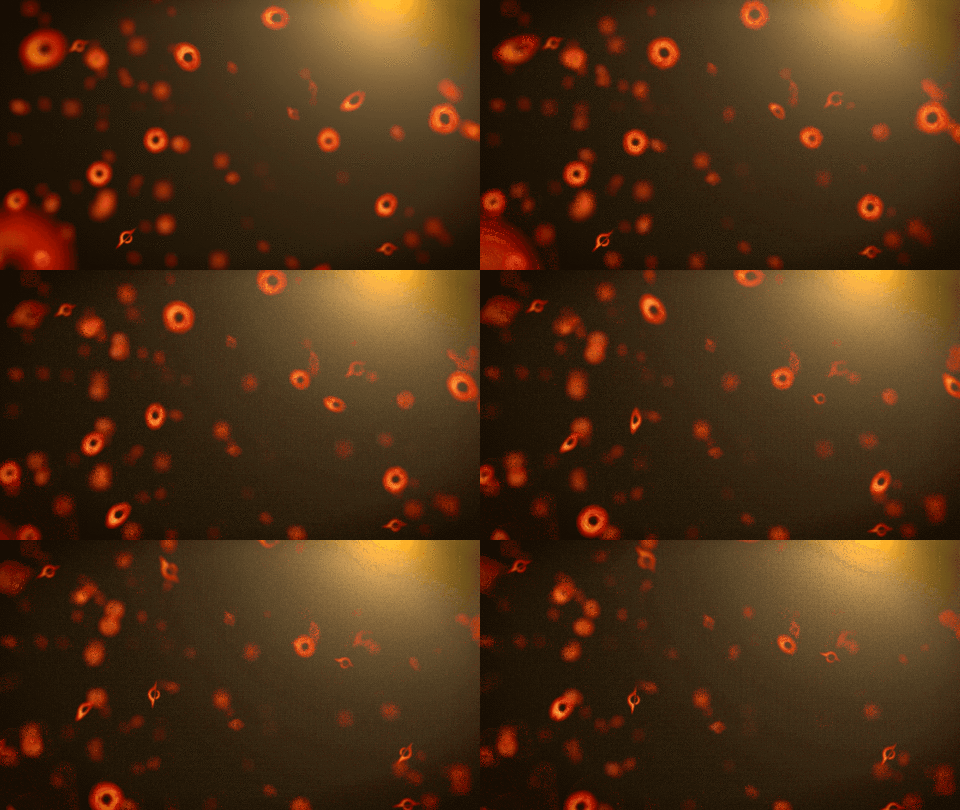
Ripples in the very fabric of space and time called “gravitational waves” may have provided the first tantalizing evidence of tiny black holes born during the Big Bang. These primordial black holes could, in turn, account for most if not all of the universe’s most mysterious stuff, known as dark matter.
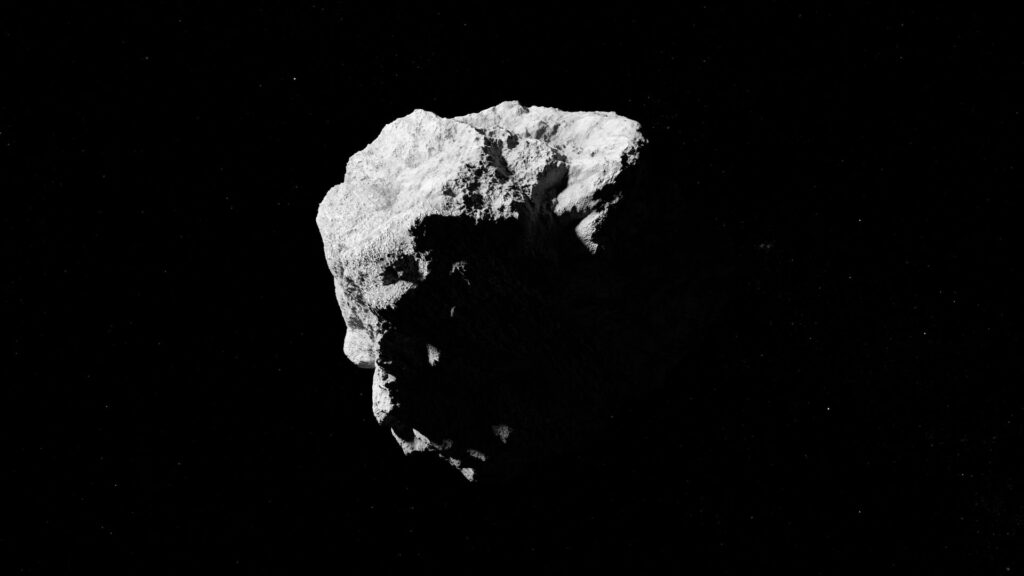
Unlike stellar mass black holes, primordial black holes weren’t born when massive stars died, but instead from fluctuations in density that occurred immediately after the birth of the cosmos. That means they can be much smaller than stellar mass black holes, which have at least the same mass as several suns. These Big-Bang-born “non-astrophysical” black holes can have masses as small as that of an average asteroid or as large as a massive planet.
“The most common black holes form as the result of a supernova, the death of a massive star. So, their masses can range from a few times the sun’s mass to billions of solar masses,” University of Miami researcher Nico Cappelluti said in a statement. “We believe our study will aid in confirming that they [primordial black holes] actually do exist.”
There remains the possibility that the gravitational wave signal mentioned above was a false alarm, the result of interference or “noise” in LIGO’s massive interferometer laser arms. However, Cappelluti and his University of Miami colleague, Alberto Magaraggia, believe that the unusual signal couldn’t be caused by anything but a primordial black hole.
And they intend to prove it.
“We attempted to estimate how many primordial black holes may exist in the universe and how many of them LIGO should be able to detect, and our results are encouraging,” Magaraggia said. “We predict that subsolar black holes like the one LIGO may have observed should indeed be rare, consistent with how infrequently such events have been seen so far.
“The most plausible explanation for the LIGO signal, which lacks any conventional astrophysical explanation, is the detection of a primordial black hole. And our research indicates that these primordial black holes could account for a significant portion, if not all, of dark matter.”
Connecting dark matter and primordial black holes
Dark matter is a pressing puzzle for physicists because, despite accounting for 85% of the universe’s matter and thus outweighing the “everyday matter” comprising stars, planets, moons, asteroids, our bodies, and everything we see around us by a ratio of five to one, they have no idea what this stuff actually is. That is partially because, unlike the particles that account for that everyday matter, dark matter doesn’t interact with electromagnetic radiation, light to you and me. That makes it effectively invisible, with scientists only able to infer the presence of dark matter due to its interaction with gravity and the knock-on effect this has on light and everyday matter.
In fact, the gravitational influence of dark matter is crucial as the gravity of the visible matter in galaxies alone isn’t sufficient to hold them together.
The unusual characteristics of dark matter have prompted scientists to search beyond the standard model of particle physics for particles that could comprise it. Thus far, this search has turned up empty-handed. That has led some scientists to postulate that dark matter could be partially or wholly accounted for by primordial black holes. Like all black holes, primordial black holes have mass and thus interact with gravity and are effectively invisible due to the fact that they are bounded by a light-trapping surface called an event horizon. That makes them a good fit for dark matter.
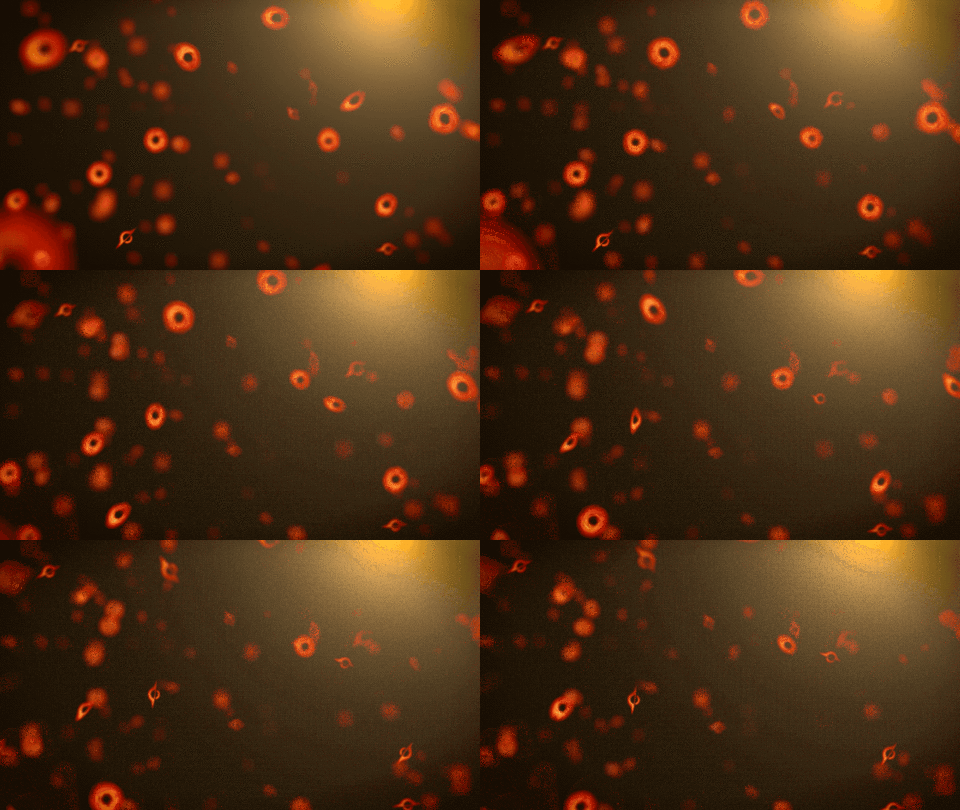
However, as Cappelluti and Magaraggia concede, as convinced as they are that this mystery signal indicates the existence of primordial black holes, a lot more evidence of these non-astrophysical black holes will be needed before they can be firmly connected to dark matter.
With U.S.-based LIGO and its gravitational wave detector partners, Virgo in Italy and KAGRA in Japan, set for sensitivity boosts and a future wealth of highly sensitive gravitational wave detectors such as the space-based LISA (Laser Interferometer Space Antenna), on the horizon, this could be merely a case of waiting for technology to catch up to theory. But that is nothing new. Considering that gravitational waves were first predicted by Einstein in 1915 and the first successful detection was only made 100 years later in 2015, hunting these ripples in spacetime has always been a waiting game requiring a lot of patience.
“LIGO picked up what is very strong evidence that these types of black holes exist. But we’ll need to detect another such signal or even several others to get the smoking-gun confirmation that they are real,” Cappelluti said. “But what is clear is that they cannot be excluded as being real.”
The team’s research has been accepted for publication in the Astrophysical Journal and is available as a preprint on the paper repository arXiv.










Related Posts


Stay Informed With the Latest & Most Important News
Previous Post
Next Post





Advertisement
-
 01Two Black Holes Observed Circling Each Other for the First Time
 -
 02From Polymerization-Enabled Folding and Assembly to Chemical Evolution: Key Processes for Emergence of Functional Polymers in the Origin of Life
 -
 03Astronomy 101: From the Sun and Moon to Wormholes and Warp Drive, Key Theories, Discoveries, and Facts about the Universe (The Adams 101 Series)
 -
 04True Anomaly hires former York Space executive as chief operating officer
 -
 05Φsat-2 begins science phase for AI Earth images
 -
 06Hurricane forecasters are losing 3 key satellites ahead of peak storm season − a meteorologist explains why it matters
 -
 07Binary star systems are complex astronomical objects − a new AI approach could pin down their properties quickly