
Now Reading: NASA prepares for Artemis 2 return
-
01
NASA prepares for Artemis 2 return


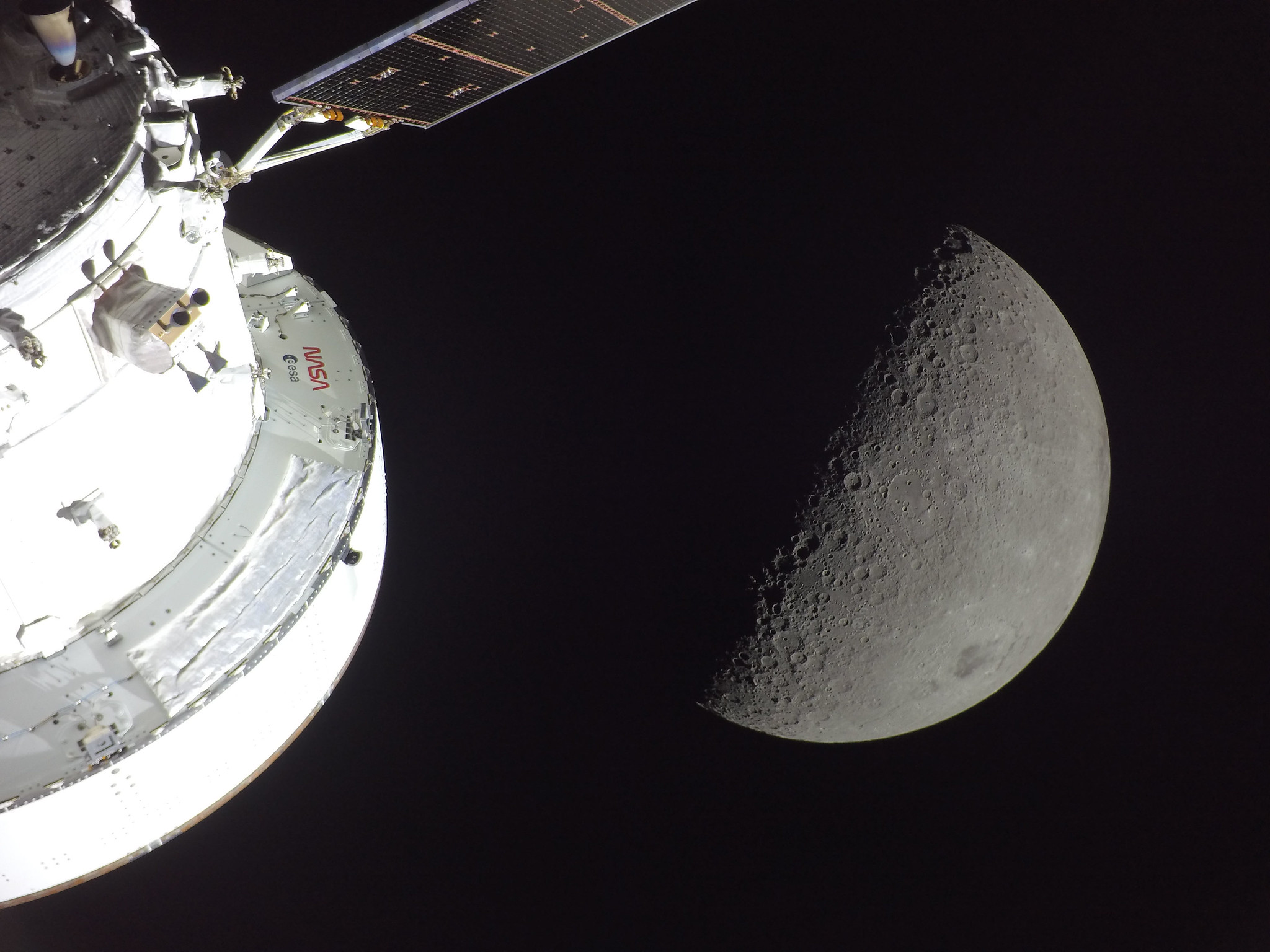

WASHINGTON — The Artemis 2 mission is set for a final, fiery test when the spacecraft reenters April 10 ahead of a splashdown off the California coast.
Artemis 2 will wrap up a mission lasting a little more than nine days with a tightly choreographed sequence of events in the mission’s final hour. It starts with the separation of the Orion crew module from its service module at 7:33 p.m. Eastern.
That will be followed a few minutes later by a maneuver by the crew module, called the crew module raise burn. “This is typically not a burn that’s going to be required, but it’s our final opportunity to fine-tune our flight path angle before entry interface,” Rick Henfling, Artemis 2 entry flight director, said at an April 8 briefing.
The capsule will also do a couple of roll maneuvers to increase separation from the service module, which will make a destructive reentry over the Pacific. NASA considers the crew module’s reentry to formally begin with an “entry interface” at an altitude of 121.9 kilometers, 13 minutes before splashdown. “That’s when the fun really begins,” he said, with the astronauts experiencing up to 3.9 Gs of acceleration during reentry.
Seconds later, a six-minute communications blackout will begin, created by the plasma from the spacecraft’s reentry. The capsule will fly a slightly lofted trajectory during reentry, holding at an altitude of about 60 kilometers while bleeding off speed before continuing its descent.
Two drogue parachutes will deploy at an altitude of 6,700 meters, followed by three main parachutes at an altitude of 1,800 meters. They will slow the spacecraft to a speed of 32 kilometers per hour at the time of splashdown, 8:07 p.m. Eastern.
A recovery team from the U.S. Navy ship USS John P. Murtha will head to the capsule after splashdown. Once flight controllers confirm there are no hazards, such as toxic propellants, the team will arrive on small boats and extract the astronauts from the capsule, who will then be loaded into helicopters to take them to the ship.
“We expect to recover the crew and deliver them to the medical bay within two hours of splashdown,” Lili Villarreal, landing and recovery director for the mission, said at the briefing. Separately, the capsule will be towed back to the ship and secured in the ship’s well deck.
The reentry will be scrutinized because of issues with the heat shield on Artemis 1, which suffered more erosion than expected. That led NASA to redesign the heat shield for later Artemis missions, but for Artemis 2, NASA developed an alternative reentry profile intended to reduce the peak heating on the shield.
“From day one, since I started in the program, and then right before they named this crew, we have been talking to the crew about this problem the whole time,” Amit Kshatriya, NASA associate administrator, said of the heat shield at an April 9 briefing. “They’ve been with us on the investigation. They’ve been with us on the production improvements that were made, all the changes to entry procedures.”
“We have high confidence in the system and the heat shield and the parachutes and the recovery systems we put together,” he said. “Our analysis supports it, and tomorrow the crew is going to put their lives behind that confidence.”
Valve redesign
During the Orion spacecraft’s return leg from the moon, engineers reported no problems with critical systems on the spacecraft. However, they have been studying a helium leak in the spacecraft’s propulsion system traced to valves.
“We are seeing what is a small leak in our pressurant system” for oxidizer, said Jeff Radigan, lead Artemis 2 flight director, at the April 9 briefing. The leaks have not affected the performance of thruster burns by the spacecraft during the flight but are an issue for future missions.
“The leak rate we saw in flight is now an order of magnitude higher than what we saw on the ground,” Kshatriya said. “It’s still acceptable, but that will lead us to probably an extensive redesign of that valve system.”
Engineers have taken time during the return leg to better characterize the leaks, canceling a manual piloting test during the trip back to do so. Radigan noted that they need to collect as much data from the valves now because the service module, where they are located, is not recovered after the mission.
Kshatriya said the current system can likely be used for Artemis 3, a flight test in low Earth orbit. “I don’t need those valves to hold pressure in the same way for a LEO orbiting mission, but for a lunar orbit mission, I do. I need all the performance in the system so I can pressurize.”
He said that will likely lead to an “extensive redesign” of those valves. “I’d characterize it as a production redesign risk for the Artemis 4 mission, which I think we can get in front of,” he said. Artemis 4, the first crewed landing attempt of the Artemis program, is currently planned for as soon as early 2028.
“I’m convinced this will not be the pacing item for a lunar mission, so we’ll be able to fix it in the time we need to,” he concluded. “It might take a little while.”










Related Posts



Stay Informed With the Latest & Most Important News
Previous Post
Next Post





Advertisement
-
 01Two Black Holes Observed Circling Each Other for the First Time
 -
 02From Polymerization-Enabled Folding and Assembly to Chemical Evolution: Key Processes for Emergence of Functional Polymers in the Origin of Life
 -
 03Astronomy 101: From the Sun and Moon to Wormholes and Warp Drive, Key Theories, Discoveries, and Facts about the Universe (The Adams 101 Series)
 -
 04True Anomaly hires former York Space executive as chief operating officer
 -
 05Φsat-2 begins science phase for AI Earth images
 -
 06Hurricane forecasters are losing 3 key satellites ahead of peak storm season − a meteorologist explains why it matters
 -
 07Binary star systems are complex astronomical objects − a new AI approach could pin down their properties quickly