
Now Reading: Why I’m hunting for Comet Pan-STARRS right now — before it’s too late
-
01
Why I’m hunting for Comet Pan-STARRS right now — before it’s too late


Comet-hunting often means going it alone. In the quiet dark of a sleeping house, I slip out of bed well before dawn, careful not to wake anyone, and make my way up the creaking stairs into the loft.
At the top, I ease open the door and reach for the window. The latch clicks, the frame shifts — and suddenly a rush of cold air floods in. It’s enough to wake me instantly. I pull on a winter coat, shut the door behind me to keep the warmth below, and lean out into the stillness.
I’m expecting clouds — I always expect clouds — but this morning the sky is clear. Finally! Stars hang in the darkness, but the eastern horizon is beginning to glow — a soft, growing light that signals the sun’s rise. Somewhere in that narrowing window between night and day is my target: a faint, ancient visitor, visible only briefly before sunrise.
Before me is a suite of gear assembled the night before — a manual camera with a telephoto lens on a tripod, a smart telescope and, now around my neck, a pair of 10×50 binoculars. I begin to scan, using the brighter stars as guides, having memorized a star chart showing exactly where the comet is this morning. My view is framed by rooftops and chimneys. Then, just above the horizon, it appears in my field of view — a dim, diffuse smudge, almost ghostly against the brightening sky.
“Got it,” I whisper, to no one but myself. I resist the temptation to say hello to the comet. After all, it’s just a big snowball.
Are you ready for the arrival of Comet C/2025 R3 (Pan-STARRS)? Hunting a dawn comet is a race against daylight — one that begins in the stillness of early morning and ends in the glow of dawn. For those willing to make the effort, the reward is a fleeting glimpse of a relic from the solar system’s edge, revealed in the quietest moments of the day.
What to expect from comet Pan-STARRS
No one ever quite knows what a newly arrived comet will do. When the Pan-STARRS survey in Hawaii discovered it in September 2025, it was just another faint point of light. A long-period comet, it likely returns to the inner solar system only once every 170,000 years. Like almost all comets, it’s a one-off opportunity for anyone alive today.
Right now, the comet is hovering just below magnitude +6, according to the Comet Observation database, so already technically on the edge of naked-eye visibility under very dark night skies.
As it approaches perihelion on April 19-20, it is expected to brighten rapidly — potentially reaching magnitude +3 — making it a relatively easy binocular object and possibly visible to the unaided eye in excellent conditions. Even if it reaches naked-eye brightness, binoculars will give a much better view.
However, there’s a geometrical catch. As the comet brightens, it also moves closer to the sun in the sky, it’s lower on the horizon, and it’s fighting against the brighter twilight. That means its peak brightness may coincide with its most difficult observing conditions.
When and where to look for comet Pan-STARRS

From mid-northern latitudes, the best chance to see comet C/2025 R3 (Pan-STARRS) will be about 90 minutes before sunrise, when it will be low in the eastern sky. What you’re looking for is subtle: a soft, diffuse coma, possibly with the beginnings of a tail. At present, the comet shows little tail in small optics, but that could change quickly as solar heating intensifies.
The key window is April 10-20, when the comet is brightening but not yet too deeply embedded in the sun’s glare. After perihelion, it becomes increasingly difficult — and eventually impossible — to see from the Northern Hemisphere. “If you want to catch the comet, your best chance is over the next week or so as the comet brightens, but it remains observable in a relatively dark sky,” says Nick James, head of the comet section at the British Astronomical Association. “You will need to get up early, a couple of hours before sunrise, and have a good, low, eastern horizon.”
By contrast, Southern Hemisphere observers will have the advantage later in April and into May, when the comet moves away from the sun in their skies and becomes better placed after perihelion.
How I’m planning to see comet Pan-STARRS
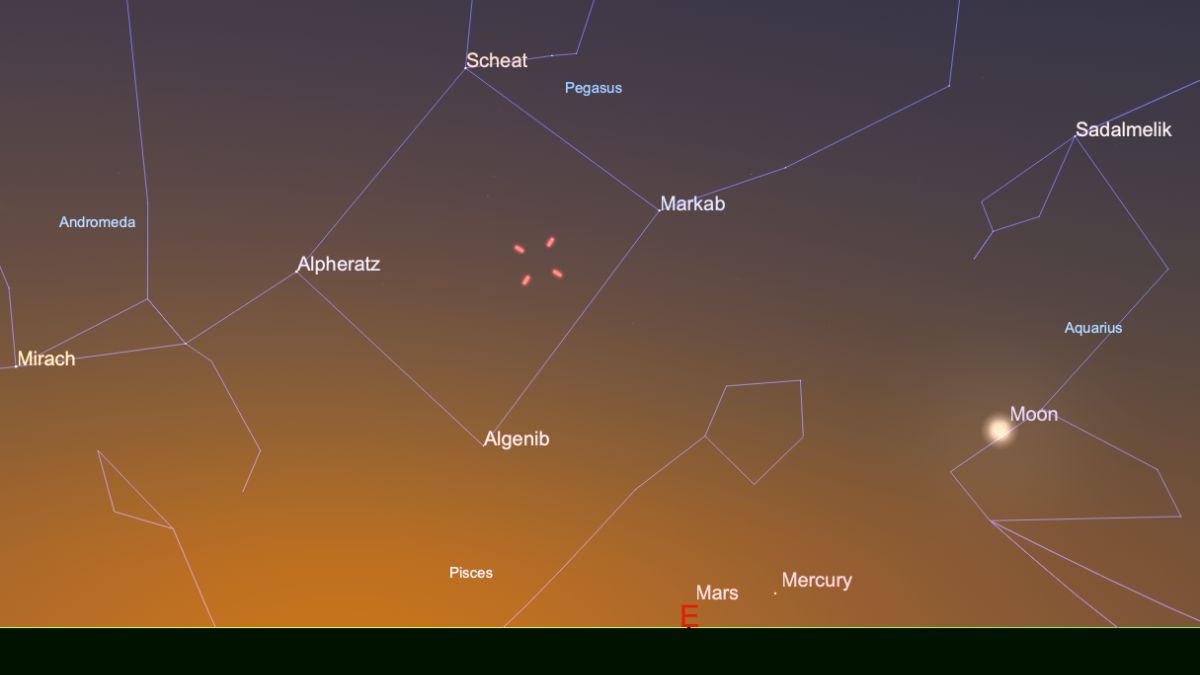
Preparation and clear skies are everything. The night before, I’ll look at the weather forecast and use planetarium software — Stellarium, Starry Night or a stargazing app like Sky Tonight or Sky Guide — to pinpoint the comet’s exact position relative to the stars in the Great Square. As twilight takes hold, there’s no time to search blindly — you need to know exactly where to look.
Binoculars will be my primary tool, sweeping slowly along the horizon. A 10×50 pair strikes the right balance between field of view and light-gathering power.
For imaging, I’ll use a tripod-mounted camera with a 200–400mm lens, experimenting with ISO 1600–6400 and short exposures. Shooting in RAW is essential — faint comet detail often emerges only later. I’ll have a smart telescope nearby, too, to automatically lock on to the comet and stack image after image.
Is imaging just as important as seeing the comet with your own eyes? Absolutely. There’s a strong possibility that the comet will look better in photographs than it does visually — especially before a tail develops in the days around perihelion.
Comet Pan-STARRS: key dates and highlights

The best plan for observers in the Northern Hemisphere is to get up at least 90 minutes before sunrise whenever clear weather is forecast between now and around April 19. The sooner you do that, the higher the comet will be, but the longer you wait, the brighter it may be — and the more daylight you’ll need to battle. It’s all a balance! However, a few mornings in April stand out as particularly rewarding opportunities to find Comet C/2025 R3 (Pan-STARRS).
- April 14: A 12%-lit waning crescent moon appears nearby, with Mercury becoming visible before sunrise.
- April 18: Comet Pan-STARRS is within about 2 degrees of galaxy NGC 7814, a distant edge-on spiral. A new moon the previous day will make this date and those on either side the sweet spot.
- April 19: Comet Pan-STARRS exits the Great Square region, appearing about 2 degrees from bright star Algenib.
Asterism of the week: Great Square of Pegasus

If you know the famous asterism, the Great Square of Pegasus, by heart already, you’ll know exactly where it is. If you don’t, it’s easy to find because its corners are marked by four stars of roughly equal brightness — Scheat, Alpheratz, Markab and Algenib. From April 13-19, the comet will travel across the bottom of the Great Square, from just above the bright stars Markab to just above Algenib, before it moves into Pisces.
Comet Pan-STARRS may get brighter, but it will also get harder to see and will, in any case, get drowned by dawn. My advice? Go find it on the next clear morning — and aim to get it in your sights at least once before April 19.










Related Posts


Stay Informed With the Latest & Most Important News
Previous Post
Next Post




Advertisement
-
 01Two Black Holes Observed Circling Each Other for the First Time
 -
 02From Polymerization-Enabled Folding and Assembly to Chemical Evolution: Key Processes for Emergence of Functional Polymers in the Origin of Life
 -
 03Astronomy 101: From the Sun and Moon to Wormholes and Warp Drive, Key Theories, Discoveries, and Facts about the Universe (The Adams 101 Series)
 -
 04True Anomaly hires former York Space executive as chief operating officer
 -
 05Φsat-2 begins science phase for AI Earth images
 -
 06Hurricane forecasters are losing 3 key satellites ahead of peak storm season − a meteorologist explains why it matters
 -
 07Binary star systems are complex astronomical objects − a new AI approach could pin down their properties quickly