
Now Reading: Splashdown! Artemis 2 astronauts return to Earth after historic NASA mission to the moon
-
01
Splashdown! Artemis 2 astronauts return to Earth after historic NASA mission to the moon

Splashdown! Artemis 2 astronauts return to Earth after historic NASA mission to the moon

Artemis 2 has come home.
“From the pages of Jules Verne to a modern-day mission to the moon, a new chapter of the exploration of our celestial neighbor is complete. Integrity’s astronauts are back on Earth,” NASA spokesperson Rob Navias said just after splashdown, referring to the name of Artemis 2’s Orion capsule.
A mission of firsts
Artemis 2 launched on April 1, sending four explorers — NASA’s Reid Wiseman, Victor Glover and Christina Koch and the Canadian Space Agency‘s Jeremy Hansen — toward the moon inside Integrity.
It was the second-ever liftoff for NASA’s huge Space Launch System rocket and the first crewed flight for both SLS and Orion.
Artemis 2 was a mission of firsts in many other ways as well. For starters, it launched humanity back to the moon for the first time since Apollo 17 in December 1972. Glover was the first person of color ever to leave Earth orbit, and Koch and Hansen were the first woman and first non-American, respectively, to do so. (The Apollo astronauts had been the only people to achieve this feat, and they were all white American men.)
Artemis 2 also took a unique path to Earth’s nearest neighbor — a “free-return” trajectory that featured a single loop around the far side. The Apollo moon missions, by contrast, targeted lunar orbit, after which some of them touched down on the gray dirt. Apollo 13 ended up flying a free-return trajectory in April 1970, but that wasn’t by design; that mission was supposed to orbit and then land on the moon, but it suffered an explosion en route that scuttled that plan and forced its astronauts into survival mode.
Apollo 13’s unplanned lunar loop sent it 248,655 miles (400,171 kilometers) from Earth, farther than any humans had ever gone before. Artemis 2 broke that record during its own flyby on Monday (April 6), which took the crewmates 252,756 miles (406,771 km) from their home planet.
They don’t want to hold this record for half a century, though, for that would signal a disappointing stagnation in human spaceflight.
“We, most importantly, choose this moment to challenge this generation and the next to make sure this record is not long-lived,” Hansen said shortly after Artemis 2 surpassed Apollo 13.
The Apollo capsules held a maximum of three astronauts. So Artemis 2 was the first mission to fly four people to deep space, as well as the first to send a bona fide toilet beyond Earth orbit. Artemis 2’s space toilet had some issues, but it was still a giant leap for deep-space hygiene; the Apollo astronauts did their business into handheld bags.
The moon up close — and a solar eclipse, too!
But Artemis 2 wasn’t about setting records. It was primarily a shakeout cruise, designed to show that SLS and Orion can fly crewed missions beyond Earth orbit.
There were some science objectives, too. After all, the Artemis 2 astronauts were getting humanity’s first up-close looks at the moon in more than 50 years.
And their free-return trajectory, which featured a lunar close-approach distance of 4,067 miles (6,545 km), gave them different, more zoomed-out views than those of the Apollo astronauts, who mostly observed the moon from a tight orbit. Indeed, during their flyby, the Artemis 2 astronauts saw parts of the far side never before seen with human eyes, which are incredibly capable instruments.
“Human eyes and brains are highly sensitive to subtle changes in color, texture and other surface characteristics,” NASA officials wrote in an Artemis 2 explainer.
“Having astronaut eyes observe the lunar surface directly, in combination with the context of all the advances that scientists have made about the moon over the last several decades, may uncover new discoveries and a more nuanced appreciation for the features on the surface of the moon,” they added.
So NASA scientists prepped the Artemis 2 crewmates extensively, giving them a long list of viewing targets and instructions on how to observe them.
One of the highest-priority landforms was Orientale Basin. This 600-mile-wide (965 km) crater, known as the “Grand Canyon of the moon,” had never been seen in sunlight before, so the science team was keen to get Artemis 2’s eyes on it.
The astronauts obliged, returning detailed observations of Orientale. They reported back effusively about many other features as well. Glover, for example, was particularly taken with the terminator, the boundary between day and night on the moon.
“There’s just so much magic in the terminator — the islands of light, the valleys that look like black holes; you’d fall straight to the center of the moon if you stepped in some of those,” he radioed to Mission Control during the flyby. “It’s just so visually captivating.”

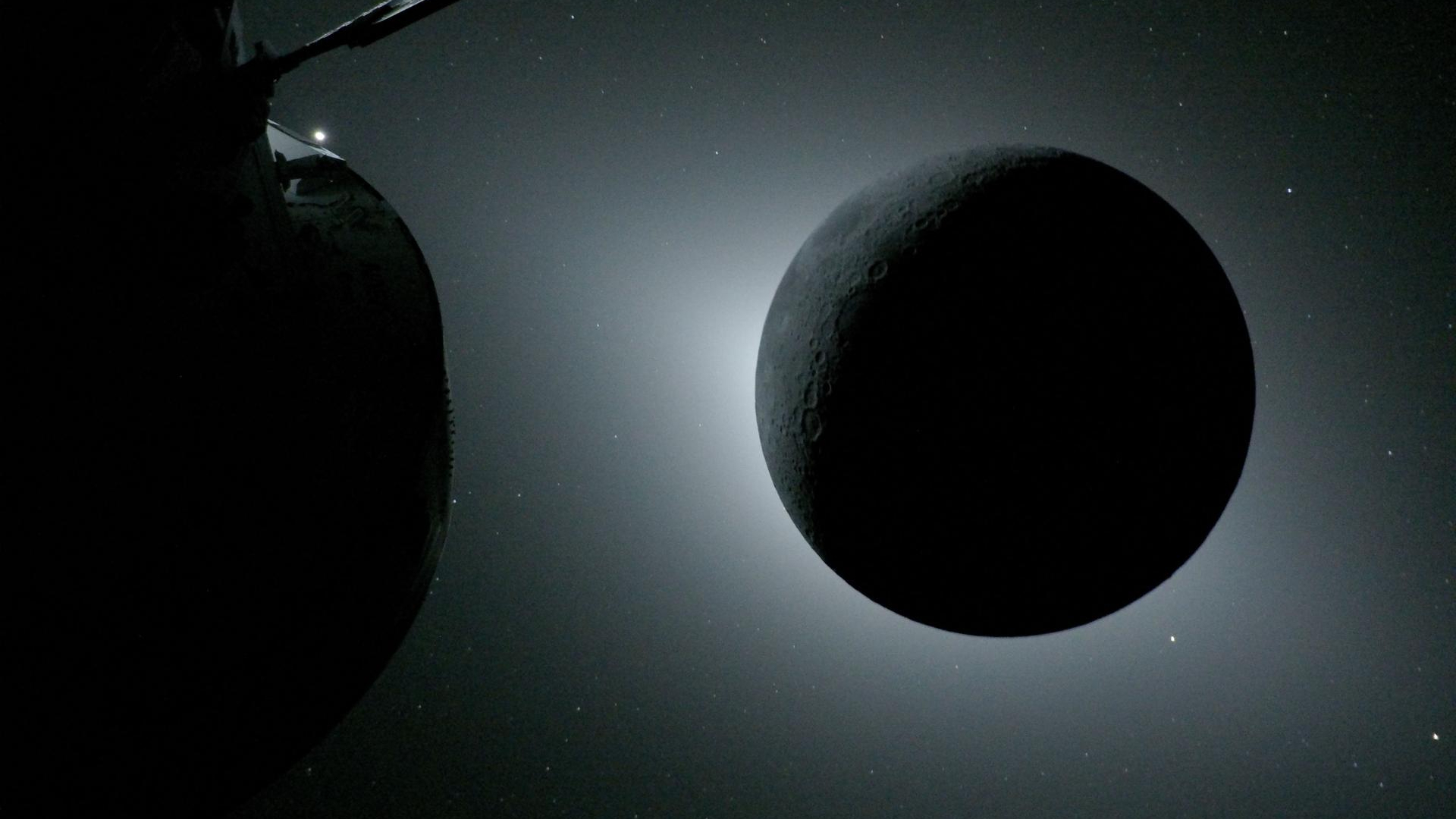
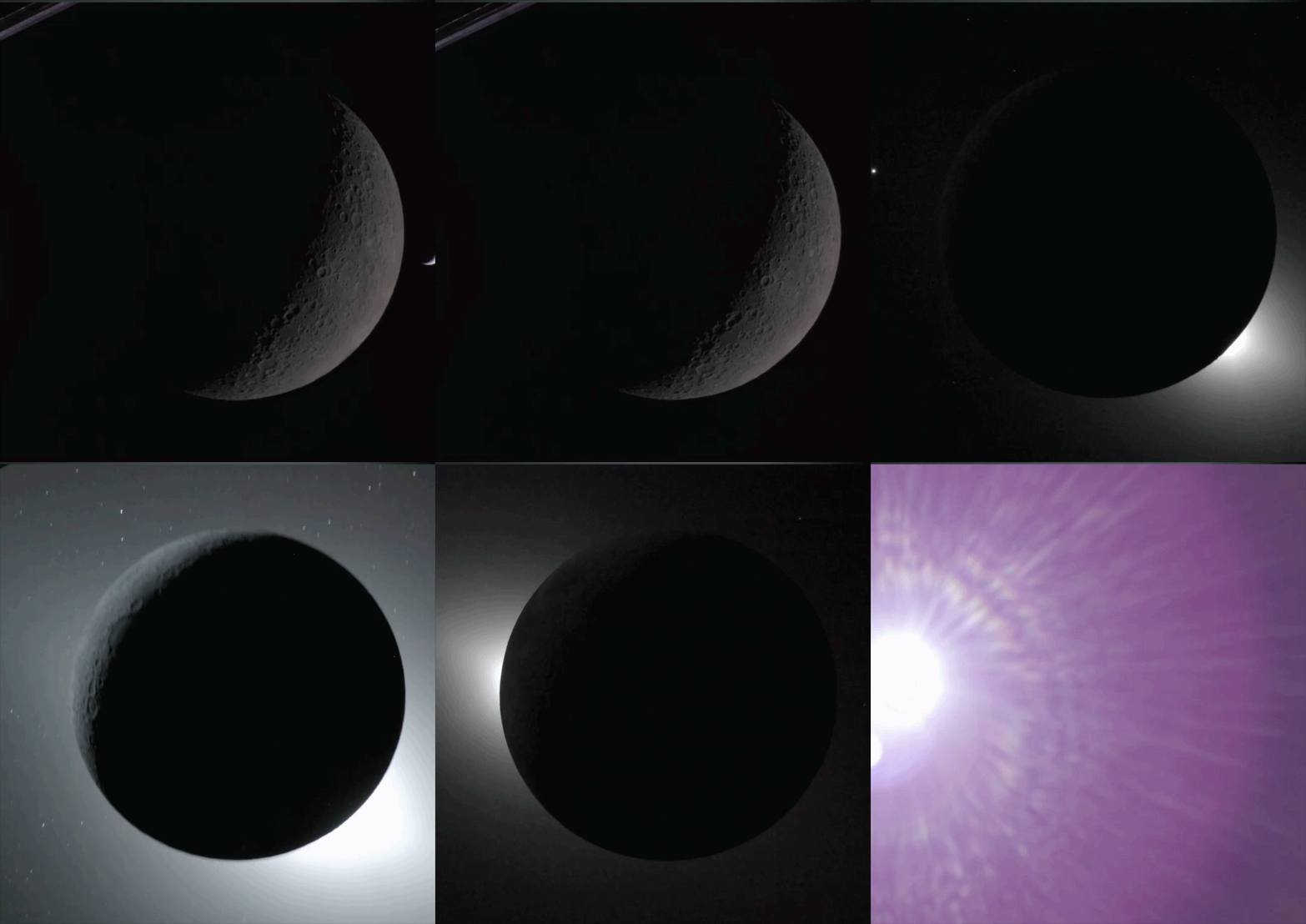
The Artemis 2 astronauts also got to see a total solar eclipse during Monday’s flyby, a happy accident of orbital dynamics locked in by the fact that they launched on April 1. (The eclipse wasn’t visible to us here on Earth.)
Because the moon loomed so large in Artemis 2’s view, it blocked the sun for a whopping 54 minutes — far longer than totality lasts during solar eclipses seen from Earth.
The astronauts dutifully recorded details of the sun’s outer atmosphere, or corona, during the epic event. But they took some time to appreciate it on an emotional level as well.
“When that actually happened, it just blew us all away,” Glover said in a call with reporters on Wednesday (April 8).
There were many such human moments on this mission, and we got to see them thanks to NASA’s 24/7 livestream. For instance, just after Artemis 2 broke Apollo 13’s distance record, Hansen radioed Mission Control asking for permission to name two heretofore anonymous craters on the moon — one after Integrity and one after Wiseman’s late wife Carroll, who died of cancer in 2020.
As Hansen made the case for Carroll Crater, his crewmates fought off tears, without much success.
“For me personally, that was kind of the pinnacle moment of the mission,” Wiseman said in Wednesday’s call. “That was, I think, where the four of us were the most forged, the most bonded, and we came out of that really focused on that day ahead.”
Mission Control agreed to both name proposals, by the way, though they won’t get onto official moon maps until the International Astronomical Union gives the thumbs-up as well.
Coming home
Monday’s lunar flyby did more than break a spaceflight record and enable unprecedented science observations; it also charted Integrity’s course back to Earth. Indeed, that was the main reason NASA picked the free-return trajectory for Artemis 2: Relying on lunar gravity to send Orion home eliminated the need for a major engine burn, reducing risks for this test mission.
So there wasn’t a lot of drama over the past few days as Integrity made its way back toward Earth. But that was just as well, for today’s homecoming had plenty of drama — and a fair bit of danger.
Spacecraft returning from the moon hit Earth’s atmosphere at tremendous speeds — 24,000 mph (38,600 kph) or thereabouts. This generates huge amounts of frictional heating; temperatures around the vehicle can hit 5,000 degrees Fahrenheit (2,800 degrees Celsius).
Orion has a heat shield to deal with such temperatures — the biggest one ever built for crewed flight, in fact, at 16.5 feet (5 meters) wide. But that heat shield showed some cracks on the lone previous Artemis mission — Artemis 1, which successfully sent an uncrewed Orion to lunar orbit and back in late 2022.
Because of that unexpected damage, NASA tweaked Artemis 2’s reentry profile, bringing Integrity in on a steeper angle to limit the amount of time its heat shield was exposed to extreme conditions in the atmosphere. But the agency didn’t modify the heat shield itself, stressing that the hardware was up to the challenge.
That confidence was well placed, for Integrity survived its trial by fire today. The capsule hit the atmosphere over the Pacific Ocean southeast of Hawaii at 7:53 p.m. (2353 GMT). Ten minutes later, the capsule’s drogue parachutes deployed as planned, followed in short succession by its three big main chutes.
The mains helped slow Integrity’s descent to 19 mph (31 kph) — the speed it was traveling when it hit the water at 8:07 p.m. EDT (0007 GMT on April 11) off the coast of San Diego, about 2,000 miles (3,200 km) from the spot where it first slammed into the atmosphere.
“A perfect bulls-eye splashdown for Integrity and its four astronauts,” Navias said. “It was, for all intents and purposes, a textbook mission.”
A recovery ship — the USS John Murtha, from Naval Base San Diego — was waiting in the area to welcome the astronauts home, and to get them to shore for medical checks. Early indications were that all four were doing well.

Bigger things coming
Artemis 2 was a big deal, but it will lead to even more ambitious missions in the next few years, if all goes according to plan.
It’s a step toward the chief goal of the Artemis program: establishing a crewed outpost near the moon’s south pole by the early 2030s. This region is thought to be rich in water ice, which can be used for life support and also processed into rocket fuel. NASA believes that building such a base will help it map out an even grander project — landing astronauts on Mars, which the agency aims to do in the late 2030s or early 2040s.
With Artemis 2 in the books, NASA can now turn its attention to Artemis 3, which is scheduled to send astronauts to Earth orbit in mid-2027. They’ll test docking procedures up there using Orion and one or both of the Artemis program’s contracted lunar landers — SpaceX’s Starship and Blue Origin‘s Blue Moon.
After that will come Artemis 4, which will use one of those privately developed vehicles to put astronauts down near the lunar south pole in late 2028. The timeline is aggressive by design: China aims to pull off its own crewed lunar landing by 2030, and the U.S. wants to win this new space race.
The Artemis 2 mission “kicks off so many other exciting ones to follow,” NASA Administrator Jared Isaacman told reporters on Tuesday (April 7).
“We return to the moon and build that enduring presence to learn so that we can undertake even grander missions … beyond the moon in the future,” he added.










Related Posts

Stay Informed With the Latest & Most Important News
Previous Post
Next Post




Advertisement
-
 01Two Black Holes Observed Circling Each Other for the First Time
 -
 02From Polymerization-Enabled Folding and Assembly to Chemical Evolution: Key Processes for Emergence of Functional Polymers in the Origin of Life
 -
 03Astronomy 101: From the Sun and Moon to Wormholes and Warp Drive, Key Theories, Discoveries, and Facts about the Universe (The Adams 101 Series)
 -
 04True Anomaly hires former York Space executive as chief operating officer
 -
 05Φsat-2 begins science phase for AI Earth images
 -
 06Hurricane forecasters are losing 3 key satellites ahead of peak storm season − a meteorologist explains why it matters
 -
 07Binary star systems are complex astronomical objects − a new AI approach could pin down their properties quickly