
Now Reading: SpaceX Accelerates Development of Lunar Lander for Artemis III with Enhanced Testing and Infrastructure Upgrades
-
01
SpaceX Accelerates Development of Lunar Lander for Artemis III with Enhanced Testing and Infrastructure Upgrades

SpaceX Accelerates Development of Lunar Lander for Artemis III with Enhanced Testing and Infrastructure Upgrades

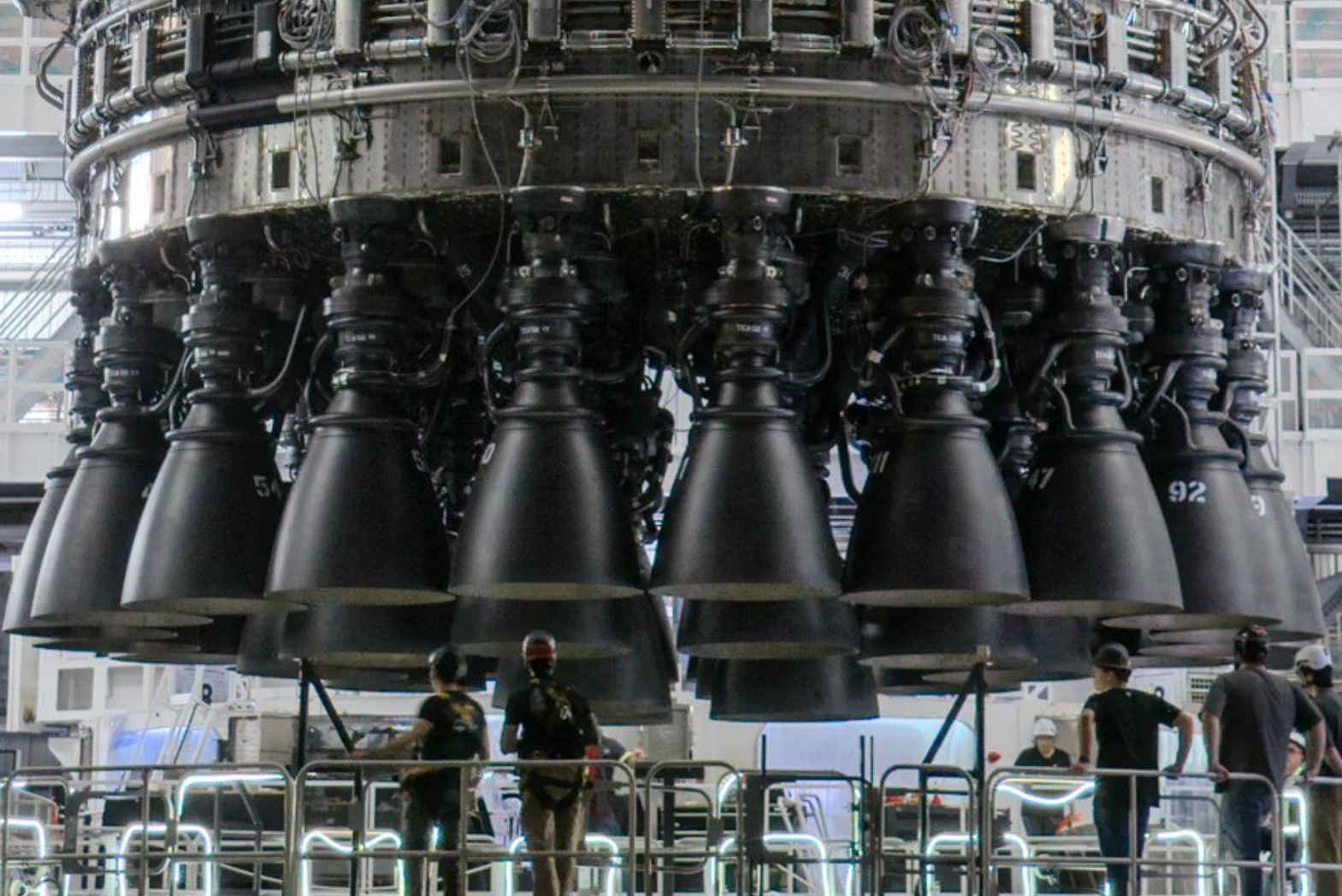

Following the recent successful mission of the Orion spacecraft, the Artemis program is now turning its focus to SpaceX and Blue Origin, which are tasked with developing a crewed lunar lander for the upcoming Artemis III mission. SpaceX’s immediate goal is to achieve full operational capability of its Starship Block 3, which is critical for constructing and launching the Human Landing System (HLS) variant. To facilitate this, its Starship Ship 39 and Booster 19—marking their first Block 3 assembly—recently conducted extensive testing at their respective sites.
Booster 19 has returned to Pad 2 for further engine evaluations following a successful round of tests that wrapped up in mid-March. This latest deployment occurred after a 10-day period at the launch site where the booster underwent significant preparations. During the initial testing campaign, SpaceX worked on activating the pad and the booster itself by mounting and demounting the unit for optimization and conducting several pressure and tanking tests, three of which included actual engine ignitions.
A key aspect of this phase was the refinement of the stacking procedure at the launch pad. SpaceX replaced the older stabilizing system—which required external supports for alignment—with a new ball-and-socket mechanism that integrates position sensors for improved accuracy. Despite the early, slower pace of stacking, the company aims to enhance efficiency through innovations such as advanced camera technologies to monitor the equipment’s status.
SpaceX significantly upgraded the infrastructure at Pad 2, increasing pump capacity and introducing a new loading sequence to streamline operations. With its enhanced setup, the company can now fuel the Superheavy booster in about half the time it previously took for its Falcon 9 rockets, allowing it to handle ten times the propellant load. Recent static fire tests demonstrated these capabilities, although one test was prematurely halted due to an issue on the ground.
Booster 19 is now poised for an extensive testing campaign involving its 33 Raptor 3 engines, with future tests expected to examine various ignition procedures and system functionalities. After completing this round, the booster will return to Mega Bay 1 for final assessments before a planned full-stack test with Ship 39.
Ship 39 has also rolled out, heading to Masseys for its testing phase. This vehicle recently emerged from Mega Bay 2, where it underwent cryo-proof testing as well as assessments of its structural integrity and propellant systems. The latest modifications to Ship 39 include new tile patches on its surface designed to withstand the pressures of reentry, a departure from earlier designs that relied on pinned tiles.
While the specific number of tests for Ship 39 remains uncertain, it’s expected to follow a procedure similar to that of Booster 19, culminating in a series of engine tests aimed at simulating various phases of flight. Once the engine evaluations are completed, Ship 39 will be returned to Mega Bay 2 for final adjustments and integration before the anticipated full-stack testing with Booster 19.
These developments mark significant progress as SpaceX moves forward with its plans for both the Artemis III mission and the ambitious Starship program, shaping the future of human space exploration.










Related Posts



Stay Informed With the Latest & Most Important News
Previous Post
Next Post




Advertisement
-
 01Two Black Holes Observed Circling Each Other for the First Time
 -
 02From Polymerization-Enabled Folding and Assembly to Chemical Evolution: Key Processes for Emergence of Functional Polymers in the Origin of Life
 -
 03Astronomy 101: From the Sun and Moon to Wormholes and Warp Drive, Key Theories, Discoveries, and Facts about the Universe (The Adams 101 Series)
 -
 04True Anomaly hires former York Space executive as chief operating officer
 -
 05Φsat-2 begins science phase for AI Earth images
 -
 06Hurricane forecasters are losing 3 key satellites ahead of peak storm season − a meteorologist explains why it matters
 -
 07Binary star systems are complex astronomical objects − a new AI approach could pin down their properties quickly