
Now Reading: Gravitics targets 2027 flight test for ‘orbital carrier’ architecture
-
01
Gravitics targets 2027 flight test for ‘orbital carrier’ architecture


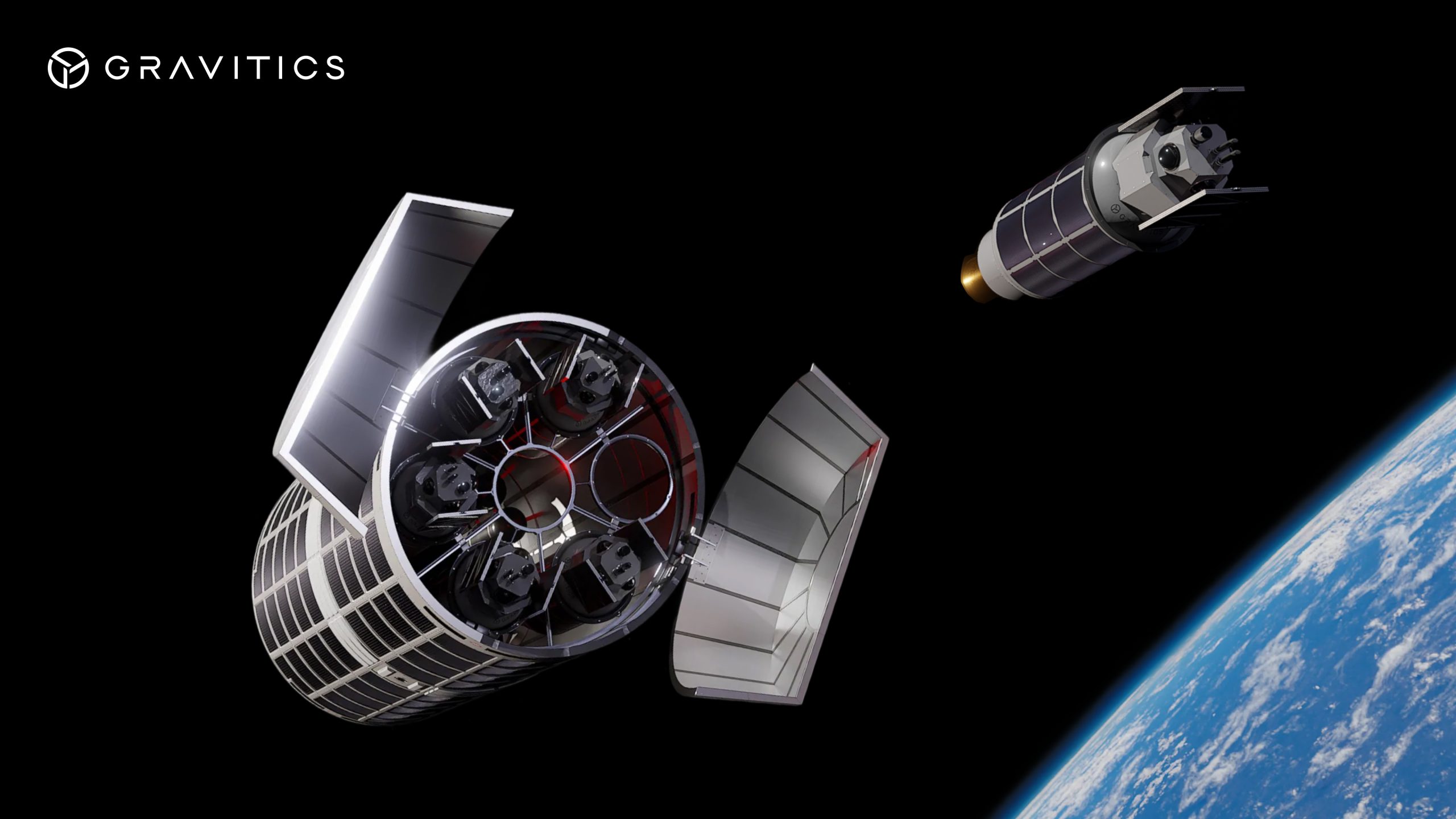

COLORADO SPRINGS — Gravitics is preparing to test a space architecture built around a large orbital platform designed to store and deploy multiple spacecraft. Customers such as the U.S. Space Force would position assets in orbit ahead of time and deploy them without waiting for a launch from Earth.
The Seattle-based firm, focused on commercial space station infrastructure, is developing what it calls an “orbital carrier” — a platform that can host as many as six maneuverable vehicles and release them on demand.
The work is being carried out under a Strategic Funding Increase, or STRATFI, agreement with the U.S. Space Force, combining $30 million in government funding with an equal amount of private capital from Gravitics investors. The deal was announced in March 2025, with the contract finalized last month.
The company developed a system known as “Medusa,” a carrier platform that acts as a staging node in orbit. Inside are vehicles called Viper OTX, reusable space tugs designed to move payloads between orbits. Together, the architecture is meant to function as a pre-positioned layer of infrastructure in space, analogous to forward-deployed assets in terrestrial military operations.
“We can house five to six response vehicles inside the Medusa,” Gravitics’ chief executive Colin Doughan said.
Under the STRATFI agreement, the company will seek to validate core technologies shared across the Orbital Carrier and the Viper platforms, including avionics, propulsion, flight software and ground control. These will be tested in the company’s first mission targeted for 2027, to be followed by a Viper OTX mission in 2028 to demonstrate on-orbit mobility by delivering a third-party payload to a higher-energy orbit.
Military interest in these systems reflects a broader push by the Space Force to perform what it calls “dynamic space operations,” or the ability to reposition satellites quickly in response to emerging needs. By storing vehicles in orbit, rather than launching them from the ground, the carrier concept is designed to reduce response times and provide greater operational flexibility.
Gravitics’ work draws on technology developed through civil programs with NASA, highlighting the overlap between commercial and government-funded space systems, Doughan said, as innovations tend to move in both directions.
The company envisions deploying its first carriers in low Earth orbit, with the option to expand into higher orbits depending on mission requirements.
Gravitics expects to eventually demonstrate the launch of a fully loaded carrier, which would require a heavy-lift rocket such as New Glenn, or potentially an even larger vehicle like Starship. Smaller, less capable variants of the orbital carrier could fly on smaller launchers, Doughan said, adding that the company is evaluating multiple options.
Beyond rapid deployment, the architecture could support missions like in-orbit logistics, refueling and sensor hosting. Doughan said one concept under consideration would outfit both the carrier and its deployable vehicles with sensors, creating a distributed sensing platform in space.
These technologies could also align with Pentagon efforts such as Golden Dome, a missile defense initiative that looks to expand the use of space-based sensors and interceptors. In that context, said Doughan, a carrier platform holding multiple spacecraft could provide a way to stage assets in orbit and deploy them as needed.










Related Posts

Stay Informed With the Latest & Most Important News
Previous Post
Next Post



Advertisement
-
 01Two Black Holes Observed Circling Each Other for the First Time
 -
 02From Polymerization-Enabled Folding and Assembly to Chemical Evolution: Key Processes for Emergence of Functional Polymers in the Origin of Life
 -
 03Astronomy 101: From the Sun and Moon to Wormholes and Warp Drive, Key Theories, Discoveries, and Facts about the Universe (The Adams 101 Series)
 -
 04True Anomaly hires former York Space executive as chief operating officer
 -
 05Φsat-2 begins science phase for AI Earth images
 -
 06Hurricane forecasters are losing 3 key satellites ahead of peak storm season − a meteorologist explains why it matters
 -
 07Binary star systems are complex astronomical objects − a new AI approach could pin down their properties quickly