
Now Reading: NCCR PlanetS: Observational And Computational Characterization Of Exoplanet Atmospheres
-
01
NCCR PlanetS: Observational And Computational Characterization Of Exoplanet Atmospheres

NCCR PlanetS: Observational And Computational Characterization Of Exoplanet Atmospheres

NCCR PlanetS
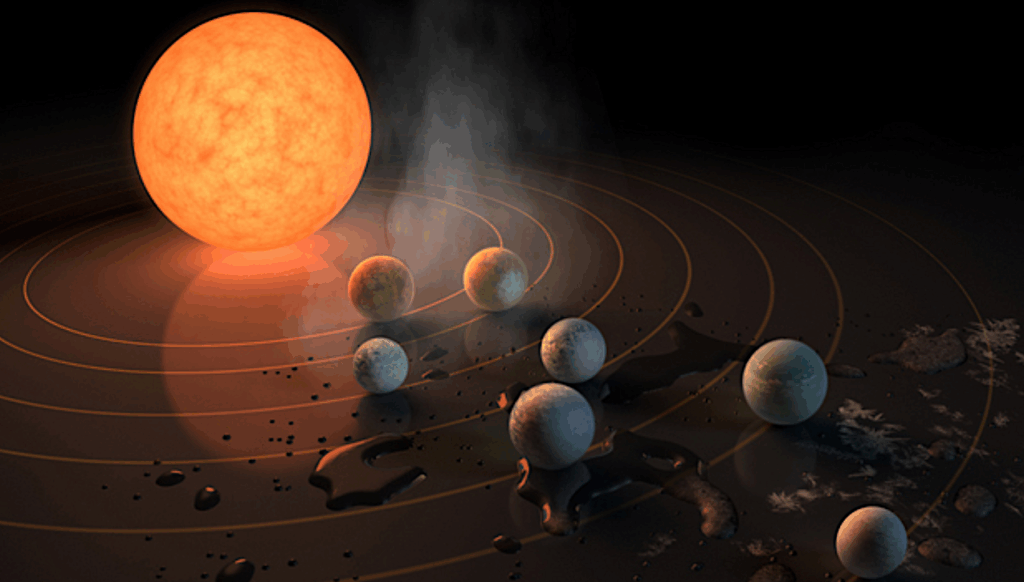
This chapter reviews the current state of observational and theoretical efforts in the characterization of exoplanet atmospheres, with a focus on developments enabled through the Swiss National Centre for Competence in Research (NCCR) PlanetS.
It covers the essential physical and chemical processes that govern atmospheric dynamics, radiative transfer, chemistry, and cloud formation in exoplanets and brown dwarfs. The review discusses the modeling approaches used to simulate these processes, ranging from simplified 1D models to fully coupled 3D general circulation models.
Atmospheric retrieval frameworks are presented as tools for inferring atmospheric properties from observational data, highlighting both classical Bayesian techniques and emerging machine learning methods.
Observational strategies using instruments like HST, JWST, and ground-based high-resolution spectrographs are also examined. Special emphasis is placed on the interplay between theory and observation, and how developments in modeling, data analysis, and instrumentation collectively advance our understanding of planetary atmospheres beyond the Solar System.
Daniel Kitzmann, Elspeth K. H. Lee, Jens Hoeijmakers, Kevin Heng
Comments: Chapter accepted for publication in the NCCR PlanetS Legacy Book: Benz, W. et al. (Eds), The National Center for Competence in Research, PlanetS: A Swiss-wide network expanding planetary sciences. Springer (2026)
Subjects: Earth and Planetary Astrophysics (astro-ph.EP)
Cite as: arXiv:2604.09385 [astro-ph.EP] (or arXiv:2604.09385v1 [astro-ph.EP] for this version)
https://doi.org/10.48550/arXiv.2604.09385
Focus to learn more
Submission history
From: Daniel Kitzmann
[v1] Fri, 10 Apr 2026 14:55:12 UTC (285 KB)
https://arxiv.org/abs/2604.09385
Astrobiology, Astronomy, exoplanet,











Related Posts
Stay Informed With the Latest & Most Important News
Previous Post
Next Post

Advertisement
-
 01Two Black Holes Observed Circling Each Other for the First Time
 -
 02From Polymerization-Enabled Folding and Assembly to Chemical Evolution: Key Processes for Emergence of Functional Polymers in the Origin of Life
 -
 03Astronomy 101: From the Sun and Moon to Wormholes and Warp Drive, Key Theories, Discoveries, and Facts about the Universe (The Adams 101 Series)
 -
 04True Anomaly hires former York Space executive as chief operating officer
 -
 05Φsat-2 begins science phase for AI Earth images
 -
 06Hurricane forecasters are losing 3 key satellites ahead of peak storm season − a meteorologist explains why it matters
 -
 07Binary star systems are complex astronomical objects − a new AI approach could pin down their properties quickly