
Now Reading: Huge ancient sandstorm on Mars revealed in rippled sediments
-
01
Huge ancient sandstorm on Mars revealed in rippled sediments


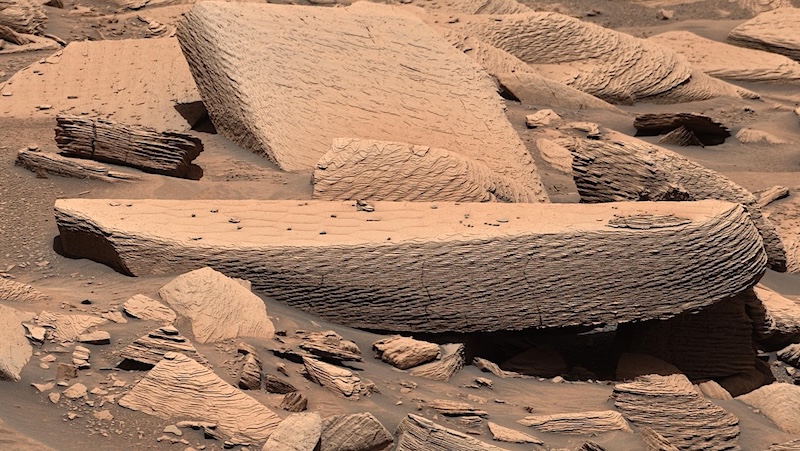

- Mars has huge dust storms that can cover the entire planet. But what about in the past?
- Odd ripple marks on slabs of bedrock, which the Curiosity rover found, are evidence of an even stronger sandstorm about 3.5 billion years ago.
- The ripples are also further evidence that Mars’ thin atmosphere used to be much thicker billions of years ago.
Ancient sandstorm on Mars
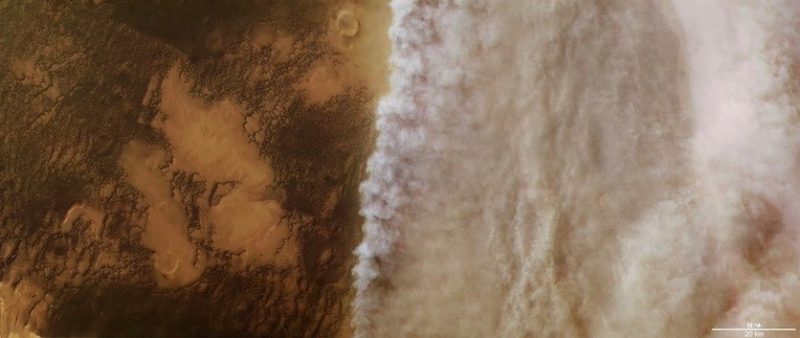
Mars is well-known for its huge dust storms, or sandstorms. They are common, even in Mars’ extremely thin atmosphere. Now, NASA’s Curiosity rover has found the first definitive evidence of an ancient sandstorm on Mars, about 3.5 billion years ago. A team of researchers, led by the Imperial College London in the U.K., said on April 4, 2026, that the intense sandstorm blew through Gale Crater, a large Martian crater that includes regions such as Jawbone Canyon. The clues come from “crinkly” ripple marks that the rover found on rock slabs.
These kinds of ripple marks are rare on Earth, and it’s the first time we’ve seen them on Mars. Sustained winds blowing sand are needed to form them. Most other sedimentary structures record trends from seasonal to thousands of years. But these kinds of ripples record wind storms that lasted from only minutes to hours.
The journal Geology published the peer-reviewed details of this discovery on March 27, 2026.
The martian atmosphere is currently 200 times thinner than that of Earth. A 3 billion-year-old sandstorm recorded in the rocks could be the first direct evidence that wasn't always so. My latest for @science.org.??? ??
— James Dinneen (@jamesdinneen.bsky.social) 2026-04-06T19:22:13.723Z
Ripples in the sediments
So how did the researchers find evidence for this huge ancient sandstorm? The answer is in ripple structures in the sedimentary rock slabs. These small millimeter-thick “crinkly” lamination-type markings are rarely seen on Earth. These ripples are also known as supercritical climbing wind ripple strata. Only sustained winds moving a lot of sand can form them.
And indeed, Mars had a much thicker atmosphere a few billion years ago. So that means it must have had stronger winds, too. It still has winds today, but those winds are weaker in the thinner atmosphere. Steven Banham is a planetary geologist at Imperial College London and lead author of the new study. He said:
Everybody knows that the wind blew on Mars. There was an atmosphere, so it must have moved, forming breezes and gusts, and so there must have been storms, too. But this is the first definitive evidence that we’ve found of such a sandstorm.

Short and long wind events
The ripples record single wind gusts that last only a few minutes. But they also document a longer sustained wind event lasting several hours or more. The paper states:
These are the shortest duration fluctuations in wind speed identified for ancient Mars thus far, recording extremely transient atmospheric conditions during a time when the Martian climate was becoming increasingly arid. Finally, these climbing ripple sets occur in a thin succession, which suggests that they record a broader sustained event, such as a sandstorm or gale, lasting several hours or more. This is the first direct physical evidence of such an event on Mars.
The sandstorm was short-lived, but intense, as Banham explained:
The thing that absolutely amazes me, is you just think that on a Tuesday afternoon, sometime, maybe 3.6 billion or so years ago, there was a sandstorm that rolled into Gale Crater. It would be like one of those scenes in [the movie] “Dune” where there’s a sandstorm happening and these ripple structures would be forming as a result. Then maybe the next day, the wind returns to normal, and it’s just another sunny day in Gale Crater. But that sandstorm happened, and we have the physical evidence for it here.
A serendipitous discovery
The discovery of the ripples was a lucky one, as it turned out. Banham and his colleagues happened to notice the ripples in the black-and-white panorama images from the rover. The ripples were in bedrock blocks in an area called Jawbone Canyon. Curiosity took images of them on sol 4391 (December 13, 2024). But the researchers weren’t quite sure what they were at first. Closer inspection showed they were ripples in the rock slabs, but they looked a bit unusual. Banham said:
This was very serendipitous. We weren’t really looking for these deposits, and then lo and behold, we drove around the corner and found them. We were lucky that we had just the right people on shift that recognized them.
In fact, the ripples looked just like the millimeter-thick “crinkly” laminations seen on Earth, a kind that only blowing sand can produce.

Evidence for a denser atmosphere long ago
There is already ample evidence that Mars’ atmosphere used to be denser and more earthlike billions of years ago. These new findings now add to that evidence. Currently, the thin atmosphere isn’t thick enough to blow sand at the intensity revealed by the ripples. So that means the atmosphere must have been substantially denser than it is now. As Banham noted:
These deposits in themselves indicate that the atmosphere was denser at the time than it is now, to form these structures.

Looking for ancient raindrops on Mars
A study from 2025 showed how rain or snow created rivers that fed ancient lakes on Mars. The researchers are now hoping to find definitive evidence for that ancient rain on Mars, in the form of preserved rain impact marks. So far, rovers and landers haven’t found any yet. Banham said:
People have been looking for those since Pathfinder and the MER rovers, and nobody’s seen them. It must have rained, as we’ve seen evidence of rivers and lake deposits. But we’ve not got that definitive evidence of rain until we see rain impacts. That would be magic if we found those.
Bottom line: Dust storms are common on Mars. But ripples in blocks of bedrock have revealed evidence of a more intense sandstorm on Mars about 3.5 billion years ago.
Via Geological Society of America/ Astrobiology
Read more: Dust storms swirl at Mars’ north pole
Read more: Lightning on Mars? Electric sparks in dust devils confirmed
The post Huge ancient sandstorm on Mars revealed in rippled sediments first appeared on EarthSky.










Related Posts
Stay Informed With the Latest & Most Important News




Advertisement
-
 01Two Black Holes Observed Circling Each Other for the First Time
 -
 02From Polymerization-Enabled Folding and Assembly to Chemical Evolution: Key Processes for Emergence of Functional Polymers in the Origin of Life
 -
 03Astronomy 101: From the Sun and Moon to Wormholes and Warp Drive, Key Theories, Discoveries, and Facts about the Universe (The Adams 101 Series)
 -
 04True Anomaly hires former York Space executive as chief operating officer
 -
 05Φsat-2 begins science phase for AI Earth images
 -
 06Hurricane forecasters are losing 3 key satellites ahead of peak storm season − a meteorologist explains why it matters
 -
 07Binary star systems are complex astronomical objects − a new AI approach could pin down their properties quickly