
Now Reading: A dark energy tool just created the most comprehensive 3D map of our universe ever: ‘This is a major paradigm shift’
-
01
A dark energy tool just created the most comprehensive 3D map of our universe ever: ‘This is a major paradigm shift’

A dark energy tool just created the most comprehensive 3D map of our universe ever: ‘This is a major paradigm shift’

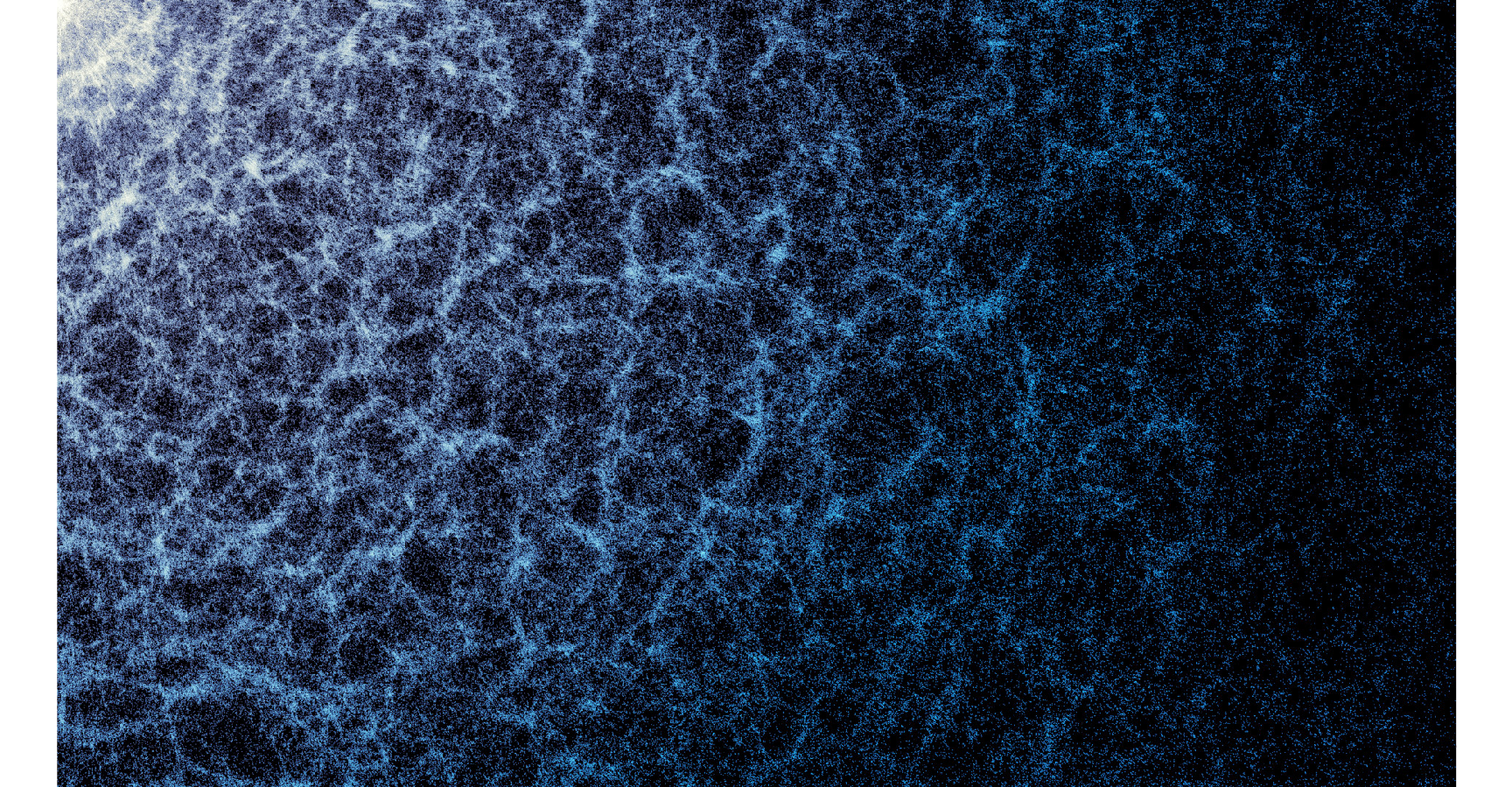
The Dark Energy Spectroscopic Instrument (DESI) has completed its five-year mission to build the largest 3D map of the cosmos ever constructed in order to investigate dark energy, the mysterious force driving the accelerating expansion of the universe. The 3D map was completed ahead of schedule on Tuesday night (April 14), but DESI is far from done. With this map in hand, it’ll continue to probe some of the greatest mysteries in cosmology.
“DESI has exceeded expectations. It is a big deal because the DESI team was able to complete a heavily ambitious survey program on schedule and on budget. It wasn’t at all clear that we would achieve this years ago when we first planned DESI and applied for support from the Department of Energy,” Klaus Honscheid, lead scientist of DESI instrument operations and a professor at The University of Ohio, told Space.com.
DESI, composed of 5,000 fiber optic eyes mounted on the Nicholas U. Mayall 4-meter Telescope at Kitt Peak National Observatory in Arizona, exceeded expectations by observing 47 million galaxies and quasars — which are central galactic regions powered by feeding supermassive black holes — as well as more than 20 million nearby stars. Originally, scientists predicted that about 34 million galaxies and quasars would compose the completed DESI dataset when it began operations in May 2021. We’re seeing a sixfold increase on previous observations of galaxies and quasars.
“Our ability to complete the survey in five years was challenged more than once. Everyone on the operations team worked incredibly hard to keep the survey progressing with high efficiency. And I think rightly so, we are all very proud that we actually achieved this goal,” Honscheid said.
Researchers will be eager to get their hands on the completed five years’ worth of DESI data. Using just year one observations, researchers already saw tantalizing evidence that dark energy is even stranger than predicted, suggesting we may need to revise the standard model of cosmology, the current best picture we have of how the universe evolved to its current state.

Already making waves
Dark energy represents such a mystery because, though accounting for around 70% of the universe’s matter and energy budget, scientists have no idea what it actually is. Discovered in the late 1990s, dark energy is really just a placeholder name for whatever force is pushing galaxies apart faster and faster.
“The mystery of dark energy arises from observations from the combination of several cosmological probes, including baryon acoustic oscillations (BAO), cosmic microwave background, and Type 1a supernovas,” Nathalie Palanque-Delabrouille, DESI collaborator and a scientist at Berkeley Lab, told Space.com. “None of these probes yet has the sensitivity to resolve the mystery of dark energy on its own. The data DESI has already gathered will allow us to strengthen our findings and clarify what options remain possible.”
After analyzing the first year of data from DESI in April 2024 and tracking the effect of dark energy over 11 billion years of cosmic history, scientists revealed they had found tantalizing hints that dark energy is weakening. If confirmed by the full DESI map, this represents a major and exciting discovery, as the standard model of cosmology, also known as the Lambda Cold Dark Matter (LCDM) model, predicts that dark energy should be constant, meaning it shouldn’t fluctuate in strength.
“This is a major paradigm shift. All data up to now were compatible with a standard cosmological model where the accelerated expansion of the universe was caused by a cosmological constant,” Nathalie Palanque-Delabrouille, DESI collaborator and scientist at Berkeley Lab, told Space.com. “The weakening acceleration observed by DESI can no longer be explained with a cosmological constant. This could be the most interesting discovery in cosmology since that of dark energy itself.”
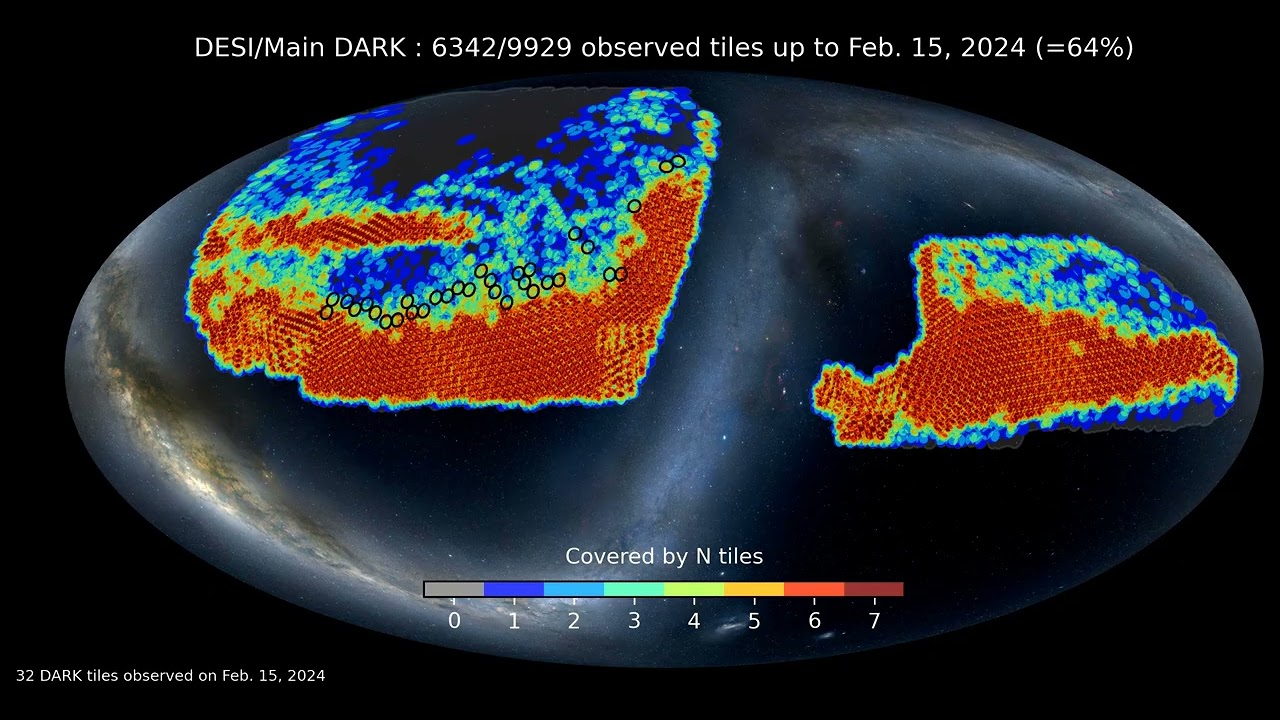
The first papers based on DESI’s full five-year program are expected to appear throughout 2027. Even before these findings begin to drip out, the completion of DESI’s initial mission represents a major scientific milestone.
“One of the most significant aspects on the science side is the remarkable cohesion of the large collaboration: over 900 scientists, including about a third graduate students, all working towards the same goals. The work is performed across 14 countries and 75 institutions, yet the data are analyzed in a timely fashion, and DESI has already published key results with its year-1 and year-3 data samples,” Palanque-Delabrouille said. “What surprised me, or rather impressed me, is that DESI continues to run on schedule, even to be ahead of schedule, despite the pandemic and the Contreras fire that swept through the Kitt Peak observatory in 2022.
“DESI’s pace is truly amazing.”
The team’s research was published across two papers in the journal Astronomy & Astrophysics.










Related Posts

Stay Informed With the Latest & Most Important News
Previous Post
Next Post





Advertisement
-
 01Two Black Holes Observed Circling Each Other for the First Time
 -
 02From Polymerization-Enabled Folding and Assembly to Chemical Evolution: Key Processes for Emergence of Functional Polymers in the Origin of Life
 -
 03Astronomy 101: From the Sun and Moon to Wormholes and Warp Drive, Key Theories, Discoveries, and Facts about the Universe (The Adams 101 Series)
 -
 04True Anomaly hires former York Space executive as chief operating officer
 -
 05Φsat-2 begins science phase for AI Earth images
 -
 06Hurricane forecasters are losing 3 key satellites ahead of peak storm season − a meteorologist explains why it matters
 -
 07Binary star systems are complex astronomical objects − a new AI approach could pin down their properties quickly