
Now Reading: Senators seek increased funding for NASA Mars missions
-
01
Senators seek increased funding for NASA Mars missions


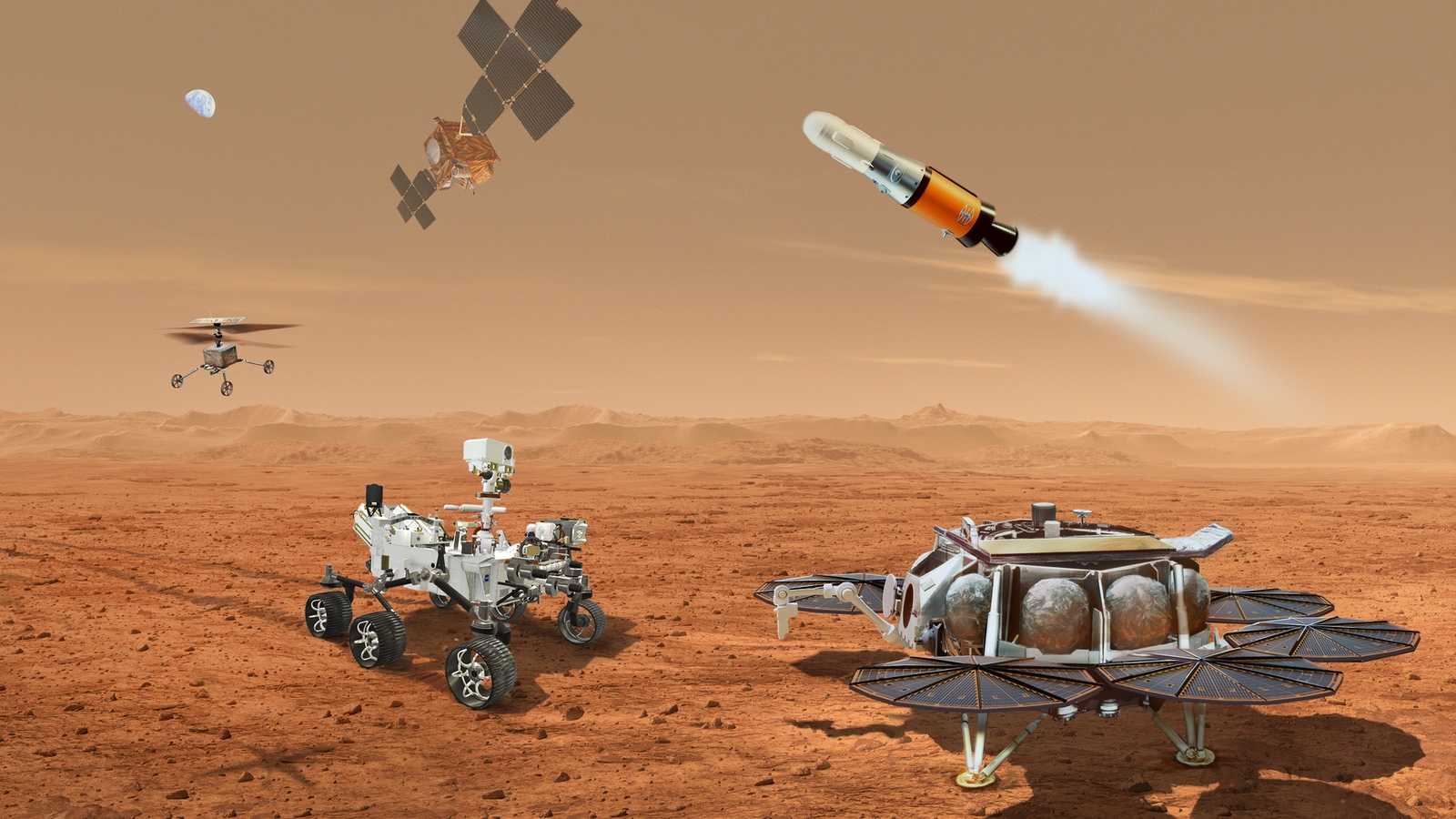

COLORADO SPRINGS — Several senators are asking appropriators to increase funding for NASA’s robotic Mars exploration efforts, fearing “severe and irreversible harm” if funding is not restored.
In a letter this week to the leadership of the Senate Appropriations Committee’s Commerce, Justice and Science (CJS) subcommittee, four senators requested that NASA’s Mars Future Missions account receive at least $400 million in a fiscal year 2027 spending bill. The letter is signed by Sens. Adam Schiff and Alex Padilla, both D-Calif., along with Sens. Mark Kelly, D-Ariz., and Ben Ray Luján, D-N.M.
A fiscal year 2026 appropriations bill provided that account with $110 million in lieu of funding the Mars Sample Return (MSR) program, which suffered cost overruns and schedule delays that led the administration to seek its cancellation. That funding was intended to preserve work on key technologies being developed for MSR but was significantly less than the $300 million proposed in a House spending bill.
The senators argue in the letter that the funding is insufficient to support continued work on technologies such as precision landing, sample retrieval and launching off the Martian surface, which could be used in any future effort to bring back samples being collected by the Perseverance rover, as well as other Mars missions.
“If this funding trajectory continues and is not reversed, NASA’s Mars programs will face severe and irreversible harm, jeopardizing the United States’ ability to land spacecraft on the surface of Mars, not just in the near future, but for decades to come,” they wrote.
The senators said they are worried that a lack of investment in such technologies threatens American leadership in Mars exploration.
“Any erosion of vital infrastructure and intellectual capital would deliver lasting damage to the U.S. economy and undermine our leadership on the global stage in science and technology,” they wrote. “In addition, we cannot allow the U.S. to cede the high ground to the Chinese government, which is already working to land its own robotic Mars missions.”
NASA’s fiscal year 2027 budget request sought $110 million for Mars Future Missions, the same amount as in 2026, but proposes to use it to begin work on “a regular cadence of science-driven, lower-cost mission and hosted payload instrument opportunities” rather than on technologies linked to MSR. That includes a solicitation planned for release in October for a science mission to launch in 2030 with a cost cap of $220 million.
NASA’s proposed funding for Mars Future Missions is part of a science budget that once again faces major cuts. The 2027 proposal released April 3 would cut overall NASA science funding by 47% to $3.4 billion, threatening dozens of planned or active missions with termination.
Those cuts face opposition, including from one of the recipients of the senators’ letter. Sen. Jerry Moran, R-Kan., chairman of the CJS appropriations subcommittee, said at a roundtable during the 41st Space Symposium April 12 that he supported “a robust and balanced NASA appropriations bill” that supported science, exploration and other agency programs.
“I think it would be a mistake to put money only in the missions related to exploration and not into science and the others,” he said after the roundtable. “I wouldn’t start with the premise that exploration is the only important aspect of the budget.”
NASA’s budget proposal did not disclose when or how it might pursue a new attempt to return samples from Mars using Mars Future Missions or another program. Industry officials, including those from companies that proposed alternative MSR approaches, say they are ready when NASA is.
Whitley Poyser, director of exploration at Lockheed Martin Space, said at an April 13 briefing that the company had developed a plan for returning samples from Mars for less than $3 billion, a fraction of earlier MSR cost estimates.
“What enabled that was the ability to leverage proven, demonstrated technologies, reducing overall risk by reducing mission complexity,” she said. “We still very much stand behind it.”










Related Posts


Stay Informed With the Latest & Most Important News
Previous Post
Next Post





Advertisement
-
 01Two Black Holes Observed Circling Each Other for the First Time
 -
 02From Polymerization-Enabled Folding and Assembly to Chemical Evolution: Key Processes for Emergence of Functional Polymers in the Origin of Life
 -
 03Astronomy 101: From the Sun and Moon to Wormholes and Warp Drive, Key Theories, Discoveries, and Facts about the Universe (The Adams 101 Series)
 -
 04True Anomaly hires former York Space executive as chief operating officer
 -
 05Φsat-2 begins science phase for AI Earth images
 -
 06Hurricane forecasters are losing 3 key satellites ahead of peak storm season − a meteorologist explains why it matters
 -
 07Binary star systems are complex astronomical objects − a new AI approach could pin down their properties quickly