
Now Reading: Origin And Characterization Of Super-Earths And Sub-Neptunes
-
01
Origin And Characterization Of Super-Earths And Sub-Neptunes


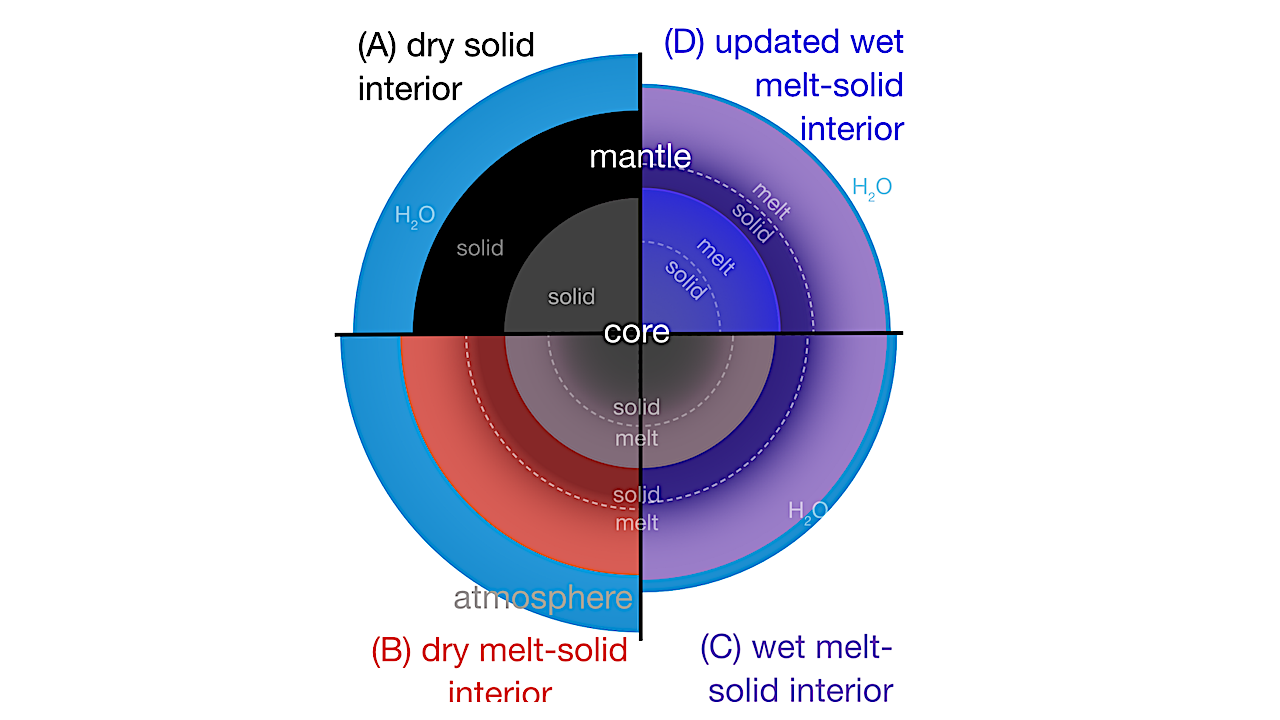

Effect of water dissolution on planetary radius (adapted from Luo et al (2024)). All interiors share identical bulk composition but differ in model assumptions. Classical models separated volatiles and refractories, and ignored melts (A). Alternative models that include melts but neglected volatile dissolution overestimate planetary radii (B). The water dissolution in the mantle (C) or mantle and core (D) reduces them. Scenario (D) is considered most realistic for hot super-Earths with magma oceans. — astro-ph.EP
Super-Earths and sub-Neptunes represent the most common class of exoplanets discovered to date in our galaxy, yet they have no direct analogues in the Solar System. Since 2014, researchers within the NCCR PlanetS have made significant contributions to understanding the origin and nature of these small planets.
This chapter provides an overview of the progress made in their detection, characterization, and theoretical interpretation during the 2014-2025 period. The combined data from space-based photometric missions such as Kepler and TESS, together with ground-based radial velocity campaigns using state-of-the-art spectrographs (e.g., HARPS, ESPRESSO, NIRPS), have enabled detailed demographic analyses of these planets.
These observational efforts are complemented by theoretical work exploring their internal structures, bulk compositions, formation and evolution, shedding light on the physical processes responsible for the observed diversity.
As high-precision observations from facilities like JWST begin to probe the atmospheric composition of individual planets, a more complete picture of super-Earth and sub-Neptune origins is emerging, one that continues to challenge and refine current planet formation theories.
Léna Parc, Julia Venturini, François Bouchy, Ravit Helled, Caroline Dorn, Adrien Leleu, Yann Alibert, Simon Müller, Haiyang Wang
Comments: Chapter accepted for publication in the NCCR PlanetS Legacy Book: Benz, W. et al. (Eds), The National Center for Competence in Research, PlanetS: A Swiss-wide network expanding planetary sciences. Springer (2026). 32 pages, 6 figures
Subjects: Earth and Planetary Astrophysics (astro-ph.EP)
Cite as: arXiv:2604.11779 [astro-ph.EP](or arXiv:2604.11779v1 [astro-ph.EP] for this version)
https://doi.org/10.48550/arXiv.2604.11779
Focus to learn more
Submission history
From: Léna Parc
[v1] Mon, 13 Apr 2026 17:45:26 UTC (3,144 KB)
https://arxiv.org/abs/2604.11779
Astrobiology, exoplanet,










Related Posts
Stay Informed With the Latest & Most Important News
Previous Post
Next Post

Advertisement
-
 01Two Black Holes Observed Circling Each Other for the First Time
 -
 02From Polymerization-Enabled Folding and Assembly to Chemical Evolution: Key Processes for Emergence of Functional Polymers in the Origin of Life
 -
 03Astronomy 101: From the Sun and Moon to Wormholes and Warp Drive, Key Theories, Discoveries, and Facts about the Universe (The Adams 101 Series)
 -
 04True Anomaly hires former York Space executive as chief operating officer
 -
 05Φsat-2 begins science phase for AI Earth images
 -
 06Hurricane forecasters are losing 3 key satellites ahead of peak storm season − a meteorologist explains why it matters
 -
 07Binary star systems are complex astronomical objects − a new AI approach could pin down their properties quickly