
Now Reading: March Brings Busy Operations and Significant Discoveries to International Space Station
-
01
March Brings Busy Operations and Significant Discoveries to International Space Station

March Brings Busy Operations and Significant Discoveries to International Space Station

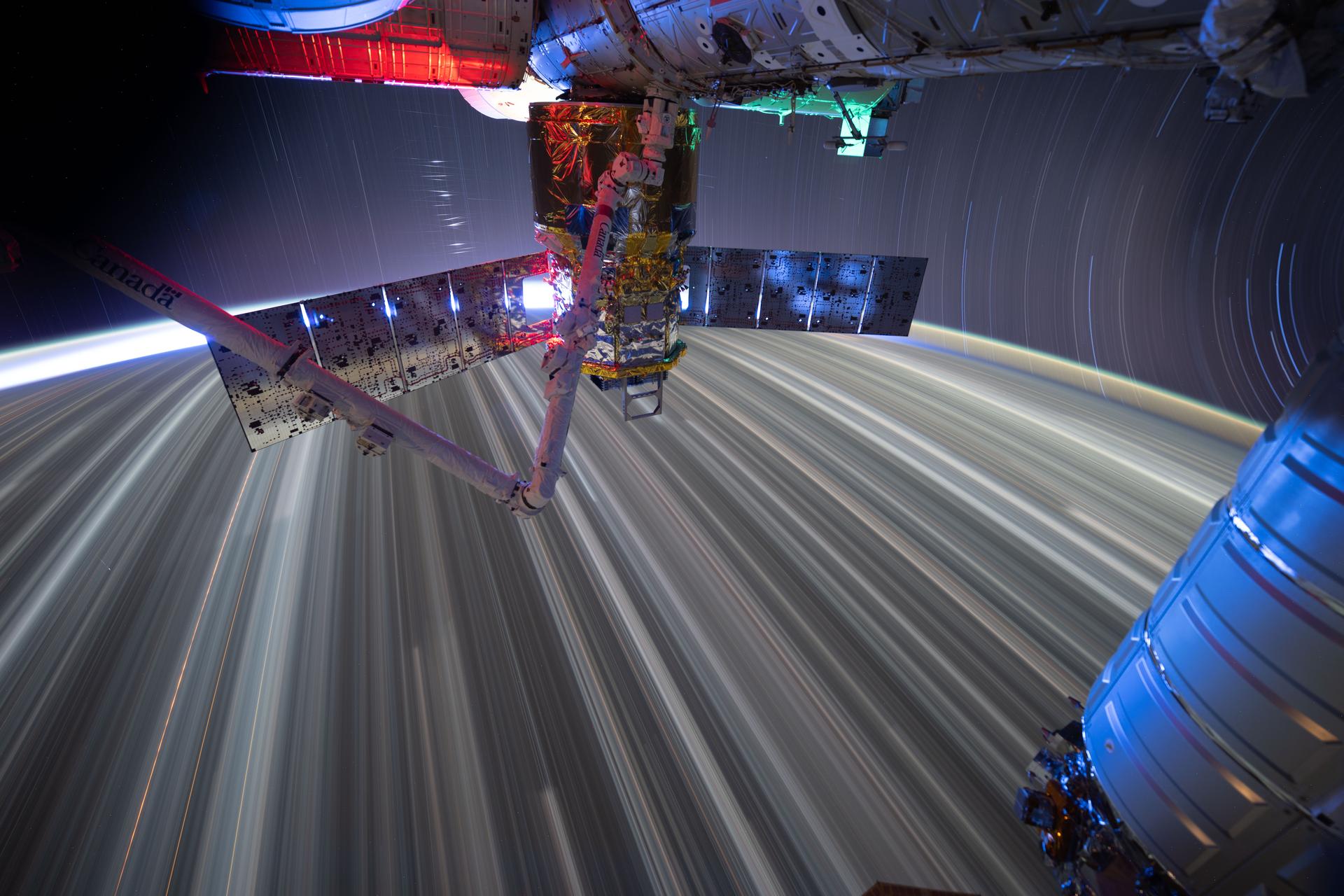

March was a dynamic month for the crew aboard the International Space Station, highlighted by the launch and departure of multiple vehicles, as well as a significant spacewalk. The Expedition 74 team managed the departure of three spacecraft and welcomed one, while also engaging in crucial scientific research and technology demonstrations.
The activities kicked off on March 5, when the Canadarm2, a robotic arm, carefully removed the HTV-X1 spacecraft, operated by Japan’s Aerospace Exploration Agency (JAXA), from the station’s Harmony module. The vehicle was officially released at 17:00 UTC on March 6 after spending 126 days docked since its arrival on October 30. HTV-X1 will now enter a high-Earth orbit where it will conduct technology demonstrations over the next three months before reentering Earth’s atmosphere and disintegrating.
Following this, on March 12 at 11:06 UTC, the Northrop Grumman Cygnus NG-23 spacecraft, named S.S. William “Willie” C. McCool in honor of a NASA astronaut lost on the STS-107 mission, undocked from the Unity module after a 175-day stay. The vehicle was deorbited on March 14, ultimately burning up upon reentry.
Another notable departure occurred on March 16 when the Soyuz MS-31 cargo vehicle, operated by Roscosmos, left the Poisk module at 13:24 UTC. After launching from Baikonur Cosmodrome on July 3 and delivering over 2,600 kilograms of supplies, it was docked for an impressive 253 days.
March also marked the launch of the Progress MS-33 resupply vehicle on March 22 from the Baikonur Cosmodrome after a delay caused by previous damage at the launch pad. However, Progress faced challenges when one of its antennas failed to deploy, complicating its automated docking system. Roscosmos cosmonaut Sergey Kud-Sverchkov successfully manually docked the vehicle after it approached the ISS.
In a separate operation, Progress MS-32 conducted a critical reboost burn on March 13 to increase the station’s orbit and combat atmospheric drag, which can lead to orbital decay.
Amidst all these vehicle maneuvers, NASA astronauts Jessica Meir and Chris Williams executed U.S. Spacewalk 94 on March 18. This marked a significant milestone for Williams, completing his first spacewalk, while Meir’s experience includes various missions, including a pioneering all-female EVA. The astronauts spent over seven hours outside the station, preparing the power infrastructure for future solar array installations and completing additional tasks aimed at maintenance and scientific readiness.
March was not solely focused on logistics, as the Expedition 74 crew engaged heavily in scientific experiments. From testing innovative biomedical devices to conducting physics studies, astronauts sought to advance understanding crucial for long-duration space travel. For instance, on March 4, Meir and an ESA counterpart worked on the EchoFinder-2 device, using augmented reality for augmented imaging techniques. Other experiments included studies on blood flow and stress management protocols for astronauts.
As NASA and its international partners continue their research aboard the ISS, they emphasize the importance of extending human presence in space, with the station expected to remain operational until at least 2032. After its eventual decommissioning, commercial ventures are anticipated to fill the void in low-Earth orbit, suggesting a future of continued exploration and innovation.










Related Posts
Stay Informed With the Latest & Most Important News
Previous Post
Next Post
Previous Post
Next Post
Advertisement
-
 01Two Black Holes Observed Circling Each Other for the First Time
 -
 02From Polymerization-Enabled Folding and Assembly to Chemical Evolution: Key Processes for Emergence of Functional Polymers in the Origin of Life
 -
 03Astronomy 101: From the Sun and Moon to Wormholes and Warp Drive, Key Theories, Discoveries, and Facts about the Universe (The Adams 101 Series)
 -
 04True Anomaly hires former York Space executive as chief operating officer
 -
 05Φsat-2 begins science phase for AI Earth images
 -
 06Hurricane forecasters are losing 3 key satellites ahead of peak storm season − a meteorologist explains why it matters
 -
 07Binary star systems are complex astronomical objects − a new AI approach could pin down their properties quickly