
Now Reading: DESI’s 3D map of the universe is complete!
-
01
DESI’s 3D map of the universe is complete!


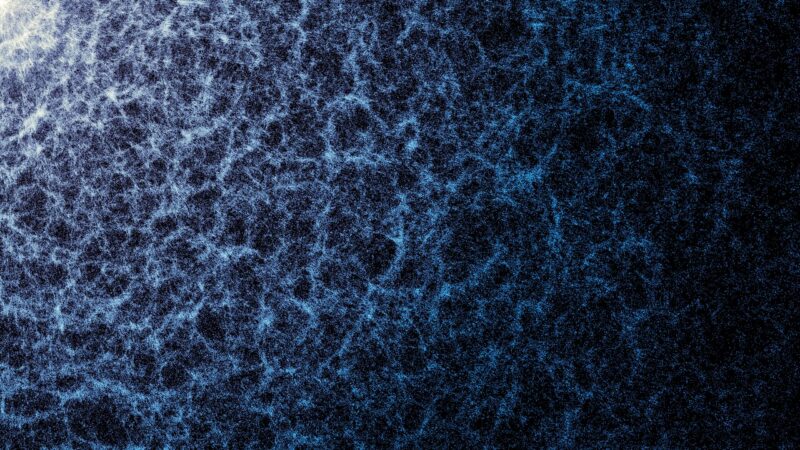
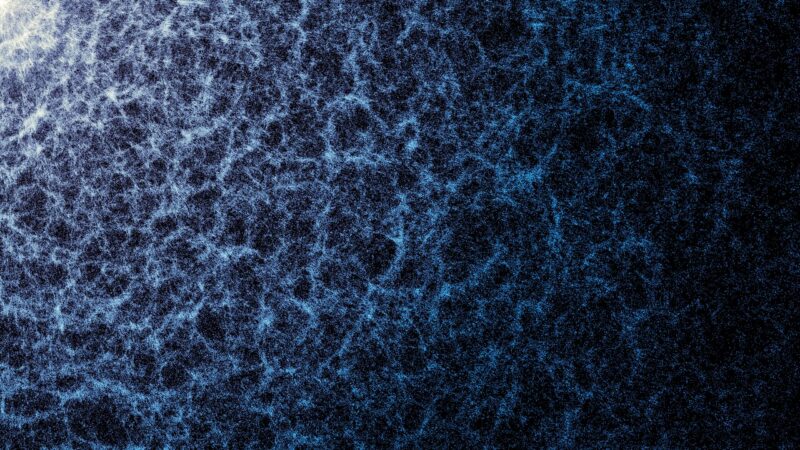
This visualization shows how DESI’s 3D map of the universe accumulated over 5 years. It begins with DESI’s tiles on the night sky, each observing around 5,000 galaxies. As we move out to see the observations in 3D, we see how DESI maps the cosmic web of filaments and voids. Earth is at the center of the wedges, and every dot represents a galaxy. Image via DESI Collaboration and DESI Member Institutions/ DOE/ KPNO/ NOIRLab/ NSF/ AURA/ R. Proctor.
- The Dark Energy Spectroscopic Instrument has created one of the most extensive surveys of the cosmos ever conducted. The five-year survey is now complete.
- DESI has mapped more than 47 million galaxies and quasars. This is the largest high-resolution 3D map of our universe to date.
- DESI will continue observations into 2028 and further expand the map. The observations will help astronomers understand how dark energy works in the universe.
NOIRLab published this original story on April 15, 2026. Edits by EarthSky.
DESI’s 3D map of the universe is complete!
On Tuesday night, April 14, 2026, the 5,000 fiber-optic eyes of the Dark Energy Spectroscopic Instrument (DESI) swiveled onto a patch of sky near the Little Dipper. Roughly every 20 minutes, it locked onto distant pinpricks of light, gathering photons that had traveled toward Earth for billions of years. When the sun rose, the instrument had completed a major milestone. It had successfully surveyed all areas in a planned 3D map of the universe.
The five-year survey, finished ahead of schedule and with vastly more data than expected, has produced the largest high-resolution 3D map of the universe ever made. Researchers use that map to explore dark energy, the fundamental ingredient that makes up about 70% of our universe and is driving its accelerating expansion.
The mission of DESI
DESI’s quest to understand dark energy is a global endeavor. The international experiment brings together the expertise of more than 900 researchers (including 300 Ph.D. students) from over 70 institutions. The U.S. Department of Energy’s Lawrence Berkeley National Laboratory (Berkeley Lab) manages this project. And the instrument was constructed and is operated with funding from the DOE Office of Science. DESI is mounted on the U.S. National Science Foundation Nicholas U. Mayall 4-meter Telescope at NSF Kitt Peak National Observatory (KPNO) in Arizona, a program of NSF NOIRLab.
By comparing how galaxies clustered in the past with their distribution today, researchers can trace dark energy’s influence over 11 billion years of cosmic history. Surprising results using DESI’s first three years of data hinted that dark energy, once thought to be a cosmological constant, might be evolving over time.
With the full set of five years of data, researchers will have significantly more information to test whether that hint disappears or grows. If confirmed, it would mark a major shift in how we think about our universe and its potential fate, which hinges on the balance between matter and dark energy.
A successful universe-mapping project
Stephanie Juneau, associate astronomer and NSF NOIRLab representative for DESI, said:
It’s impossible to capture everything that went into making DESI such a successful experiment. From instrument builders and software engineers to technicians, observatory staff, and scientists – including many early-career researchers – it truly took a village. Ultimately, we are doing this for all humanity, to better understand our universe and its eventual fate. After finding hints that dark energy might deviate from a constant, potentially altering that fate, this moment feels like sitting on the edge of my seat as we analyze the new map to see whether those hints will be confirmed. I’m also very intrigued by the many other discoveries that await in this new dataset.
Kathy Turner, Program Manager for the Cosmic Frontier in the Office of High Energy Physics at the Department of Energy, said:
The Dark Energy Spectroscopic Instrument has truly exceeded all expectations, delivering an unprecedented 3D map of the universe that will revolutionize our understanding of dark energy. From its inception, we envisioned a project that would push the boundaries of cosmology, and to see it come to such a spectacularly successful completion for its initial survey, ahead of schedule and with such rich data, is incredibly rewarding. The dedication and ingenuity of the entire DESI collaboration have made this world-leading science a reality, and I am immensely proud of the groundbreaking results we are already seeing and the discoveries yet to come as we continue to explore the mysteries of our cosmos.
What’s next for DESI?
DESI has now measured cosmological data for six times as many galaxies and quasars as all previous measurements combined. The collaboration will immediately begin processing the completed dataset, with the first dark energy results from the full five-year survey expected in 2027. In the meantime, DESI collaborators continue to analyze the survey’s first three years of data, refining dark energy measurements and producing additional results on the structure and evolution of the universe, with several papers planned later this year.
Michael Levi, DESI director and a scientist at Berkeley Lab, said:
We’re going to celebrate completion of the original survey and then get started on the work of churning through the data, because we’re all curious about what new surprises are waiting for us.
The plan was to capture light from 34 million galaxies and quasars (extremely distant yet bright objects with black holes at their cores) over the five-year sky survey. DESI instead observed more than 47 million galaxies and quasars, as well as 20 million stars.
Expanding the 3D map of the universe
DESI will continue observations through 2028 and grow its map by about 20%, from 14,000 square degrees to 17,000 square degrees. (For comparison, the moon covers approximately 0.2 square degrees, and the full sky has over 41,000 square degrees). The extended map will cover parts of the sky that are more challenging to observe. These are areas that are closer to the plane of the Milky Way, where bright nearby stars can make it harder to see more distant objects. It also includes areas farther to the south, where the telescope must account for peering through more of Earth’s atmosphere.
The experiment will also revisit the existing area of the map to collect data from a new set of galaxies: more distant, fainter luminous red galaxies. These will provide an even denser, more detailed map of the regions DESI has already covered, giving researchers a clearer picture of the universe’s history.
Researchers will also study nearby dwarf galaxies and stellar streams, bands of stars torn from smaller galaxies by the Milky Way’s gravity. The hope is to better understand dark matter, the invisible form of matter that accounts for most of the mass in the universe but has never been directly detected.
Bottom line: Astronomers have completed the largest, most detailed 3D map of the universe ever made. It charts tens of millions of galaxies and quasars to help reveal how dark energy shapes the cosmos.
The post DESI’s 3D map of the universe is complete! first appeared on EarthSky.










Related Posts
Stay Informed With the Latest & Most Important News
Previous Post
Next Post

Advertisement
-
 01Two Black Holes Observed Circling Each Other for the First Time
 -
 02From Polymerization-Enabled Folding and Assembly to Chemical Evolution: Key Processes for Emergence of Functional Polymers in the Origin of Life
 -
 03Astronomy 101: From the Sun and Moon to Wormholes and Warp Drive, Key Theories, Discoveries, and Facts about the Universe (The Adams 101 Series)
 -
 04True Anomaly hires former York Space executive as chief operating officer
 -
 05Φsat-2 begins science phase for AI Earth images
 -
 06Hurricane forecasters are losing 3 key satellites ahead of peak storm season − a meteorologist explains why it matters
 -
 07Binary star systems are complex astronomical objects − a new AI approach could pin down their properties quickly