
Now Reading: Interstellar Comet Reveals Methane On Its Journey Through Our Solar System
-
01
Interstellar Comet Reveals Methane On Its Journey Through Our Solar System


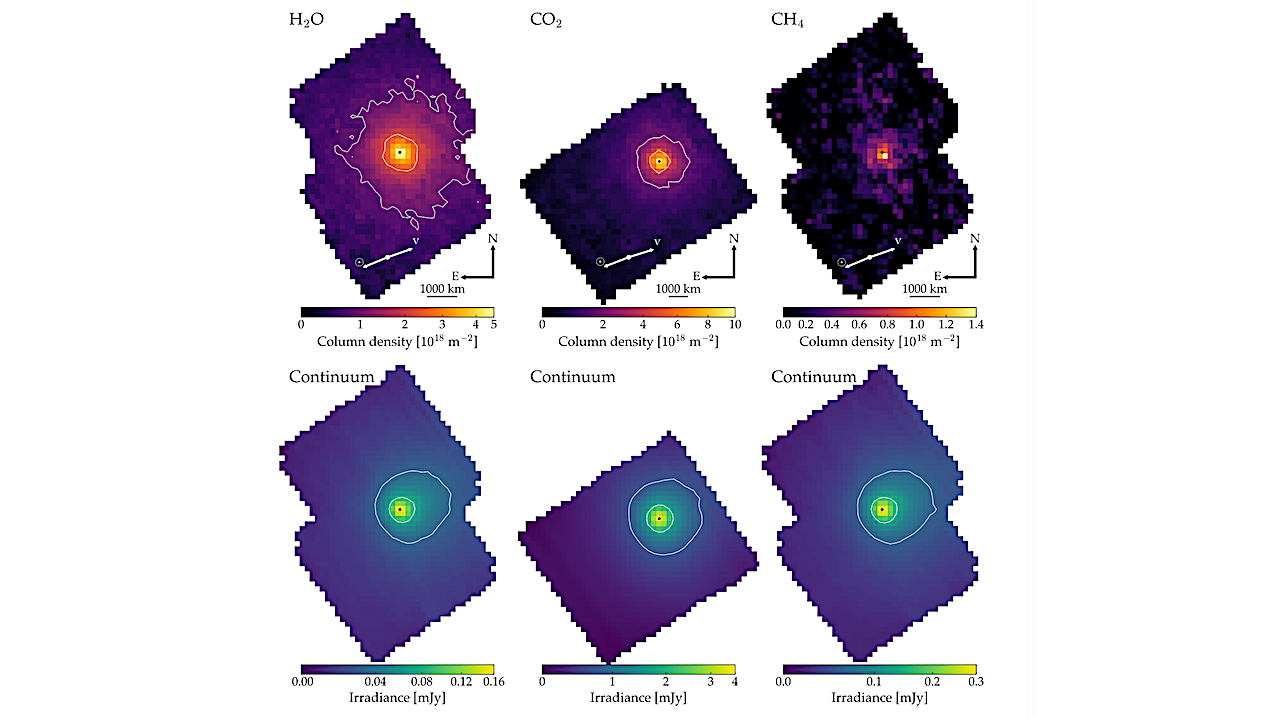
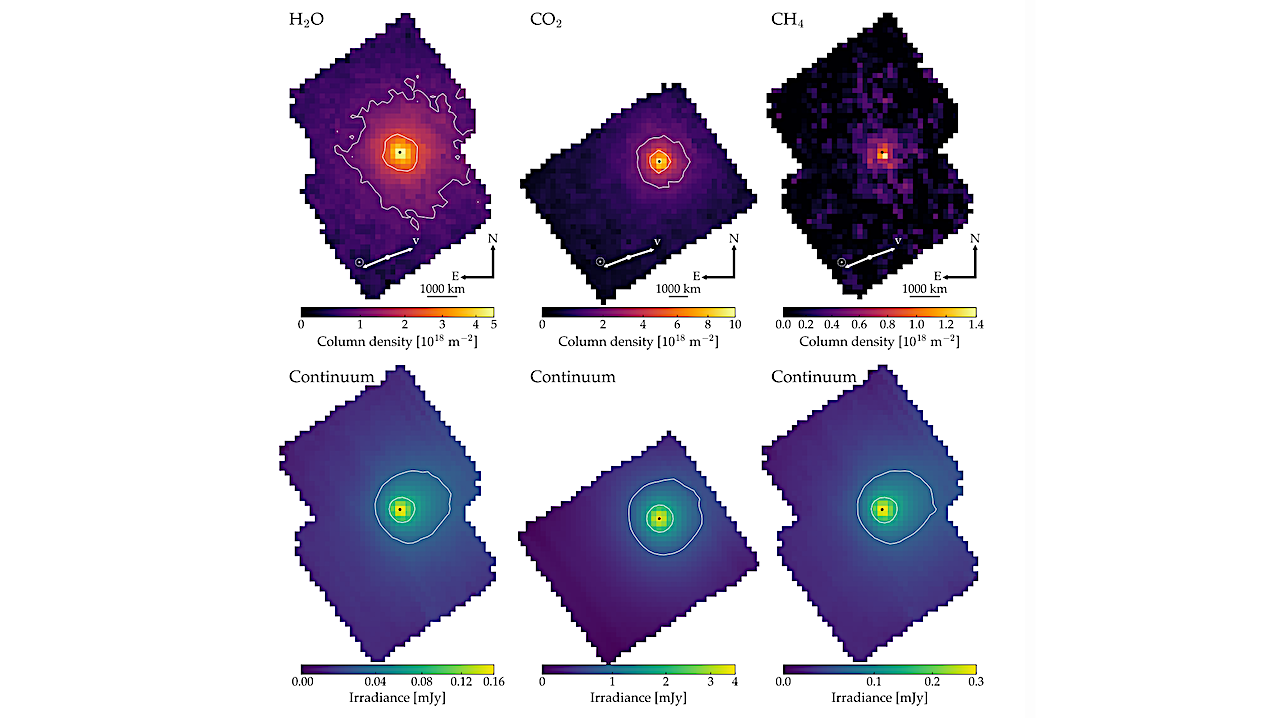
Top row: coma maps of H2O, CO2, and CH4, computed as the molecular column density from a pixel-by-pixel retrieval analysis for Observations 6, 15, and 6, respectively. The sunward and target velocity directions are denoted by the white arrows. The target centroids, computed as the photocenter in the median-stacked images (Figure 1), are marked with the black points. For H2O and CO2, the white contours correspond to emission levels of 50% and 20% relative to the maximum value and illustrate the slight anti-sunward extension of the respective comae. The contours are omitted in the CH4 panel due to the poorer signal-to-noise ratio of the data. Bottom row: corresponding median-stacked images across the continuum wavelengths within each fluorescence region. The H2O coma map shows significant enhancement in emission level at large nucleocentric distances relative to the dust continuum, indicating extended H2O production within the coma. — arxiv.org
Interstellar comet 3I/ATLAS is now on its way out of our solar system, never to return.
The comet was only the third-ever detected object to originate from outside our solar system. Traveling at high speeds, it looped around the Sun within 1.5 AU (one AU, or astronomical unit, is the distance between the Earth and the Sun) in October 2025; as of April, it is now past the orbit of Jupiter on its way out of the solar system.
3I/ATLAS is over a kilometer wide and is made up of dust and ices from the far-off planetary system where it originated. Using the advanced instrumentation of the James Webb Space Telescope (JWST), Caltech researchers examined the mid-infrared signatures (wavelengths of light 10 times longer than those humans see) that emitted from 3I/ATLAS as it approached the Sun in an effort to understand the distant environment in which the comet formed. The results are now published in a paper appearing in The Astrophysical Journal Letters.
“It’s a very interesting object,” says Caltech graduate student Matthew Belyakov, lead author on the new paper. “It has been traveling through the galaxy for at least a billion years. The high speed at which it flew past us gave just a narrow window to study it.”
During our own solar system’s formation, countless planetesimals—small clumps of rock and ice—coalesced together to build up Earth and other planets. 3I/ATLAS is an example of a planetesimal from another planetary system, and, as such, it contains different ratios and compositions of chemical compounds than the objects in our own. Instruments on JWST can detect and map many of these compounds coming off the comet and give an indication of where it formed in its own native system.
Two other interstellar objects previously visited our solar system: The first, designated 1I and known as ‘Oumuamua, did not exhibit comet-like activity when it was discovered in 2017; the second, 2I/Borisov, found in 2019, was relatively faint. In contrast, 3I/ATLAS is a very bright comet, making it a prime target to analyze with the sophisticated instrumentation on JWST.
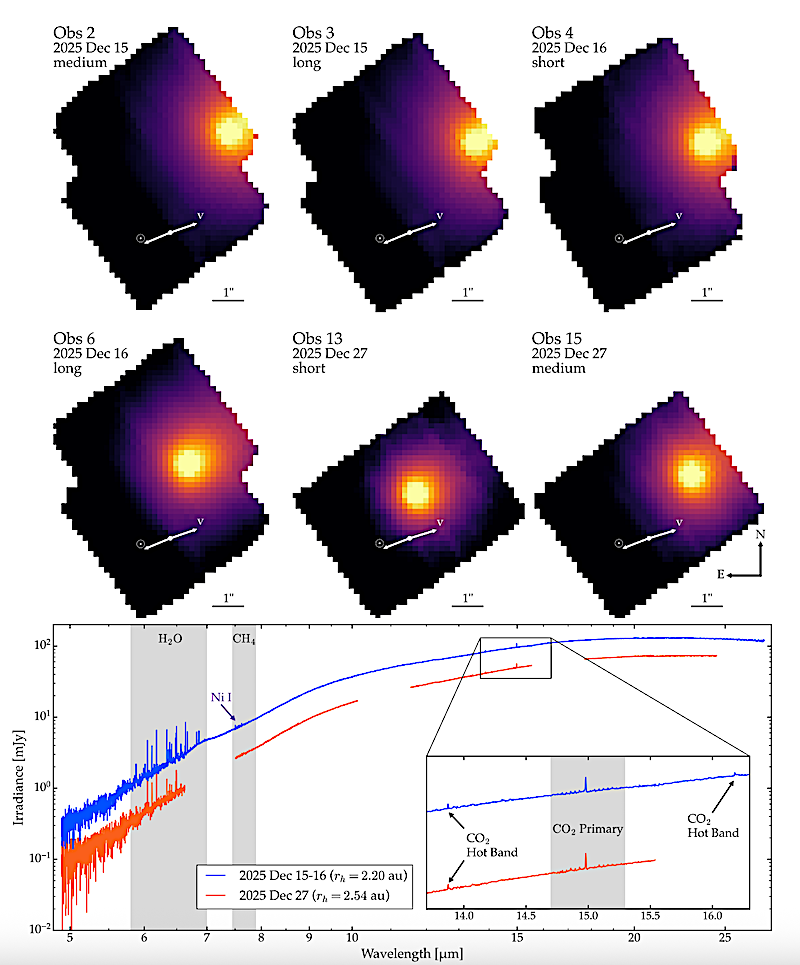
Top panels: Median-stacked images derived from the fully calibrated Channel 2 data cubes for the six successful JWST/MIRI observations of 3I. A logarithmic stretch has been applied to accentuate the extended dust coma. The sunward and target velocity directions are indicated. The panels are labeled with the corresponding date and spectral grating setting. The first three observations suffered from poor pointing due to an uncertain ephemeris. There is low-level striping due to numerical artifacts from the IFU data cube building process. Bottom panel: Spectra of 3I extracted using a 1′′-diameter circular aperture. Observations 2, 4, and 6 (blue) are combined into a single spectrum by normalizing individual segments to align across their overlapping wavelengths. The spectra from Observations 13 and 15 (orange) are unaltered, illustrating the significant decrease in flux as the comet passed from a heliocentric distance of 2.20 au to 2.54 au. The main H2O, CO2, CH4, and Ni fluorescence features are marked. The inset panel provides a zoomed-in view of the CO2 primary and hot bands. — arxiv.org
The comet’s surface has been irradiated by cosmic rays on its long journey, and so its most volatile surface ices—such as methane—were only weakly outgassing as it approached Earth.
However, as 3I/ATLAS was leaving our solar system in December, Belyakov’s JWST analysis showed that the comet began increasingly emitting methane as it was warmed by our Sun. This change indicated that 3I/ATLAS had shed its ancient outer surface and began to melt its inner icy layers—which means that observations taken of 3I after its close approach reveal the underlying composition of this unique object, not just the chemistry of its topmost irradiated layers.
“JWST is going to look at 3I/ATLAS one more time this spring,” Belyakov says. “It’s already getting tough to observe; it’s now out by Jupiter.”
The team also observed the dust composition of 3I/ATLAS, to be reported in a forthcoming paper.
The paper is titled “The Volatile Inventory of 3I/ATLAS as Seen with JWST/MIRI.” In addition to Belyakov, Ian Wong (PhD ’18) of the Space Telescope Science Institute in Baltimore Maryland is a co-first author. Additional Caltech co-authors are graduate student M. Ryleigh Davis (MS ’22) and Mike Brown, the Richard and Barbara Rosenberg Professor of Planetary Astronomy and Terence D. Barr Leadership Chair and director of the Center for Comparative Planetary Evolution at Caltech. Other co-authors are Bryce T. Bolin of Eureka Scientific in Oakland, California; Steven J. Bromley of Auburn University; and Carey M. Lisse of Johns Hopkins University. Funding was provided by a NASA JWST grant through the Space Telescope Science Institute.
Astrobiology, Astrochemistry,










Related Posts
Stay Informed With the Latest & Most Important News
Previous Post
Next Post

Advertisement
-
 01Two Black Holes Observed Circling Each Other for the First Time
 -
 02From Polymerization-Enabled Folding and Assembly to Chemical Evolution: Key Processes for Emergence of Functional Polymers in the Origin of Life
 -
 03Astronomy 101: From the Sun and Moon to Wormholes and Warp Drive, Key Theories, Discoveries, and Facts about the Universe (The Adams 101 Series)
 -
 04True Anomaly hires former York Space executive as chief operating officer
 -
 05Φsat-2 begins science phase for AI Earth images
 -
 06Hurricane forecasters are losing 3 key satellites ahead of peak storm season − a meteorologist explains why it matters
 -
 07Binary star systems are complex astronomical objects − a new AI approach could pin down their properties quickly