
Now Reading: Third New Glenn launch suffers upper stage malfunction
-
01
Third New Glenn launch suffers upper stage malfunction


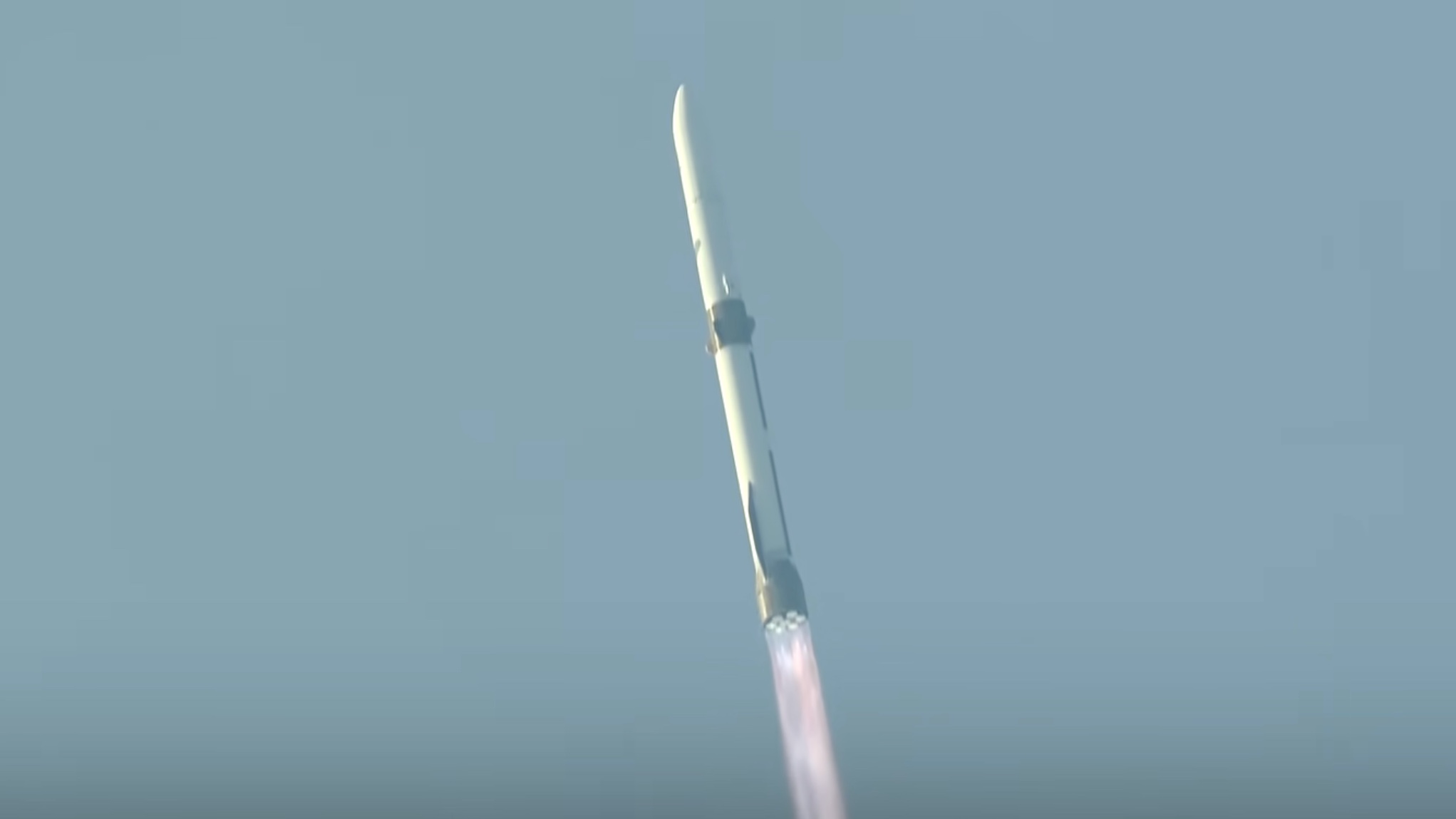

WASHINGTON — Blue Origin’s New Glenn suffered a malfunction of its second stage on the rocket’s third flight April 19, stranding its payload in an “off-nominal” orbit and dealing the company a setback as it seeks to increase its flight rate.
New Glenn lifted off from Cape Canaveral Space Force Station’s Launch Complex 36 at 7:25 a.m. Eastern, 40 minutes into a two-hour window for the NG-3 mission. The countdown was held for an unspecified technical issue before successfully lifting off.
The rocket’s payload, AST SpaceMobile’s BlueBird 7 satellite, was scheduled to deploy about 75 minutes after liftoff into a 460-kilometer circular orbit at an inclination of 49.4 degrees. That separation was planned for five minutes after a second burn of the upper stage’s BE-3U engines, lasting 68 seconds.
However, Blue Origin, which ended its launch webcast after the successful landing of its first stage, did not provide updates about the burn or payload deployment when they were scheduled to occur.
An hour after the scheduled payload separation, Blue Origin confirmed on social media that BlueBird 7 had separated and powered on. “The payload was placed into an off-nominal orbit. We are currently assessing and will update when we have more detailed information.”
The upper stage problem overshadowed the launch, which featured the first reflight of a New Glenn first stage. The booster, called “Never Tell Me The Odds” by Blue Origin, touched down on the company’s landing platform, Jacklyn, in the Atlantic Ocean nearly nine and a half minutes after liftoff. The booster launched NASA’s ESCAPADE Mars mission on the NG-2 flight in November.
However, the booster reuse on NG-3 was only partial since the stage’s biggest component, its BE-4 engines, was new. “With our first refurbished booster we elected to replace all seven engines and test out a few upgrades including a thermal protection system on one of the engine nozzles,” Dave Limp, chief executive of Blue Origin, said in an April 13 social media post. “We plan to use the engines we flew for NG-2 on future flights.”
Reuse is critical for Blue Origin to ramp up launch rates to meet demand for AST SpaceMobile and other customers, although the company has provided little in the way of launch forecasts.
“We’re looking at increasing our resources, our tooling, our processes, obviously leveraging a lot of great systems engineering and innovation that we put into the system to allow us to scale very quickly at this point,” Laura Maginnis, vice president of New Glenn mission management at Blue Origin, said during a March 24 panel discussion at the Satellite 2026 conference.
“The market demand, as everyone has said, is significant, and we’re excited to meet it,” she said, but did not provide an estimate of the number of launches the company will perform this year.
BlueBird 7, with a mass of 6,100 kilograms, featured a phased-array antenna that, when fully deployed, had an area of more than 220 square meters. That antenna is used to provide broadband direct-to-device, or D2D, services to smartphones.
AST SpaceMobile had planned to launch 45 to 60 satellites this year for its D2D constellation, but BlueBird 7 is the first to launch since BlueBird 6 launched on an Indian LVM3 rocket in December.
In an earnings call in March, Abel Avellan, chief executive of the company, committed to “an expectation of 45 satellites in orbit and 60 satellites ready to ship during 2026.” The pace would accelerate in part because future spacecraft could be commissioned in orbit faster based on the lessons from BlueBird 6.
“The other thing that will happen going forward after [BlueBird] 6 and 7 is that we are stacking the satellites,” he said. “We are not launching individual satellites anymore. They will be batched in groups of either three, four, six or eight in a single launch.”
He said the company expected a frequent series of New Glenn launches after NG-3. “To support our launch cadence during 2026, we expect the New Glenn booster to be reused every 30 days or less after our ongoing launch,” Avellan said.










Related Posts

Stay Informed With the Latest & Most Important News
Previous Post
Next Post


Advertisement
-
 01Two Black Holes Observed Circling Each Other for the First Time
 -
 02From Polymerization-Enabled Folding and Assembly to Chemical Evolution: Key Processes for Emergence of Functional Polymers in the Origin of Life
 -
 03Astronomy 101: From the Sun and Moon to Wormholes and Warp Drive, Key Theories, Discoveries, and Facts about the Universe (The Adams 101 Series)
 -
 04True Anomaly hires former York Space executive as chief operating officer
 -
 05Φsat-2 begins science phase for AI Earth images
 -
 06Hurricane forecasters are losing 3 key satellites ahead of peak storm season − a meteorologist explains why it matters
 -
 07Binary star systems are complex astronomical objects − a new AI approach could pin down their properties quickly