
Now Reading: What Triggered Earth’s Shift From A Greenhouse To An Icehouse Climate And The Onset Of The Late Paleozoic Ice Age?
-
01
What Triggered Earth’s Shift From A Greenhouse To An Icehouse Climate And The Onset Of The Late Paleozoic Ice Age?

What Triggered Earth’s Shift From A Greenhouse To An Icehouse Climate And The Onset Of The Late Paleozoic Ice Age?

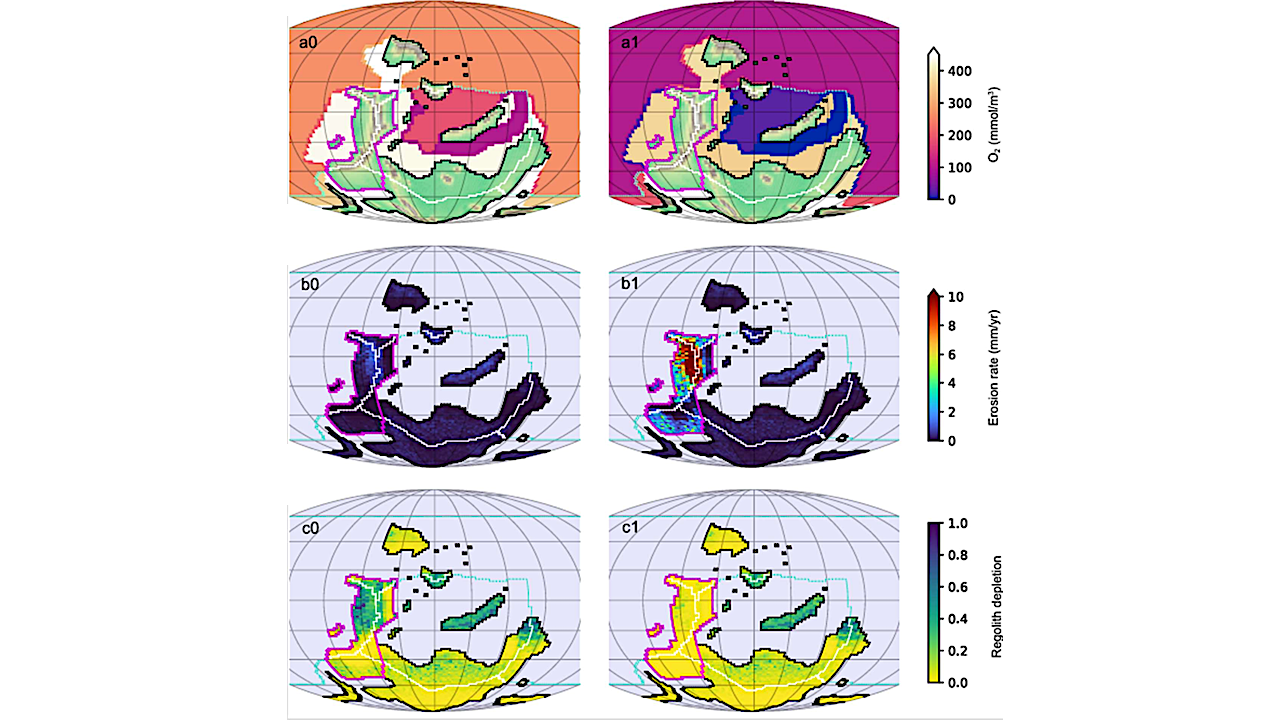
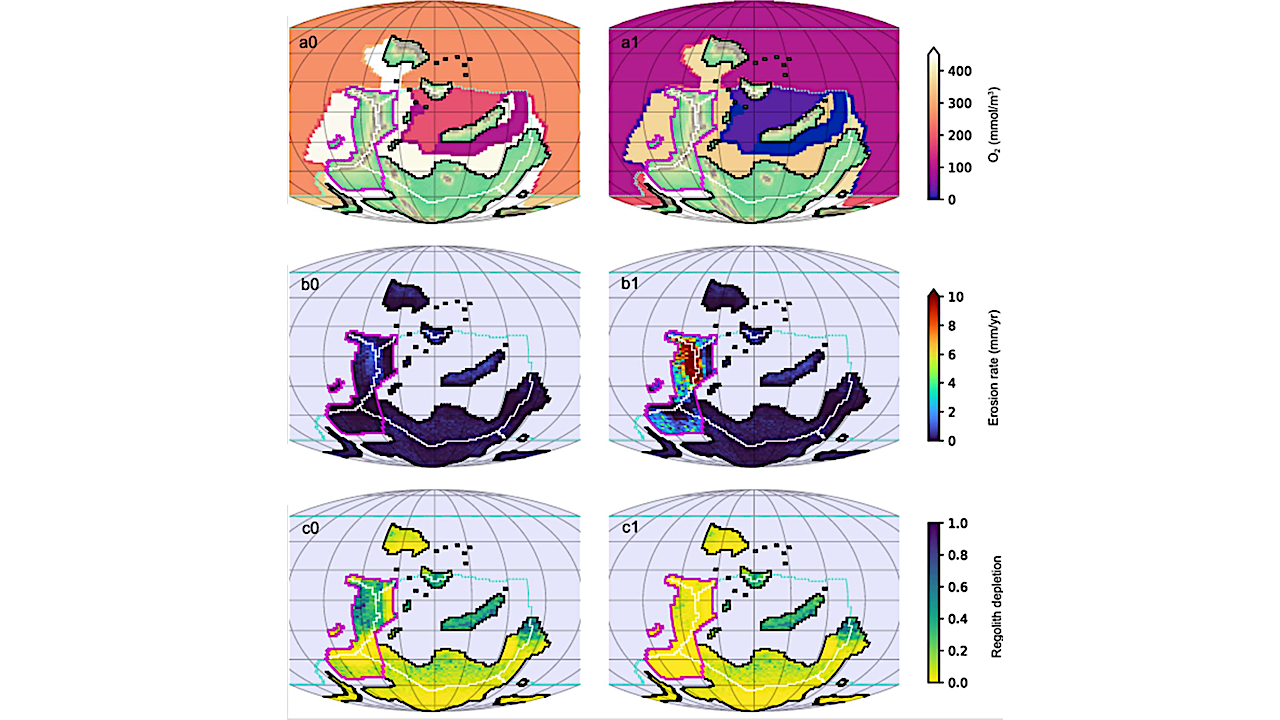
Maps of GEOCLIM simulation (two time slices). “0” maps (left column) are the initial condition, “1” maps (right column) are at the perturbation peak (3 Myr of run time, cf Fig. 4a). (a0–1) Topography and oceanic O2 concentration at bottom of water column, (b0–1) physical erosion rate, showing enhanced physical erosion around the Variscan orogeny, and (c0– 1) regolith depletion quantified by the proportion of unweathered mineral at top of regolith. The uplifted area is contoured in magenta on each map. The boundaries of oceanic boxes, and their corresponding continental drainage basins are drawn on each map (white solid and blue dotted lines). GEOCLIM computes one mean O2 concentration for each of the 21 boxes. The maps panels (a0–1) show the mean concentrations of GEOCLIM bottom boxes drawn on the full geographic extent of these boxes at the oceanic resolution of the FOAM ocean-atmosphere general circulation model [90] simulations, which were used as GEOCLIM forcing. — Science China Press
Scientists have debated for decades what caused the Late Paleozoic climate transition from a greenhouse to an icehouse state ~350 million years ago. Some invoke a pronounced increase in continental silicate weathering intensity; others propose enhanced burial of organic carbon linked to elevated marine primary productivity.
The precise cause has remained elusive, partly because global weathering regimes from that interval are poorly constrained. A research team led by scientists at Nanjing University and funded by the National Natural Science Foundation of China aims to resolve this question and to assess what the transition reveals about present and future climate change. The study, led by Prof. Feifei Zhang (School of Earth Sciences and Engineering, Nanjing University), was published in National Science Review.
Silicate weathering is a slow chemical process in which atmospheric CO2 dissolves in rainwater to form carbonic acid, which reacts with silicate minerals. The reaction breaks down rocks and converts atmospheric CO2 into soluble bicarbonate ions that are ultimately sequestered in marine sediments.
To evaluate whether intensified silicate weathering could have driven the climatic shift, the team combined novel geochemical proxies with numerical Earth‑system models. They analyzed marine limestone samples from Montana and Nevada, USA—regions that preserve excellent Late Paleozoic records. The samples, deposited between 359 and 347 Ma, span one of the largest positive carbonate carbon‑isotope excursions (TICE) that may mark the onset of the Late Paleozoic Ice Age.
In the laboratory, the researchers measured lithium isotope variations (δ7Li) in the carbonates and integrated these data with models including COPSE and GEOCLIM. They observed an approximate 12‰ decline in δ7Li, corresponding to a ~30% increase in continental silicate weathering rates. The inferred intensification of weathering would have reduced atmospheric CO2 from about 1000 ppm to roughly 200 ± 200 ppm and enhanced marine nutrient supply and productivity, producing the observed shifts in carbon isotopes.
These results provide quantitative support for the hypothesis that enhanced silicate weathering contributed to CO22 drawdown and the initiation of Late Paleozoic glaciation.
“The past holds the clues to understanding the present and predicting the future” says lead author Feifei Zhang. These results emphasize the importance of weathering–carbon cycle feedbacks in climate models: although natural weathering operates on much slower timescales than current anthropogenic CO2 emissions, quantifying its magnitude and rate limits improves projections of long‑term CO2 removal, ocean biogeochemical responses, and the persistence or recovery pathways of ecosystems under sustained climate forcing.
Professor Feifei Zhang from Nanjing University is the lead and corresponding author of the paper. Key collaborators include Professor Guang-Yi Wei, Pierre Maffre from Aix-Marseille University, Dr. Ziheng Li (Zi-Heng Li) from China University of Geosciences (Wuhan), Alexandre Pohl from the Université Bourgogne Europe, Maya Elrick from the University of New Mexico, Philip A.E. Pogge von Strandmann from the Johannes Gutenberg University, as well as Professor Shuzhong Shen and researchers Jianlin Zhou, Yi-Bo Lin, and Dr. Keyi Cheng from University of Victoria. The study received support from various funding bodies, including the National Natural Science Foundation of China (42322304,42293280,42373056); ANR research project “RISE” and “CYCLO-SED” (ANR-20-CE49-0014 RISE, ANR-23-CE01-0003).
Lithium Isotope Evidence for Enhanced Continental Weathering Triggering the Late Paleozoic Greenhouse-to-Icehouse Climate Transition, National Science Review, (open access)
Astrobiology,










Related Posts
Stay Informed With the Latest & Most Important News
Previous Post
Next Post


Advertisement
-
 01Two Black Holes Observed Circling Each Other for the First Time
 -
 02From Polymerization-Enabled Folding and Assembly to Chemical Evolution: Key Processes for Emergence of Functional Polymers in the Origin of Life
 -
 03Astronomy 101: From the Sun and Moon to Wormholes and Warp Drive, Key Theories, Discoveries, and Facts about the Universe (The Adams 101 Series)
 -
 04True Anomaly hires former York Space executive as chief operating officer
 -
 05Φsat-2 begins science phase for AI Earth images
 -
 06Hurricane forecasters are losing 3 key satellites ahead of peak storm season − a meteorologist explains why it matters
 -
 07Binary star systems are complex astronomical objects − a new AI approach could pin down their properties quickly